Get Full Government Meeting Transcripts, Videos, & Alerts Forever!
Get email alerts on the Historic Preservation topic
No spam. Unsubscribe anytime.
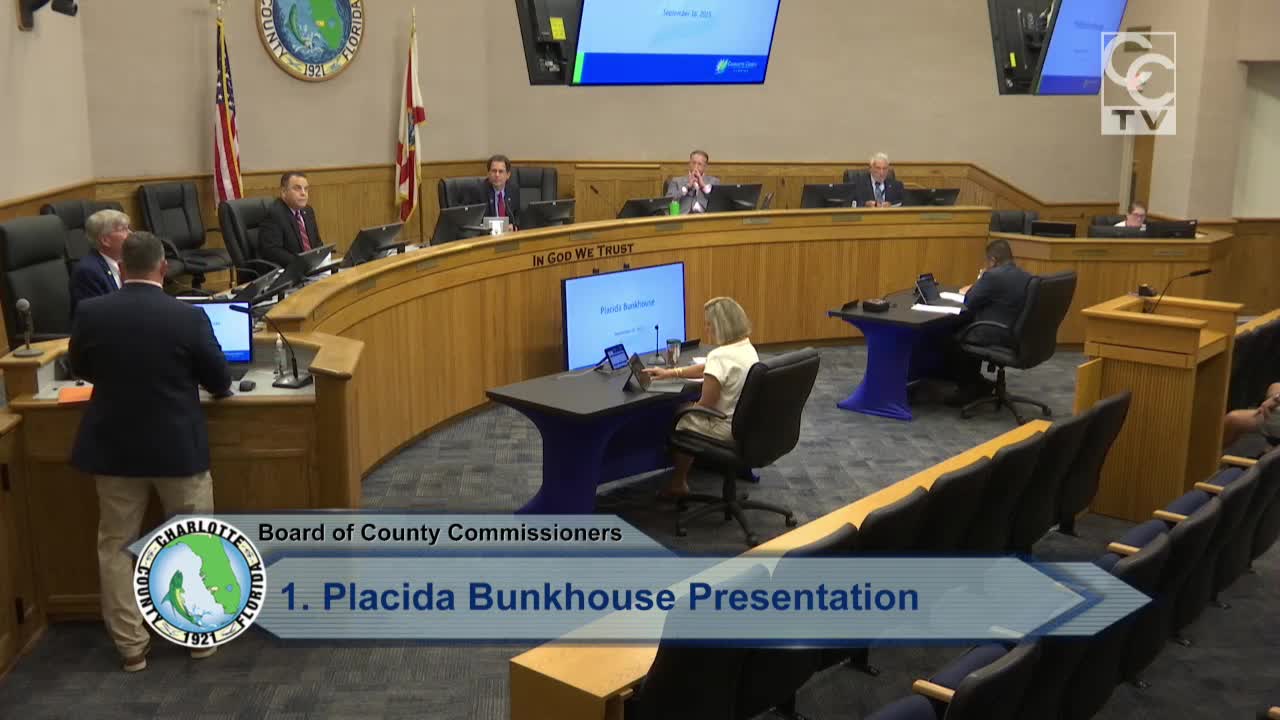
Charlotte County commissioners back interpretive signage for Placita bunkhouse, direct phased planning
Summary
After hearing options and cost estimates for stabilizing, relocating or interpreting the historic Placita bunkhouse, Charlotte County commissioners agreed to proceed with low‑cost interpretive signage and asked staff to develop site planning and move-cost estimates for later phases; no funding was identified at the workshop.
The Charlotte County Board of County Commissioners on Sept. 16 directed staff to develop design and costing work for an interpretive signage option at the Placita bunkhouse and to begin planning for potential relocation, while keeping the structure in place and maintained for now.
Tommy Scott, Community Services Director, told the board the county has a preservation plan and consultant recommendations and summarized three consultant options plus a county-proposed, lower-cost alternative. “Phase 1 is just ongoing stabilization preservation work,” Scott said, and listed an immediate preservation cost estimate “in the range of between 150 and 210” (thousand dollars). He described option 1 as adding an ADA-compliant ramped walkway (no interior access), with an estimated cost between $100,000 and $126,000; option 2 would fit out one interior room in addition to option 1 for roughly $25,000–$35,000 more; and option 3, Scott said, would place ground-level, tilt‑style educational panels around the building and cost “somewhere between 30 and 45,000.”
Scott also presented a consultant estimate of $130,000–$160,000 to hire a specialized mover to return the building to Placida, and said site work to meet flood-elevation rules would be required. “We would not be able to get a variance. We don't have an exemption, so we're going to have to meet flood elevation,” Scott said, adding that meeting the elevation requirement (he cited a 10‑foot elevation requirement and that the Placida site grade is roughly 4 feet) could substantially increase costs and require additional design; he gave a design estimate of about $30,000 and said full relocation plus elevation could be “somewhere between 1 and $2,000,000” in later phases.
Why this matters: commissioners stressed the structure is historically important to the county but expressed concern about costs and resilience. Several members urged a phased approach that preserves the building now while refining relocation and elevation costs and pursuing private fundraising. Commissioner Doherty suggested looking at fill plus flood panels as a potentially less intrusive elevation solution; Commissioner Trex recommended phasing move and restoration work so the structure could be prepared for relocation; Commissioner Deutsch advocated beginning with the lower-cost interpretive option and saving the building first.
Board direction and next steps: After discussion about stability, historical designation and funding, the board coalesced around starting with interpretive signage (option 3) while continuing to maintain the building in its current location. Commissioners asked staff to return with more detailed site-preparation and move cost estimates, to explore funding options including private fundraising and potential tourism funding, and to engage civil/structural designers through the county’s procurement process to produce a firm opinion of probable cost for relocation and elevation. Scott noted the county has not identified funding for any of the options and that any design or relocation work would require budget approval.
Context and constraints: Claire Jubb, Assistant County Administrator, and County Attorney Jeanette Knowlton told the board that federal FEMA exemptions for historic structures are narrowly defined and that moving the structure likely triggers stricter flood‑elevation requirements. Commissioners repeatedly cautioned that moving the bunkhouse to a lower‑elevation Placida site would require careful resiliency engineering and likely increase the ramping and foundation work needed to comply with codes. Several commissioners encouraged pursuing private donations or a public‑private partnership before asking the county to fund relocation.
What remains unresolved: The board did not vote on a funding source or adopt construction documents; it asked staff to return with a project decision item after the recommended design and cost work is completed. The county will continue maintenance and pest abatement at the existing site in the interim.