Get Full Government Meeting Transcripts, Videos, & Alerts Forever!
Get email alerts on the Legislative Priorities topic
No spam. Unsubscribe anytime.
Fauquier supervisors review draft 2026 General Assembly legislative priorities, seek clarifications on school choice and data center proffers
Summary
Fauquier County Board of Supervisors reviewed a draft 2026 legislative priorities document during a Sept. 11 work session and directed staff and their lobbyist to revise language on education options, affordable housing, speed cameras, and siting agreements for large energy and data facilities.
Fauquier County Board of Supervisors reviewed a draft 2026 legislative priorities document during a Sept. 11 work session and directed staff and their lobbyist to revise language on education options, affordable housing, speed-camera authority, and siting agreements for large energy and data facilities.
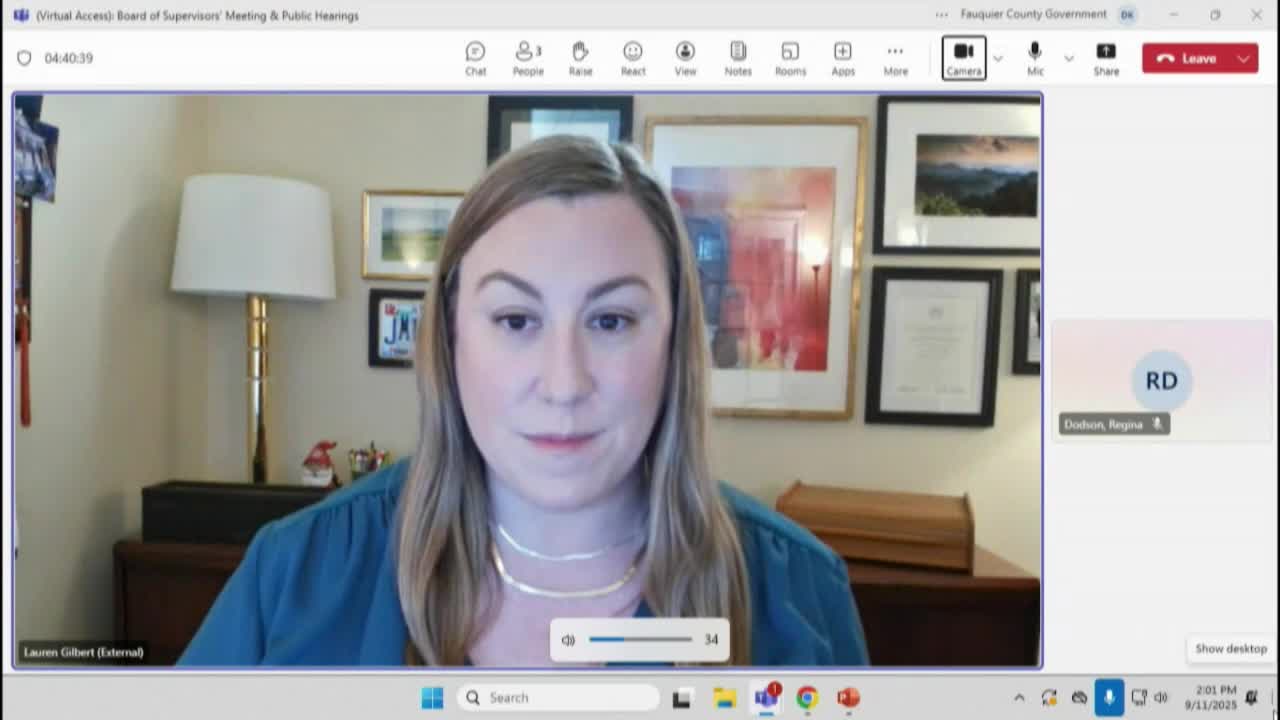
The draft was presented remotely by Lauren Gilbert of Advantage Strategies, who told the board she approached updates with “four goals in mind,” including streamlining the document, updating technical items, and positioning the county to respond to likely legislation in 2026. Supervisors raised a series of clarifying questions before agreeing to revisions and a later consent‑agenda adoption if language is adjusted.
Why it matters: The legislative priorities set the county’s stance during the General Assembly session, guiding whether staff and the county’s lobbyist support, oppose or seek amendments to bills. Supervisors said they wanted high‑level consensus now so the county can take positions quickly as bills are filed.
Most discussion centered on five topics supervisors asked be clarified or strengthened: - Education and “innovation”/school choice: Supervisor Washer said language supporting “innovation in schools” was vague and could be read as support for tax‑credit style school‑choice measures. Washer and others expressed concern that tax credits or vouchers could reduce funding available to Fauquier County Public Schools. Chair Carter proposed revised wording to signal support for additional education options only if those options do not reduce state or local school funding to the public school system; the board agreed to adjust the language and directed staff to reword the item.
- Affordable housing and LIHTC: Supervisors asked that any legislative support for low‑income housing tax credits (LIHTC) or other affordable‑housing programs explicitly preserve local land‑use authority over location, density and permitting decisions. Lauren Gilbert said the draft mirrored language used by VACO, VML and regional partners and that recent and expected bills make local clarity important.
- Siting agreements and proffers for large facilities: Supervisors asked staff to explore expanding siting‑agreement authority beyond the current categories (solar, battery storage, substations) to include data centers or other high‑impact uses so the county could negotiate off‑site or cash contributions when appropriate. Staff said Virginia Code currently limits which projects can use siting agreements and noted JLARC work and other studies are addressing data‑center policy; staff will research options and report back.
- Speed cameras and local authority: Supervisors raised whether state law could allow a local process by which the sheriff requests automated speed enforcement for specific roads and the board could approve locations after public hearings; they agreed this would need a longer discussion and additional research.
- Funding primaries: One supervisor questioned whether the county should request state funding for party primaries or instead require parties to pay their own costs. The issue drew brief comment and no change to the draft was recorded.
Next steps and staff direction: Mary (staff lead for the legislative program) and Lauren Gilbert will incorporate board edits — including the Chair’s suggested caveat that education innovations must not reduce public‑school funding — and circulate an updated draft for placement on the evening consent agenda if the board wishes. Supervisors also asked staff to investigate two follow‑ups for the draft: possible budget or grant support for municipal filtration to remove PFAS/PFOA contamination from water systems, and stronger language to support agricultural and agritourism economic development assistance.