Get Full Government Meeting Transcripts, Videos, & Alerts Forever!
Get email alerts on the Capital Improvements topic
No spam. Unsubscribe anytime.
Waukesha council approves 2026 capital plan; moves ahead with pedestrian-bridge design and Mendiola pavilion funding
Summary
The Waukesha Common Council approved the city's 2026 capital improvement plan and five-year capital program, including a USDOT-funded planning grant to design two pedestrian bridges over the Les Paul Parkway and a pavilion at Mendiola Park. An amendment to reduce the pavilion's debt share failed.
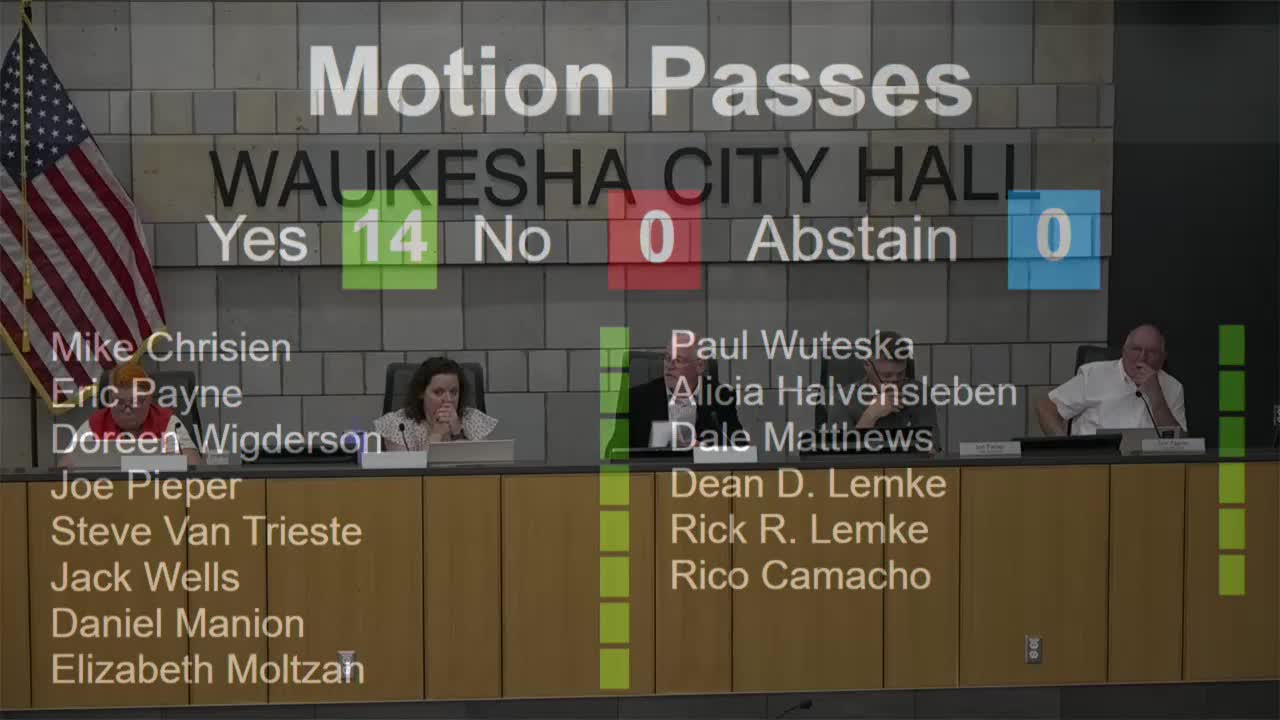
The Waukesha Common Council voted 12-2 on Sept. 16 to approve the 2026 capital improvement plan (CIP) of $39,887,329 and a five-year capital plan for 2026–2030 totaling $179,471,597.
The vote implements a package of projects the finance committee described as a mix of major projects, equipment replacements and fleet purchases and includes two high-profile items that drew extended discussion: a USDOT planning grant to design two pedestrian bridges to connect the New Berlin Trail across the Les Paul Parkway, and a pavilion with restrooms and concessions at Mendiola Park.
Councilmembers and members of the public said the bridge designs respond to rising trail use and vehicle traffic on the Les Paul Parkway and would improve safety for people who bike or walk into the city. City engineer Brandon Schwen said the federal award is for the planning and design phases — covering environmental review, preliminary and final design and producing bid-ready documents — and is an 80/20 cost share. He told the council the planning grant award has been received and that the city must still enter a grant agreement with FHWA and USDOT to formalize the award.
Schwen said the current estimate for construction of both bridges, including construction engineering, is about $17.5 million. He said the likely future funding path for construction would be similar federal grant programs (previously TIGER/RAISE, now BUILD), which commonly use an 80/20 federal-to-local cost share; at that split, a $17 million construction cost would imply roughly $3.5 million in local share.
Multiple residents who spoke during public comment urged the council to prioritize bike and pedestrian investments. David Birch, 1219 Sweet Briar Drive, and others described heavy trail use and flooding on the Fox River Trail tunnel, and called the bridges important regional connections.
The Mendiola Park pavilion, listed in the CIP at $2.4 million, also drew debate. Parks Director Ron Graal said the facility is designed to be largely self-supporting, with rentable community space, concessions and restroom facilities that would generate revenue for ongoing operations and future capital repairs. Staff presented a proposed funding mix that included general obligation debt, park impact fees and private donations. During discussion Alderman Patricia Matthews moved an amendment to reduce the pavilion's general obligation debt issuance and seek a greater share from sponsorships or donations; that amendment failed on the floor and the CIP passed as presented.
Finance staff and council members discussed maintenance obligations for any new bridges and noted the city would seek state and federal bridge-maintenance funding programs in the future to offset ongoing costs.
The council also heard a department-by-department summary of other CIP items, including a $7 million request for phase 3 upgrades at the clean water plant, street resurfacing, cemetery repairs and equipment and fleet replacements across departments.
With the CIP adopted, the finance committee will move next to the 2026 operating budget review, starting Sept. 30 at 6 p.m. in council chambers.
Votes at a glance: The motion to adopt the 2026 CIP and five-year capital plan passed 12-2.