Get Full Government Meeting Transcripts, Videos, & Alerts Forever!
Get email alerts on the Budget topic
No spam. Unsubscribe anytime.
St. Petersburg council sets millage at 6.4525 mills and adopts tentative FY2026 budget after debate over youth programs, stormwater and fire funding
Summary
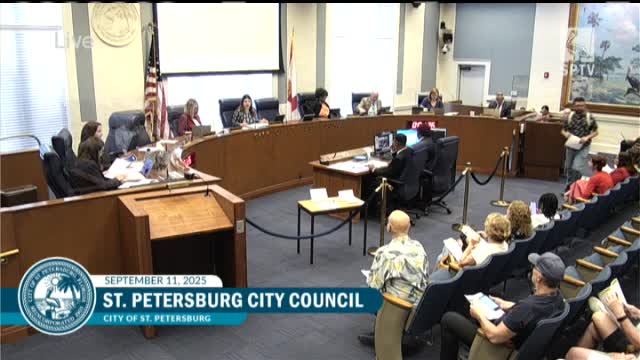
St. Petersburg City Council on Sept. 11, 2025, approved a proposed millage rate of 6.4525 mills and adopted the mayor’s recommended fiscal year 2026 budget as the tentative budget after a public hearing and extended council discussion.
St. Petersburg City Council on Sept. 11, 2025, approved a proposed millage rate of 6.4525 mills and adopted the mayor’s recommended fiscal year 2026 budget as the tentative budget after a public hearing and extended council discussion. The council adopted the millage unanimously; the motions to pass the budget ordinance on first reading and to adopt the tentative budget each passed 5–2.
The tentative budget will serve as the city’s working FY2026 budget pending a final public hearing and second reading on Sept. 25, 2025. City budget staff said the recommended plan totals roughly $967 million in operating resources, with total general fund requirements of $411,763,000. Budget staff described the 6.4525‑mill rate as a 3.93 percent increase over the rollback rate of 6.2083 mills; staff said the change reflects growth in taxable value and is intended to fund city priorities including wage increases for all city employees, continued funding for police and Fire Rescue, stormwater and other capital investments.
Why it matters: The millage and tentative budget allocate property‑tax revenue and other city receipts across public safety, infrastructure, neighborhood programs and resilience work. Budget materials and staff presentations said key investments would continue under the mayor’s five pillars (education and youth; equitable economic development and the arts; neighborhood health and safety; housing; and environment, infrastructure and resilience). Staff cited a projected $10,452,000 year‑over‑year increase in ad valorem revenue and described a $202 million capital program for FY2026.
What the council and public said
Public commenters focused on youth funding, outreach and public‑safety concerns. Yordanos Mola, identified in the record as a resident and a Dream Defenders organizer, urged the council to increase investment in youth programming and outreach, saying, “We want to stop violence in our communities, and our budget should reflect that.” Several other residents and neighborhood advocates told council they could not consistently find existing programs and urged more active, paid outreach so residents would know what is available.
Several speakers pressed for additional funding for street‑safety and Complete Streets projects. Max McCann said his family was directly affected by a traffic crash and urged the city to fund more local street‑safety work rather than wait on state grants.
Council discussion concentrated on balancing competing priorities within a constrained revenue picture. Council Member Gina Driscoll (District 6) said she supported many of the mayor’s priorities but objected to the recommended level of funding for Fire Rescue and related protective equipment and staffing; she told the council, “I will not be able to support this budget,” and voted against the ordinance and tentative budget. Council Member Corey Givens said he likewise opposed the ordinance and tentative budget as presented and urged more funding for youth, food security and other programs.
Budget mechanics and staff explanation
Budget Director Liz McCausey and other staff briefed the council on the Truth in Millage (TRIM) process under Florida Statutes 200.065, the mechanics of calculating the value of one mill, and the composition of the general fund. Staff said taxes (property, franchise and utility taxes) remain the single largest general‑fund revenue source (about 73 percent of general fund revenue in the FY2026 proposal) and that public safety is the largest general‑fund expenditure (about 53 percent). Staff also summarized changes made to the recommended budget since July — including a new "Fluoride for Families" program in Housing and Neighborhood Services and project reallocation at the Mahaffey Theatre.
Council amendments and votes
- Millage resolution (proposed millage 6.4525 mills): approved unanimously (motion passed 7‑0, one council member absent). The clerk recorded the vote after the required TRIM discussion and public comment. - Ordinance (first reading) adopting the mayor’s recommended FY2026 appropriations ordinance: passed on first reading, 5–2. Yes: Brandy Gabbard, Deborah Fick Sanders, Richie Floyd, Lizeth Hanowitz, Mike Harding. No: Gina Driscoll, Corey Givens. One member absent. - Resolution adopting the ordinance as the tentative budget for FY2026: passed 5–2 with the same split; the second and final public hearing and second reading were scheduled for Sept. 25, 2025, at 6 p.m. in Council Chambers.
A council amendment proposed by Council Member Driscoll to reallocate $150,000 from an "infrastructure — TBD" line to bicycle and pedestrian facilities failed 2–5.
Context and next steps
Staff warned that several revenue and cost pressures shaped the recommended budget, including pension contribution increases, storm‑damage responses and negotiated wage adjustments. The tentative budget is the basis for staff work between now and the Sept. 25 final hearing; city officials said they will publish any recommended adjustments and that council may consider amendments at the final hearing. The public record and staff materials for FY2026 — including a budget‑in‑brief and the five‑year capital improvement plan — are posted on the city’s website.
Ending note: Council members and staff encouraged residents with questions about property assessments to consult the Pinellas County Property Appraiser’s Office, which had staff available after the meeting to answer TRIM‑related questions.