Get Full Government Meeting Transcripts, Videos, & Alerts Forever!
Get email alerts on the Rezoning Controversy topic
No spam. Unsubscribe anytime.
Northside residents press council over RMDA rezoning; public hearing continued
Summary
Hundreds of residents and dozens of speakers opposed a developer's rezoning request to RMDA (residential medium density) for a Northside parcel, saying the proposal conflicts with the neighborhood's low-density character; the committee continued the hearing to give time for additional revisions and outreach.
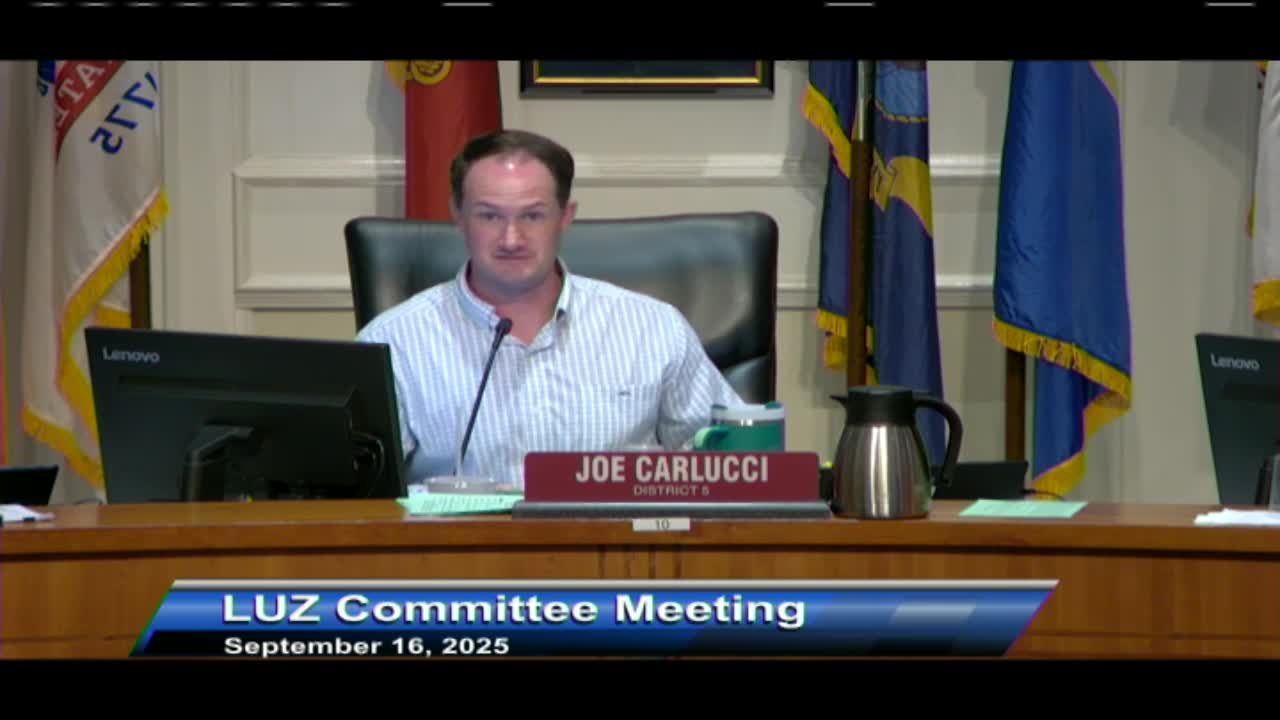
A large group of residents turned out Sept. 16 for a public hearing on a controversial rezoning application (appearing as ordinance 2025-0176 on the Land Use and Zoning Committee agenda). Neighbors said the applicant's change from rural/residential to RMDA would produce development out of scale with existing, long-established properties; the committee continued the public hearing to allow more time for the applicant to work with the community.
Dozens of people signed speaker cards and many addressed the committee. Robert McFeely told the panel he had attended an earlier community meeting and said the developer’s July and August pivots — from townhomes to RLD 40 and then to RMDA — felt tactical, not responsive. "This pivot was not a genuine compromise," McFeely said, arguing the application should be dismissed or restarted under the city code. Several speakers, including Jason Reif and Jim Drost, said the neighborhood’s lot pattern (many larger lots developed in the 1950s and 1960s) is inconsistent with the smaller-lot housing allowed under RMDA or similar designations.
Cindy Trimmer, representing the applicant, told the committee the team had heard neighborhood concerns and was continuing to negotiate with the seller and residents. She said the party had abandoned a duplex/townhouse approach and was working toward single-family lots with larger footprints, and that changes are still being refined. "We're not going to move it forward until we have that answer," Trimmer said.
Multiple residents asked why the application had been deferred previously and whether deferments were being used to reduce public turnout; staff and the chair explained applicants may request deferrals and that the committee may set a new date for the hearing. The committee set the public hearing to be continued; on the record the chair announced the item would be continued and scheduled for an October cycle (the public hearing was continued to Oct. 7, then referenced for later consideration in committee materials).
The hearing produced sustained opposition: speakers cited traffic and flooding concerns, compatibility with the 2045 comprehensive plan, and the developer’s compliance history. Several neighborhood leaders asked the applicant to refile as a planned-unit development (PUD) that would include a site plan and enforceable written commitments, rather than a conventional rezoning that would allow a wider range of future uses.
The committee did not vote on the rezoning; it continued the public hearing to permit additional work and outreach by the applicant and to allow staff to prepare revised materials for a future meeting.