Get Full Government Meeting Transcripts, Videos, & Alerts Forever!
Get email alerts on the Public Safety Regulation topic
No spam. Unsubscribe anytime.
Comal County delays action on proposed countywide towing rotation after stakeholder concerns
Summary
The commissioners discussed a draft countywide wrecker/towing services order but took no action, citing continued stakeholder input and legal questions; a towing operator urged further due diligence and warned of safety and regionalization concerns.
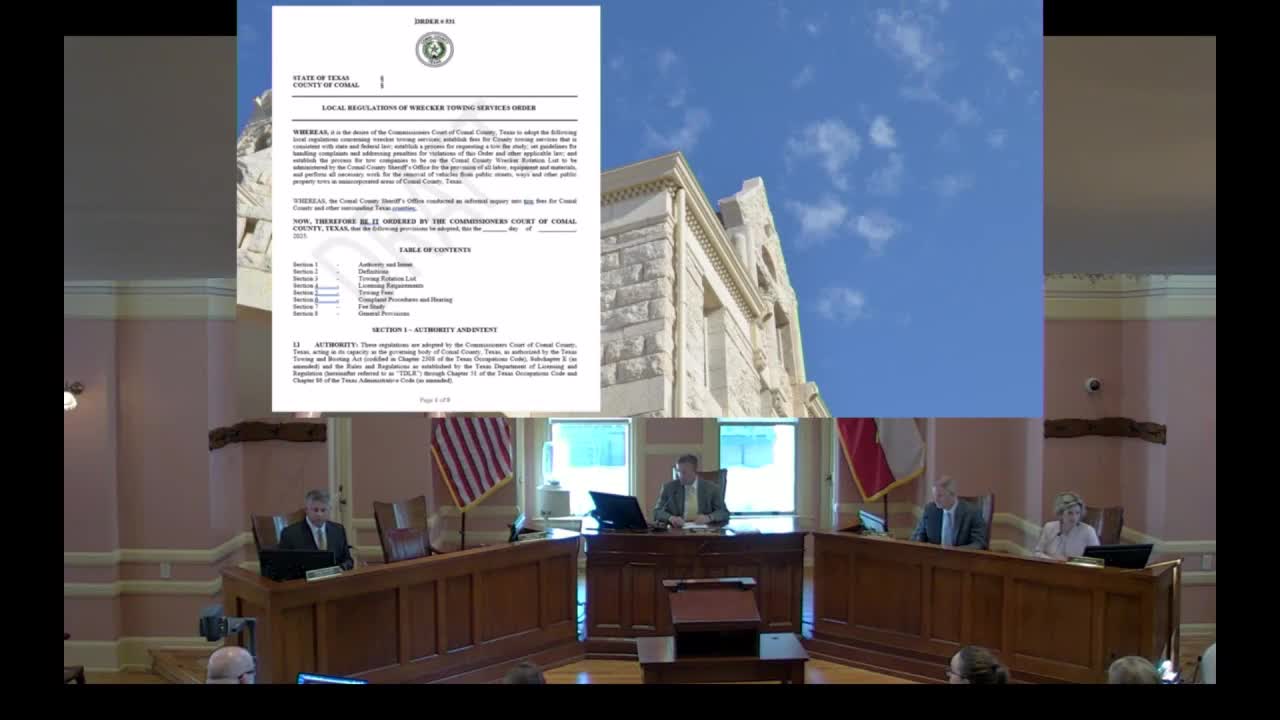
Comal County Commissioners Court on Sept. 18, 2025 discussed a draft order to revise local regulations of wrecker and towing services but did not vote, instead directing staff to continue stakeholder engagement and return the item at a later date.
County staff described proposed changes that would replace current regional on-call systems with a single countywide rotation list, using two primary wreckers alternating per week, and requiring applicants to be licensed by the Texas Department of Licensing and Regulation (TDLR) and own a vehicle-storage facility within Comal County. Staff said the rotation would attempt to assign a single tow company to handle an entire incident, but that companies lacking capacity for a heavy tow would be excused and the rotation would move to the next eligible provider.
Commissioners and staff emphasized they were not ready to adopt the draft. Commissioner Leacock asked clarifying questions about blending the current on-call model with a rotation system; county counsel and staff said the draft intends to maintain on-call advantages while adding a broader rotation. Commissioner Crownover asked that no action be taken pending further stakeholder review; the court agreed.
During the public-comment portion, towing business owner Rodrigo Amaya, who said he has worked in towing since 2012, urged the court to complete additional due diligence before adopting the draft. Amaya said stakeholders had not been given adequate study of certain legal and operational effects and noted the district attorney's office had been given documents raising concerns about safety and county risk. He also argued that the current six-region structure exists to address region-specific needs and said consolidating zones "is very dangerous" because each area has different operational requirements.
County staff said they will continue meetings with stakeholders, tentatively plan an application period in November and expect a possible effective date near the start of the new year once the court addresses stakeholder feedback.