Get Full Government Meeting Transcripts, Videos, & Alerts Forever!
Get email alerts on the Homelessness Workshop topic
No spam. Unsubscribe anytime.
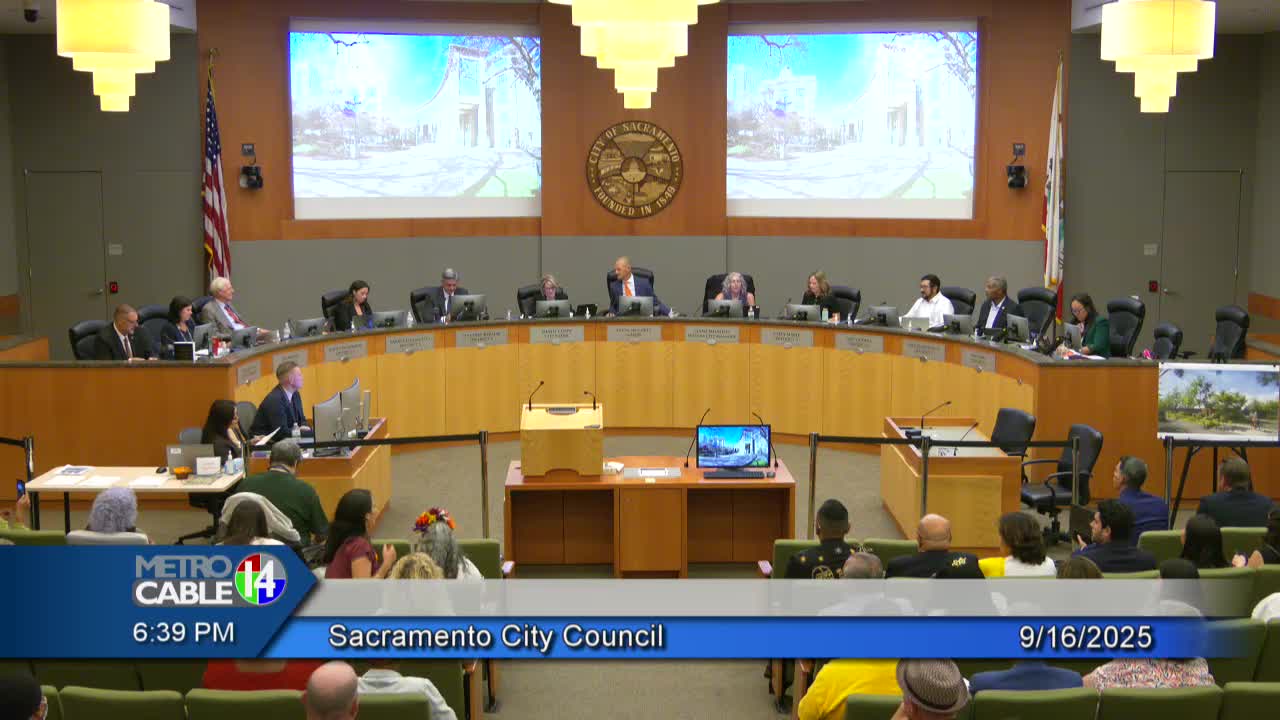
Council directs program fees for senior micro‑communities and adopts voucher model for motel program after lengthy homelessness workshop
Summary
After a lengthy Sept. 16 workshop on homelessness, Sacramento City Council voted to direct staff to (1) implement a program fee for micro communities capped at 30% of a participant’s gross monthly income (after a 90‑day period) and (2) switch the city motel program to a voucher‑based model to encourage client choice and control costs.
The Sacramento City Council held an extended workshop on Sept. 16 to review staff proposals for expanding shelter options and interim housing, including safe camping, safe parking, micro communities (interim supportive tiny‑home sites), voucher changes to the city motel program and Homekey Plus applications.
Staff presentation and scope: Bridal Pedro, director of the Department of Community Response (DCR), described a multi‑lane strategy to expand interim and transitional options while continuing prevention and permanent housing work. Pedro said the meeting’s votes would focus on (1) a program fee for micro communities and (2) a voucher model for the motel program; he explicitly said site selection was not before council that night.
Safe camping and safe parking: Staff outlined a proposed safe camping site in the River District with up to 100 sleeping spaces, tent platforms, restroom trailers, phone charging, lighting, cameras, security and an entry control point. The site would be monitored, have a curfew (10 p.m.–6 a.m.), a good‑neighbor policy, rules limiting belongings and no‑tolerance for criminal activity. Safe parking would use underutilized lots (example: a Sacramento Regional Transit lot) to allow people to sleep in operable, registered vehicles; staff proposed a structured intake, security and rotation to avoid long‑term single‑spot residence.
Micro communities (interim supportive housing): Staff proposed modular micro communities targeted primarily to residents aged 55 and older on fixed incomes. Each site would be capped at 40 units (one person per unit in most sites), with communal services (showers, laundry, gathering space), electricity for small appliances, Wi‑Fi and on‑site supportive services focused on housing navigation and health enrollment (CalAIM/Medi‑Cal). Operations would include an initial 90‑day transition period followed by a program fee set at up to 30% of gross income. Key system figures staff presented included an estimated start‑up cost of roughly $3.5 million per site (about $85,000 per door) and estimated annual operating costs around $500,000 per site; staff compared that with average permanent supportive housing costs (roughly $420,000 per door) to show micro communities’ cost efficiency for interim capacity.
Voucher model for motel program: Staff proposed shifting monthly motel payments to a voucher model that the client can use at participating motels; vouchers would be renewed monthly and renewal would be contingent on active engagement with services. Staff said the change could free approximately $2,000,000 and create capacity for roughly 90 additional placements.
Public input and council concerns: The meeting drew dozens of public commenters (staff counted 34 and growing before the public comment period). Supporters praised the creation of interim housing and the micro‑communities approach; several speakers urged robust security, enforcement and clear good‑neighbor standards. Opponents and nearby residents raised concerns about site selection, public safety, ADA access and transportation access, and asked for stronger enforcement plans and defined eviction/tow processes for program rule violations. Council members pressed staff on implementation details, ADA accessibility, case management, eviction procedures, transportation and where operations and ongoing costs would be funded.
Council votes and motions: The council split the staff request into two separate actions and voted on each. Motion 1 (micro community program fee): "Develop a monthly program fee for micro communities for participants of no more than 30% of their monthly gross income to help sustain and expand the program." Moved by Mayor McCarty, seconded by Mayor Pro Tem Guerra. Roll‑call: Kaplan (yes), Dickinson (no), Vice Mayor Talamantes (yes), Council member Pluckybaum (yes), Council member Maple (yes), Mayor Pro Tem Guerra (yes), Council member Jennings (yes), Council member Vang (no), Mayor McCarty (yes). Tally: 7 yes, 2 no. Motion 1 passed. Motion 2 (voucher model): "Develop a voucher‑based model for the city motel program to better support client choice, create additional cost savings, assist in maintaining the program and expand capacity." Moved by Mayor McCarty, seconded by Mayor Pro Tem Guerra; passed by voice vote with no opposition (9–0 recorded).
Staff directions and next steps: Staff was directed to develop program rules and operational memos for micro communities (including intake, fee collection, animal/visitor policies and enforcement procedures), finalize a voucher design and return with implementation plans and any required agreements (for example, leases with Sacramento Regional Transit for safe parking sites). Staff noted that site selection authority for the micro‑community locations had been delegated previously to the city manager and was not part of this vote.
Why it matters: The two council decisions provide policy direction to expand interim options and change how the city pays motels, potentially increasing near‑term capacity while shifting some operating costs to participant contributions and voucher design. Both motions received extensive public comment and council scrutiny about how to ensure safety, ADA accessibility, accountability and long‑term pathways into permanent housing.
Limitations and unresolved issues: Several implementation details remained unresolved in the workshop: precise ADA compliance for units, how to handle tenants with no income, formal eviction/tow protocols, final site engineering (flood plain and utility checks were raised for specific sites), enforcement staffing levels, and whether program fees should be covered by alternative revenue sources instead of participant contributions. Council asked staff to return with more definitive memos and legal analysis on those questions.
Sources: Staff presentation and Q&A, public comment and roll‑call recorded during the Sept. 16 City Council meeting.