Get Full Government Meeting Transcripts, Videos, & Alerts Forever!
Get email alerts on the Cannabis Consumption topic
No spam. Unsubscribe anytime.
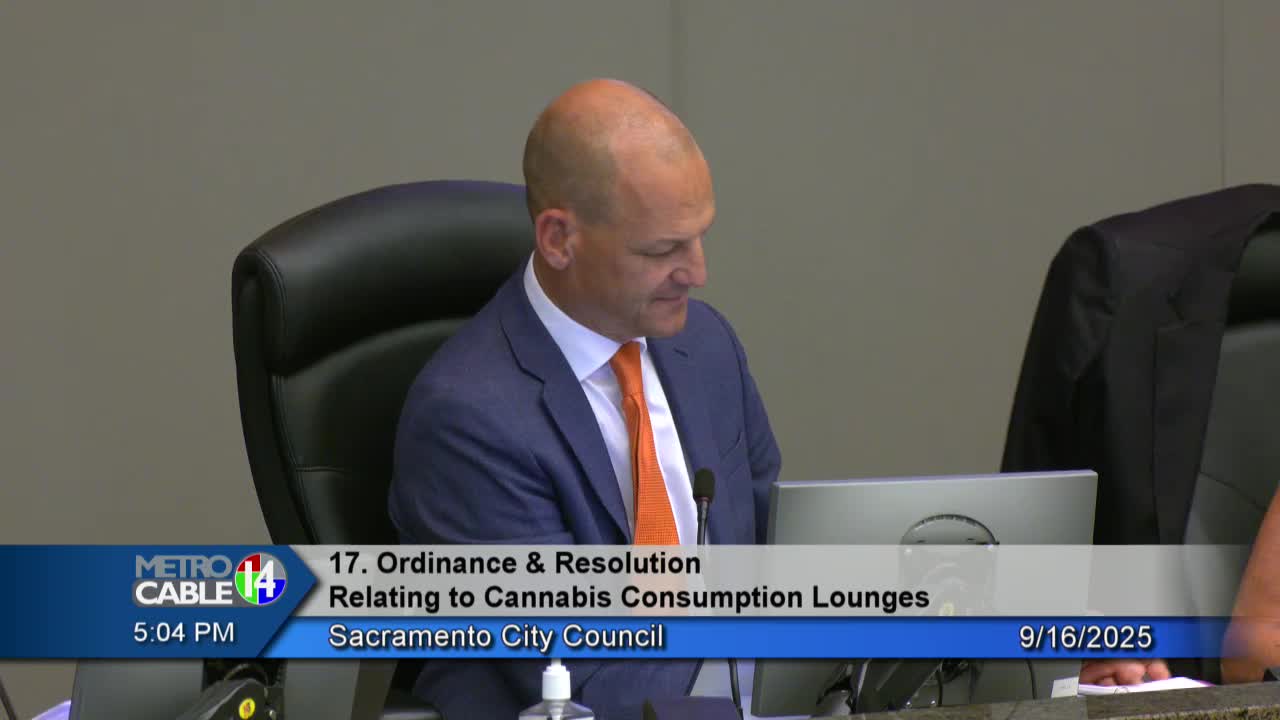
Council approves permit framework for cannabis consumption lounges, rejects a per-district cap
Summary
The council directed staff to adopt an ordinance for a cannabis consumption lounge pilot and moved the call-up review to the conditional-use stage; council rejected proposed per-district caps and approved a first-come, first-served route for qualified dispensaries.
The Sacramento City Council on Oct. 25 advanced the city’s five-year pilot program for cannabis consumption lounges by directing staff to put the program into ordinance form and by clarifying permitting and review procedures.
Staff said the pilot — previously authorized by the council — allows two types of lounge add-ons for storefront dispensaries: Type 1 (non-smoking consumption) and Type 2 (smoking and ingestibles). The Office of Cannabis Management surveyed 36 storefront dispensaries and received eight responses indicating interest in operating lounges; staff said the permit requires substantial investment in ventilation and safety systems and that the application fee will be set after a city fee study. Core participants in the city’s equity program would have the application fee waived.
Council considered whether to limit lounges by a fixed number per council district (staff’s earlier draft recommended up to five lounges per district to achieve geographic equity). After debate, the council voted to remove the per-district cap and instead directed staff to proceed without district limits. The council also agreed to relocate the council call-up review from the business-operating permit (Title 5) to the conditional use permit stage (Title 17), meaning that call-up and public review would occur during land-use review before a business invests in ventilation and other lounge upgrades.
Fiona Masson of the Office of Cannabis Management said the city would process complete lounge applications in chronological order under a “first-in-line” approach and that staff would return with a fee resolution and any code amendments needed to implement training, staffing and safety requirements. Councilmembers asking policy questions voiced differing views on smoking lounges; some members said they would prefer to move cautiously, while others favored fewer limits and more opportunities for legal consumption venues.
On a recorded roll call the council approved the motion to move the ordinance forward without a per-district cap; the clerk recorded the final tally as six ayes and four noes (the transcript records the roll and the clerk’s post-vote statement). Staff will bring back ordinance text and a fee resolution for formal adoption and implementation.