Get Full Government Meeting Transcripts, Videos, & Alerts Forever!
Get email alerts on the Infrastructure Transit topic
No spam. Unsubscribe anytime.
TJPA updates portal schedule and funding plan after federal grant rescind; local share remains short
Summary
Transbay Joint Powers Authority staff reported a reduced project cost estimate and the loss of a FRA CRISI grant, leaving a significant local funding gap; staff outlined next procurements, right-of-way work and outreach plans.
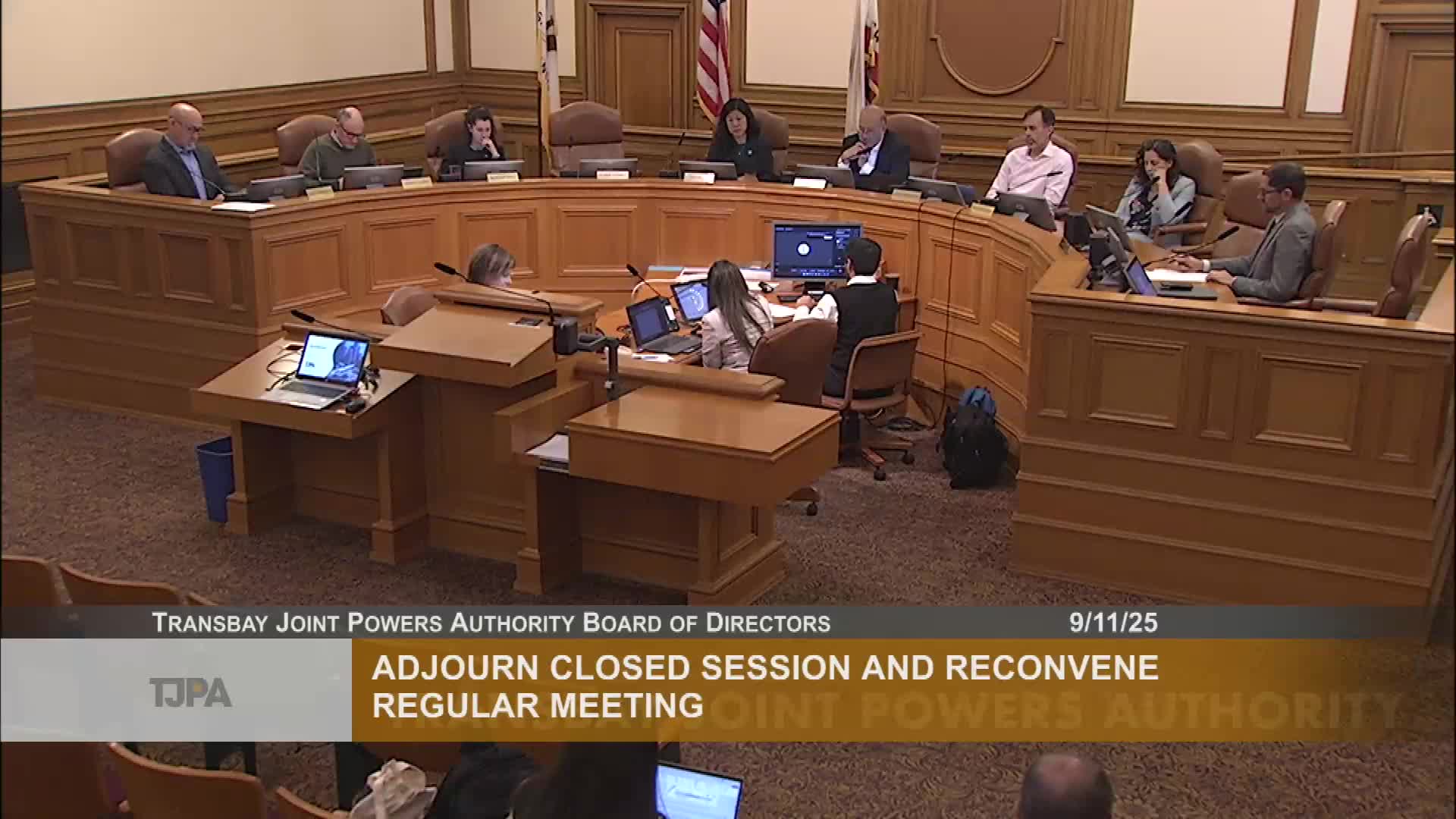
SAN FRANCISCO — At its Sept. 11 meeting, the Transbay Joint Powers Authority received a monthly update on the Downtown Rail Extension (the "portal") that described schedule, procurement and funding changes after the Federal Railroad Administration rescinded a previously announced CRISI grant. Executive staff said the program has reduced its indicative construction estimate to about $7.57 billion but still faces a local funding shortfall and is reprogramming available local funds to cover highest-priority, design-phase work.
The portal update summarized near-term work: launching right-of-way appraisals and property surveys, issuing the request for proposals (RFP) for the progressive design-build 40CT tunnel contract (expected to take about a year to procure), progressing a 60% design update for the Fourth and King and utility-relocation packages, and preparing management-plan updates required for a future federal New Starts (FFGA) funding request.
The report explained why the funding picture has changed. "In October 2024, FRA approved CRISI grant for track rail final design but rescinded this selection in August 2025," Chief Financial Officer Shima Mirzai told the board. The rescission removed a previously budgeted $25 million from the project plan and increased the size of the remaining funding gap. Mirzai said the project team is treating some previously budgeted amounts as "planned" rather than "committed" until formal allocations are made by funding agencies.
Staff described multiple parallel advocacy and financing actions intended to close the remaining local share, including continued work with the Bay Area Rail Working Group, advocacy for a reauthorized state "cap and invest" (cap-and-trade successor) program that would create a state funding stream for high-speed-rail and related bookend projects, and efforts to secure the $160 million in regional-transportation funding assigned to the Central SOMA Community Facilities District (CFD). van der Water said TJPA and regional partners will continue lobbying to move planned state and federal sources into committed status.
Financial-management details: Mirzai said TJPA maintains a board-adopted fiscal reserve equal to about 60 days of working capital (about $9 million at current burn rates) to bridge short-term obligations because the agency does not receive cash advances from funding partners. Mirzai noted that as the portal moves into construction, the authority will need to grow that reserve through financing or shifts in funding-agency payment structures.
Staff also described program risks and mitigation. Alfonso Rodriguez, portal project director, listed top risks including right-of-way acquisition and securing the full local match. He told the board fewer qualified contractors exist for sequential excavation mining methods (the planned tunneling technique) and emphasized the need to keep shortlisted teams engaged while the 40CT RFP is prepared.
Outreach and next steps: Rodriguez said staff is sending subsurface-easement notices to property owners along the alignment (consent letters were due Sept. 15) to keep the schedule on track for a summer board request next year to vacate subsurface envelopes and begin utility relocation in 2027. Staff also plans industry outreach after near-term RFP releases and continuing community events tied to Transit Month to keep public stakeholders informed.
The board asked for additional detail on the remaining $728 million shown in the staff funding chart and asked staff to return with a strategy to close the gap. Several public callers urged the authority to show supporting ridership and business-case documentation and to consider lower-cost alternatives, but no formal policy decision was made at the meeting.
Looking ahead, staff said they will present revised monthly reports showing risk-register changes, updates to the funding plan as advocacy progresses, and results from the 60% design updates.