Get Full Government Meeting Transcripts, Videos, & Alerts Forever!
Get email alerts on the Civil Rights Policing topic
No spam. Unsubscribe anytime.
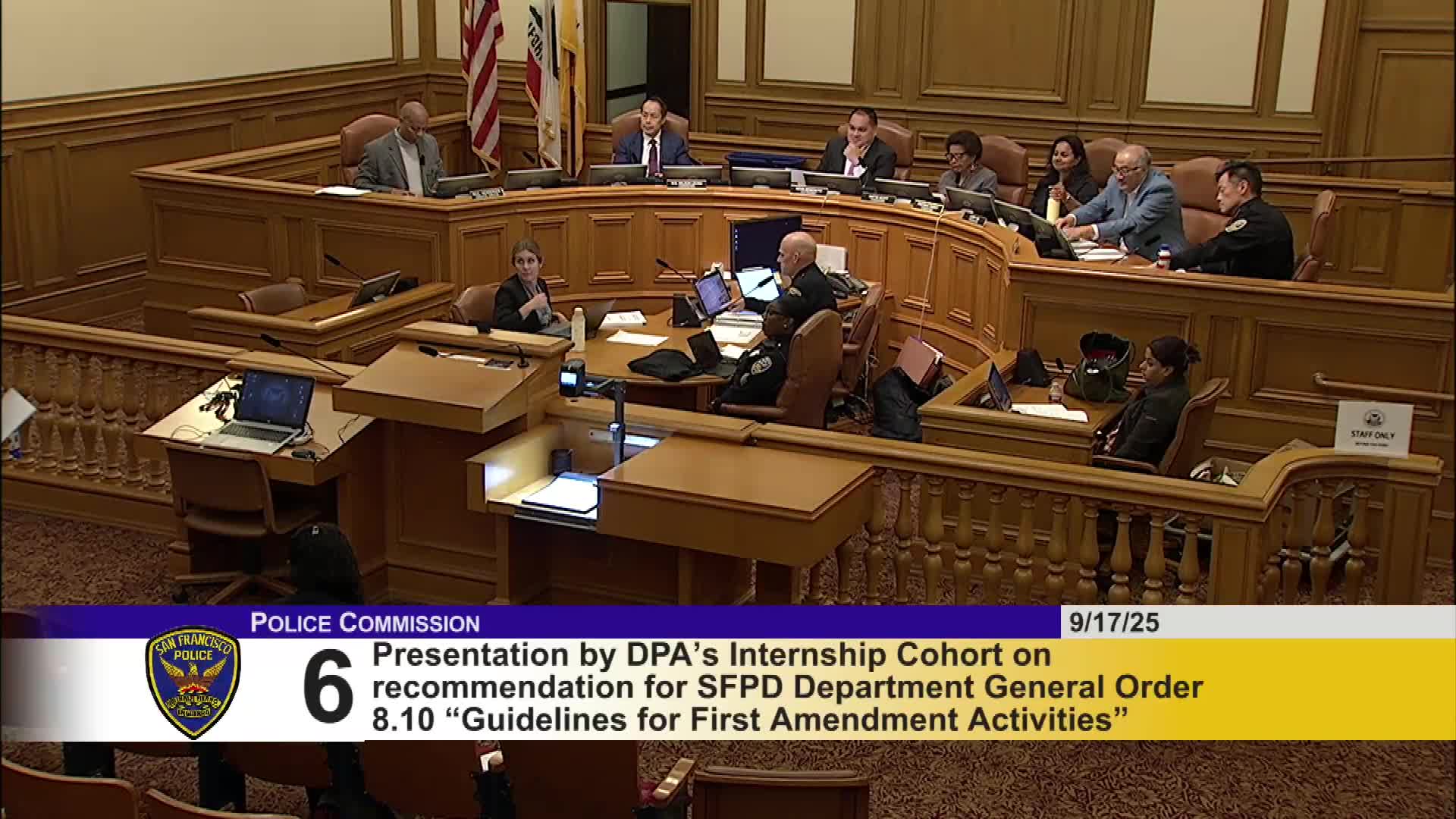
DPA interns propose updates to SFPD guidelines on First Amendment activities
Summary
A summer internship cohort at the Department of Police Accountability presented a 104-page report urging updates to SFPD's DGO 8.1 to define unclear terms, address modern surveillance (including drones), establish oversight, expand training and require incident tagging for First Amendment-related encounters.
A cohort of Department of Police Accountability interns presented policy recommendations to modernize San Francisco Police Department handling of incidents involving First Amendment activity, urging clearer definitions, alignment with city surveillance rules, expanded training and new oversight mechanisms.
The DPA's summer interns delivered a condensed presentation summarizing a 104-page report that recommends five main changes to Department General Order 8.1 (guidelines for investigations involving First Amendment activities): define unclear terms (for example, "criminal investigation" and what it means for an investigation to "involve" First Amendment activity), provide explicit guidance on modern surveillance technologies including drones and reference the city's surveillance technology ordinance, create an oversight unit to audit protest responses and compliance, expand mandatory First Amendment training departmentwide, and add a structured tagging/checkbox mechanism in incident reports to mark encounters involving protests, filming or political expression.
Presenters said DGO 8.1 is roughly 30 years old and that the existing guidance focuses on paper records and internal processes while lacking specific direction for digital evidence and transparency. The interns said they drew on best practices from other U.S. jurisdictions (including New York City and Baltimore) and incorporated academic work on implicit bias to craft recommendations intended to reduce discretionary disparity and improve public accountability.
DPA staff and commissioners praised the interns'work and suggested the SFPD should provide a formal departmental response. Vice President Kevin Benedicto asked staff to consider agendizing a formal SFPD response to the interns'recommendations later in the year so that the commission could review whether items were "partially achievable" or "on track." Executive Director Paul Henderson and SFPD staff had participated in the interns'process, the DPA said, and the interns thanked subject-matter experts and city partners who supported the program.
The interns called for an oversight unit composed of a police commissioner liaison, a DPA member, and an SFPD officer to audit protest responses and recommend best practices; they also proposed a searchable checkbox in incident-reporting systems to create an auditable trail for First Amendment encounters. Commissioners and DPA staff noted that similar recommendations in earlier years led to concrete departmental policy changes and that staff would work to coordinate next steps and a formal departmental review.
The interns who presented included law students and cohort members who organized research, benchmarks, and policy drafts. DPA staff said the written materials include links to audit reports and other resources. Commission members thanked the interns and instructed staff to schedule follow-up in coordination with SFPD policy development.