Get Full Government Meeting Transcripts, Videos, & Alerts Forever!
Get email alerts on the Marina Remediation topic
No spam. Unsubscribe anytime.
Rec and Park OKs $8.19 million contract increase for Marina remediation and improvement design
Summary
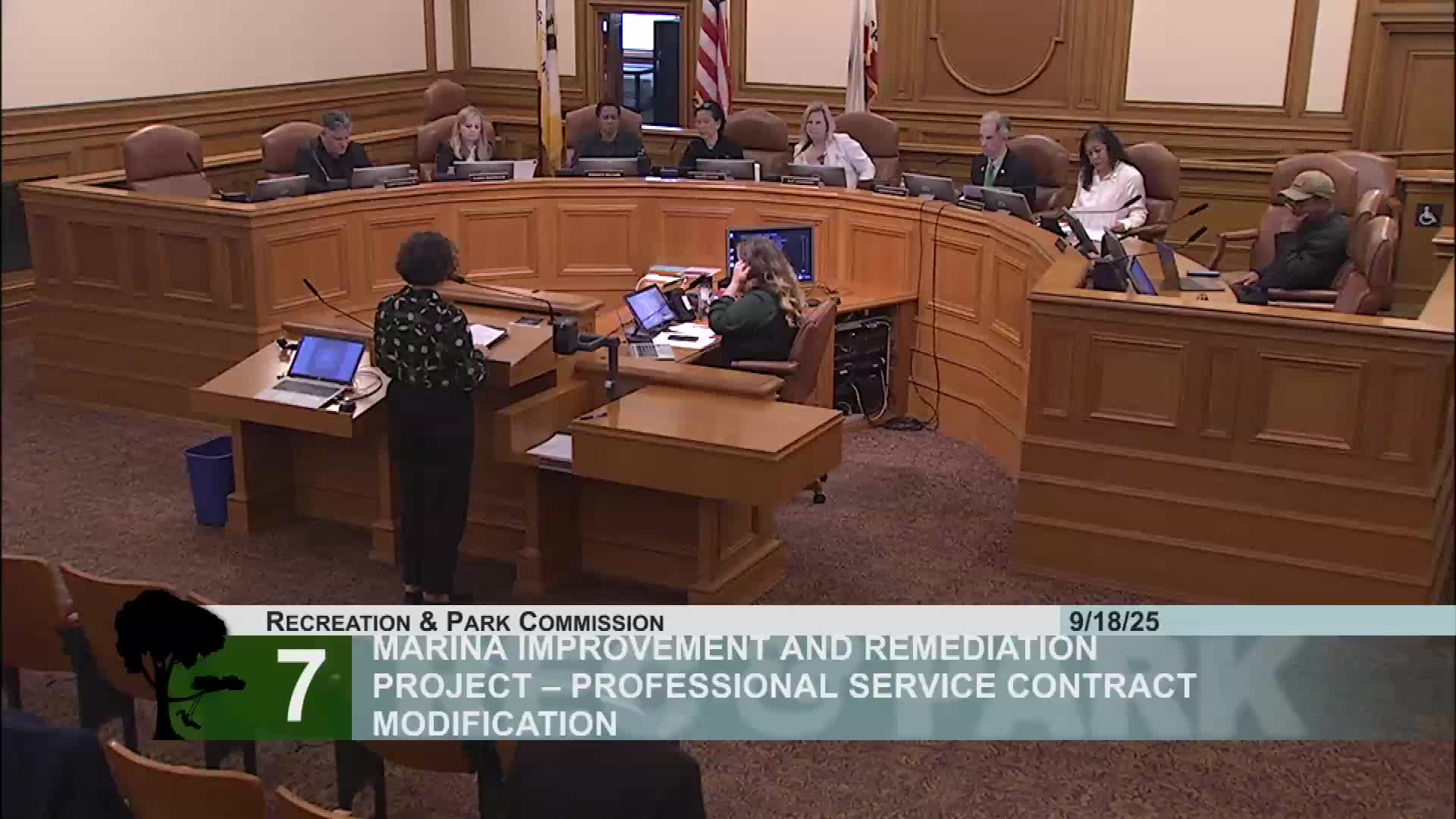
The Recreation and Park Commission on Sept. 18 voted to increase the design contract for the East Harbor Marina Improvement and Remediation Project to $8,190,670 to cover extended engineering and unforeseen work tied to an expanded concept design.
The Recreation and Park Commission on Sept. 18 voted to expand the professional services contract for the Marina Improvement and Remediation Project to $8,190,670 to cover additional engineering and design work.
The commission’s action approves an increase of $1,690,654 for Moffatt & Nichol (prime consultant) to accommodate extended concept design work, additional geotechnical borings, hydrodynamic modeling and increased shoreline and upland design coordination, project manager Monica Scott told the commission. “This is not a request for additional funding,” Scott said; she said the amendment will draw from an existing soft‑cost reserve for the project.
The project responds to contamination discovered in subsurface soils and sediments in the East Harbor Marina that city staff said trace to a historic gasification plant formerly owned by a PG&E predecessor. Scott summarized the planning background: a settlement agreement between the city and PG&E provides that PG&E will fund planning, environmental review, design and construction, and that a portion of the cost will be repaid by marina revenues over 30 years at no interest.
Why it matters: staff say the project will remove or cap contaminated sediments with engineered backfill, reconfigure harbor slips and docks, add recreational amenities and construct a breakwater to reduce shoaling. Scott said the project is intended to reduce frequent dredging and long‑term maintenance costs and preserve recreational boating access.
Public comment at the meeting raised environmental and operational concerns. Several speakers asked how the project addresses the Laguna Street (Laguna) outfall and ongoing sewer discharges into the East Harbor. Captain Maggie Hallahan and others urged that the outfall be shown and discussed in project visuals; Chrissy Kaplan, who manages the Gas House Cove fuel dock, said the East Harbor has not been dredged since 1989 and warned that the fuel dock supplies essential vessels including Coast Guard and public safety boats. Dan Clark, a local commenter, urged that any relocation of the fuel dock be done only after a fully operational replacement is built.
Commissioners and staff responded that the outfall is being accounted for in remediation and marina engineering work and that Rec and Park is coordinating with the Water Board, PG&E and other agencies. Scott said permit applications are due to go to multiple permitting bodies in the next month and cautioned that permitting could take up to a year.
The commission approved the contract amendment by voice vote. Monica Scott and staff said design is roughly 60% complete and environmental review is expected to finish in 2026, with construction targeting mid‑2027 and an estimated three‑year build period.
What remains open: no final decisions were made at the meeting about the fuel dock’s future location or construction funding for a replacement dock. Several speakers asked for additional briefings and for the department to coordinate with the Port, public works, and the Water Board on outfall monitoring and fuel‑dock contingencies.
Ending: Commission members who supported the amendment said increased design work was necessary to respond to public and governmental feedback and to reduce risk during construction. The project team said it will return with permitting updates and additional briefings as the environmental review and permitting processes advance.