Get Full Government Meeting Transcripts, Videos, & Alerts Forever!
Get email alerts on the Population Health topic
No spam. Unsubscribe anytime.
Population Health Division details data, lab modernization and neighborhood health planning
Summary
The San Francisco Department of Public Health’s Population Health Division told the Health Commission about organizational changes, a $151 million budget, lab billing improvements after EPIC integration, the community health assessment/CHIP process and a push for neighborhood‑level epidemiology.
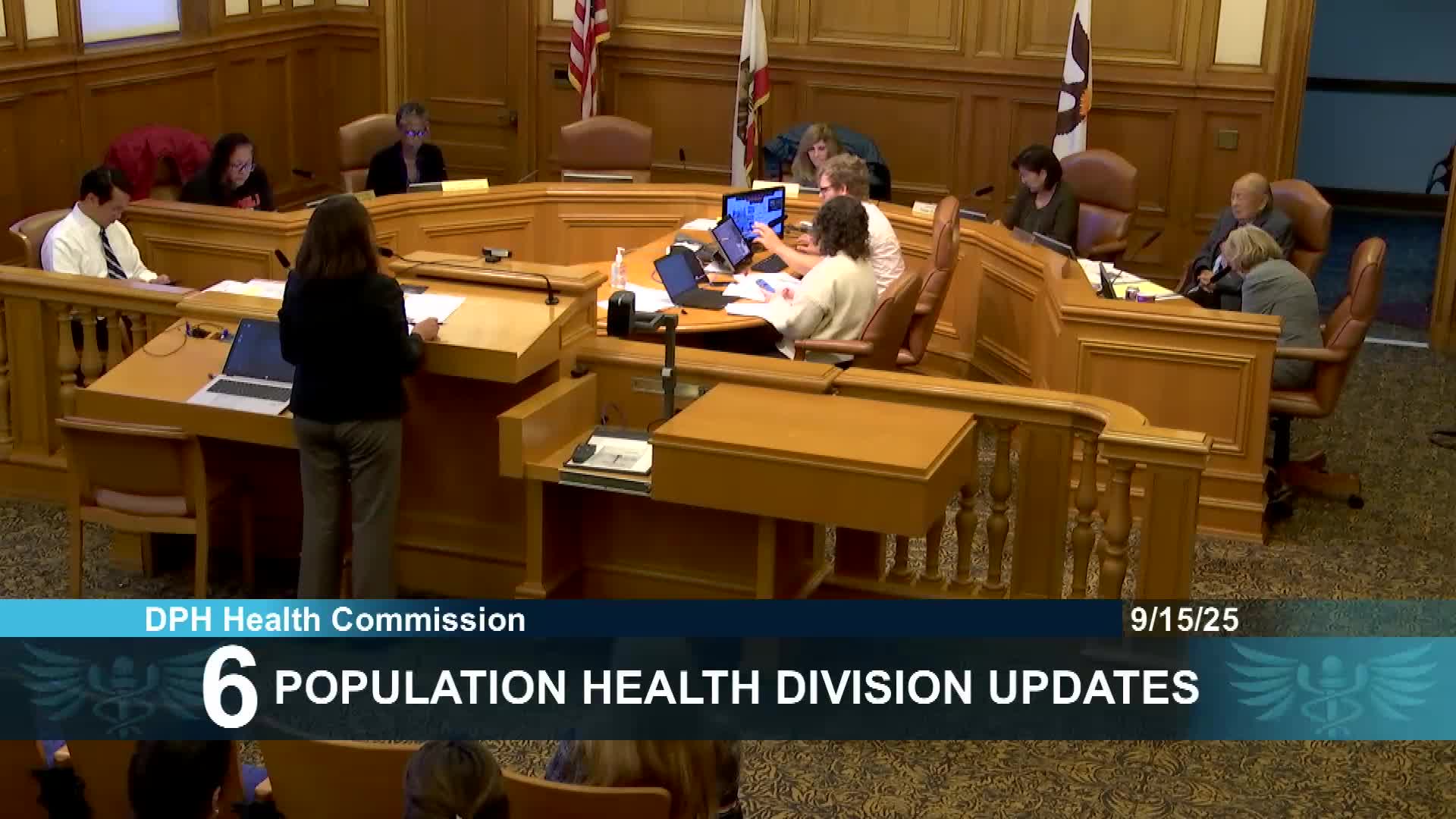
Dr. Susan Philip, director of the Population Health Division (PhD) at the San Francisco Department of Public Health, presented an overview of the division’s work and priorities to the Health Commission on Sept. 22, highlighting data modernization, public health laboratory upgrades and neighborhood‑level community health planning.
Dr. Philip said the division’s total expenditure budget is about $151 million and that roughly 25 percent of funding comes from grant sources. She described an organizational change that added deputy directors and deputy health officers to improve coordination across branches, and she introduced a new deputy director for Surveillance, Data and Analytics, Dr. Kyle Bernstein.
Public health laboratory and billing changes Dr. Philip described the public health laboratory’s (PHL) recent technical and billing work. PHL connected to the citywide EPIC electronic health record in 2023 and, after a multi‑disciplinary effort to build billing interfaces, began billing Medi‑Cal managed care plans in August 2024. The division said the change produced an incremental revenue stream for the lab and will inform expansion of billing improvements to other clinics.
Community health assessment and data work PhD is continuing community workshops for the Community Health Assessment (CHA) and Community Health Improvement Plan (CHIP); completion of the CHIP is expected in winter 2025–26 with regular monitoring thereafter and the next CHA/CHIP cycle planned for 2028. Dr. Philip said the division is increasing capacity to present neighborhood‑level “community epidemiology” that combines infectious and noninfectious conditions so partners can plan interventions across clinical and social domains.
Staffing and operations The division reported about 471 budgeted full‑time equivalents covering laboratory, environmental health, epidemiology, clinics and operations. Dr. Philip emphasized efforts to diversify staff and leadership and praised a centralized operations group responsible for finance, hiring, purchasing, vital records, and other shared services.
Other highlights and next steps Dr. Philip noted recent site moves and upgrades: the adult immunization and travel clinic moved to 27 Van Ness and the PHL is scheduled to open in a renovated Building 5 next year. She told the commission the division will continue to strengthen data linkages, advance neighborhood epidemiology, and use state and academic partnerships to tackle chronic disease, climate‑related health risks and surveillance for emerging infections.
Ending Commissioners asked for follow‑up on workforce diversity categories and on potential collaborations with school health programs. Dr. Philip said staff would provide updates and that the division will return Oct. 6 with a focused Hunters Point shipyard update.