Get Full Government Meeting Transcripts, Videos, & Alerts Forever!
Get email alerts on the Behavioral Health topic
No spam. Unsubscribe anytime.
San Francisco behavioral health leaders outline state-led plan, overdose response and new treatment capacity
Summary
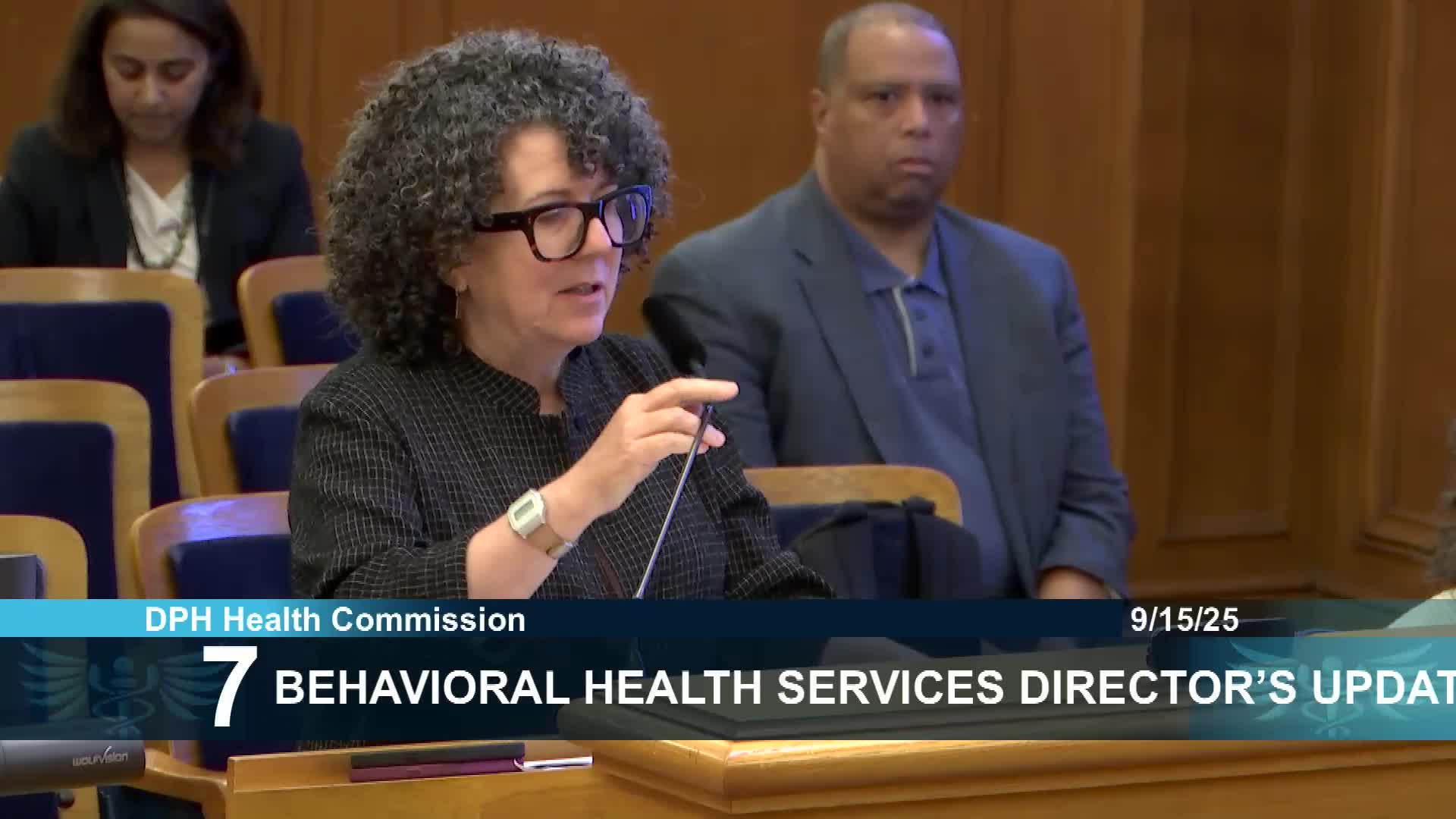
San Francisco Department of Public Health behavioral health leaders presented a wide‑ranging update to the San Francisco Health Commission on Sept. 22, saying new state requirements will require counties to submit a three‑year Behavioral Health Services Act integrated plan and budget and that the city is expanding overdose prevention and addiction‑treatment capacity.
San Francisco Department of Public Health behavioral health leaders presented a wide-ranging update to the San Francisco Health Commission on Sept. 22, saying new state requirements will require counties to submit a three‑year Behavioral Health Services Act integrated plan and budget and that the city is expanding overdose prevention and addiction‑treatment capacity.
The integrated plan required under the Behavioral Health Services Act (Prop 1) covers fiscal years 2026–29 and, officials said, for the first time must account for all payer and revenue sources used for specialty behavioral health services. “The plan must be informed by local stakeholder input,” Behavioral Health Director Dr. Coonens told commissioners, and counties must submit drafts for state review in March 2026 with final plans due June 30, 2026.
Why it matters: the change demands that local agencies inventory and report all funding streams—beyond the Mental Health Services Act—and tie them to measurable service outcomes. Department officials said the requirement is a substantial operational lift for program, finance and personnel teams but could create clearer, more transparent reporting on what services are being paid for and where gaps remain.
On Medi‑Cal and new billing authorities, DPH staff described state plan amendments that let counties bill Medi‑Cal for additional evidence‑based practices, including assertive community treatment and coordinated specialty care for first‑episode psychosis. The department said designated state centers of excellence will provide technical support to counties implementing the changes.
Overdose response and treatment expansion DPH reported an expanded local effort to reduce fatal overdose. Officials said the number of people treated in the San Francisco Health Network for substance use disorders rose by about 70 percent since January 2023 and about 40 percent since January 2024. Much of the increase, Dr. Coonens said, comes from street‑initiated starts and jail‑initiated treatment: “Two thirds of new patients on buprenorphine are started through our street telehealth program,” she said, citing the city’s street telehealth and navigator partnerships.
The department also described retention challenges: clinicians said they have succeeded in starting more people on medications for addiction treatment (MAT), but keeping patients in care remains difficult in the early weeks. DPH reported a low six‑month retention rate for newly started buprenorphine patients and is piloting strategies—long‑acting injectable buprenorphine, contingency management (small incentives for engagement), and greater linkages to shelter or structured respite—to improve retention.
Methadone access and jail health DPH said it has increased methadone program capacity and is initiating more patients in jail settings, noting that methadone can produce higher retention for some patients but is subject to federal and state clinic regulations. The city reported growth in the total number of unique monthly methadone patients since 2023 and said additional jail‑based initiation programs and settlement funding are helping expand access.
New and expanded beds Officials summarized recently opened and planned capacity: about 72 short‑term respite beds at the Eleanor Fagan site (formerly described as the Kean Hotel) for people exiting street homelessness; 62 recovery/step‑down beds at the Marina Inn (a Salvation Army program) intended for people leaving structured treatment; 15 new emergency stabilization unit beds for up to 30‑day stays; and increased withdrawal management beds at Harbor Lights. DPH said program outcomes will be measured primarily by exits to a next‑level-of‑care (treatment or housing) and reduced premature departures.
Conservatorship (SB 43) and system capacity The commission also heard a focused briefing on SB 43, which amended the Lanterman‑Petris‑Short (LPS) Act to include severe substance use disorder in the definition of grave disability in some cases. DPH said the change has clarified eligibility for conservatorship in complex cases, but local leaders noted it has also increased referrals for locked subacute placements and exposed capacity limits in placements that can handle dual diagnoses (serious mental illness plus severe substance use). The department described ongoing planning to add locked subacute and dual‑diagnosis beds and to pilot placement and workflow changes with the public conservator’s office to reduce referral delays.
What the department will track: officials said they are tracking conservatorship referrals, placement availability, and whether new placements enable timely transitions from community or jail referrals. Dr. Coonens emphasized that conservatorship is a last‑resort intervention and described required clinical justification steps and court review.
Commissioner questions focused on measurement and follow‑up. Commissioners asked the department to provide the justification/recommendation templates and to return with outcome data showing whether SB 43 is increasing effective access to structured treatment for people with repeated decompensation.
Ending Department leaders said they will return with updated metrics on medication retention, outcomes from the new respite and recovery beds, and additional detail on the integrated Behavioral Health Services Act plan as state guidance and performance measures become available.