Get Full Government Meeting Transcripts, Videos, & Alerts Forever!
Ethics Commission approves streamlining ordinances, raises individual contribution cap to $1,000
Summary
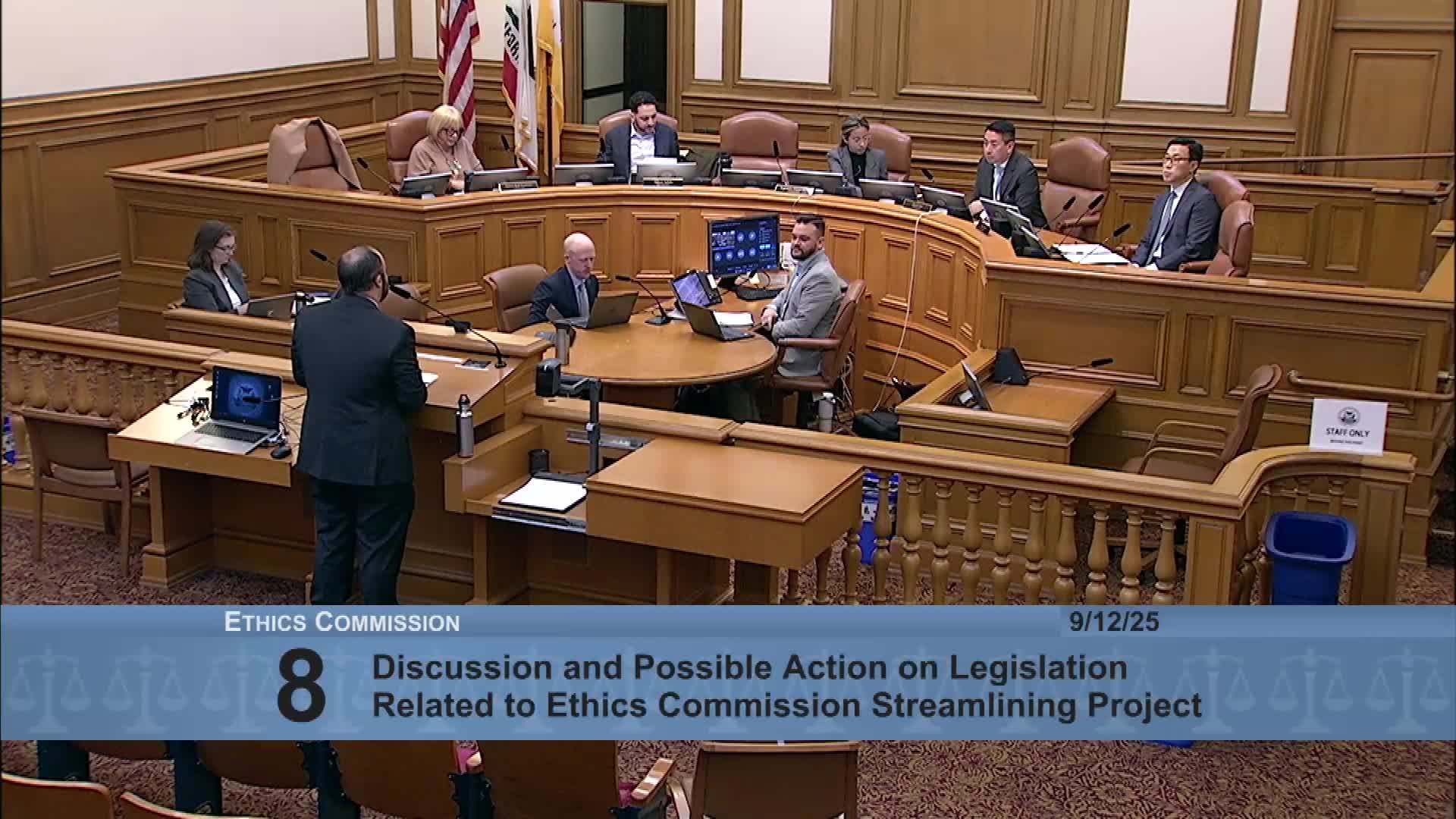
At its Sept. 12 meeting the San Francisco Ethics Commission voted 5-0 to approve two ordinances to streamline consultant and developer reporting and to change how expenditure ceilings are lifted; the package also increases the city's individual contribution limit from $500 to $1,000.
The San Francisco Ethics Commission on Sept. 12 voted 5-0 to approve two ordinances that would remove certain consultant and developer reporting requirements and change how the city's public financing expenditure ceilings are applied, while increasing the individual contribution cap from $500 to $1,000.
The measures, summarized in staff attachments labeled "Attachment 2" and "Attachment 4," were presented by Policy and Legislative Affairs Manager Michael Canning and recommended by Executive Director Patrick Ford. Staff said the changes are intended to reduce administrative burden and make the public financing rules operate more predictably.
"This project is intended to look at various programs and policies administered by the ethics commission to determine if they're effective, efficient, and adding value to the city and furthering the mission of the commission," Michael Canning said as he introduced the two ordinances. Canning told commissioners the package grew from a review that began in February and included two interested-persons meetings in March and staff reports published in June.
Patrick Ford, the commission's executive director, said the proposed change to how expenditure ceilings are lifted would move San Francisco to a single, per-race "one-and-done" model in which ceilings are applied consistently to all candidates in a race and are removed for the race when third-party or nonparticipating-candidate spending crosses a defined threshold. Ford said the change aims to reduce repeated incremental adjustments that staff and participating candidates find burdensome.
"The real utility of expenditure ceilings exists when there are few candidates or when all or most of the candidates in a race are…
Already have an account? Log in
Subscribe to keep reading
Unlock the rest of this article — and every article on Citizen Portal.
- Unlimited articles
- AI-powered breakdowns of topics, speakers, decisions, and budgets
- Instant alerts when your location has a new meeting
- Follow topics and more locations
- 1,000 AI Insights / month, plus AI Chat