Get Full Government Meeting Transcripts, Videos, & Alerts Forever!
Get email alerts on the Campaign Finance Reform topic
No spam. Unsubscribe anytime.
Ethics Commission approves streamlining ordinances, raises individual contribution cap to $1,000
Summary
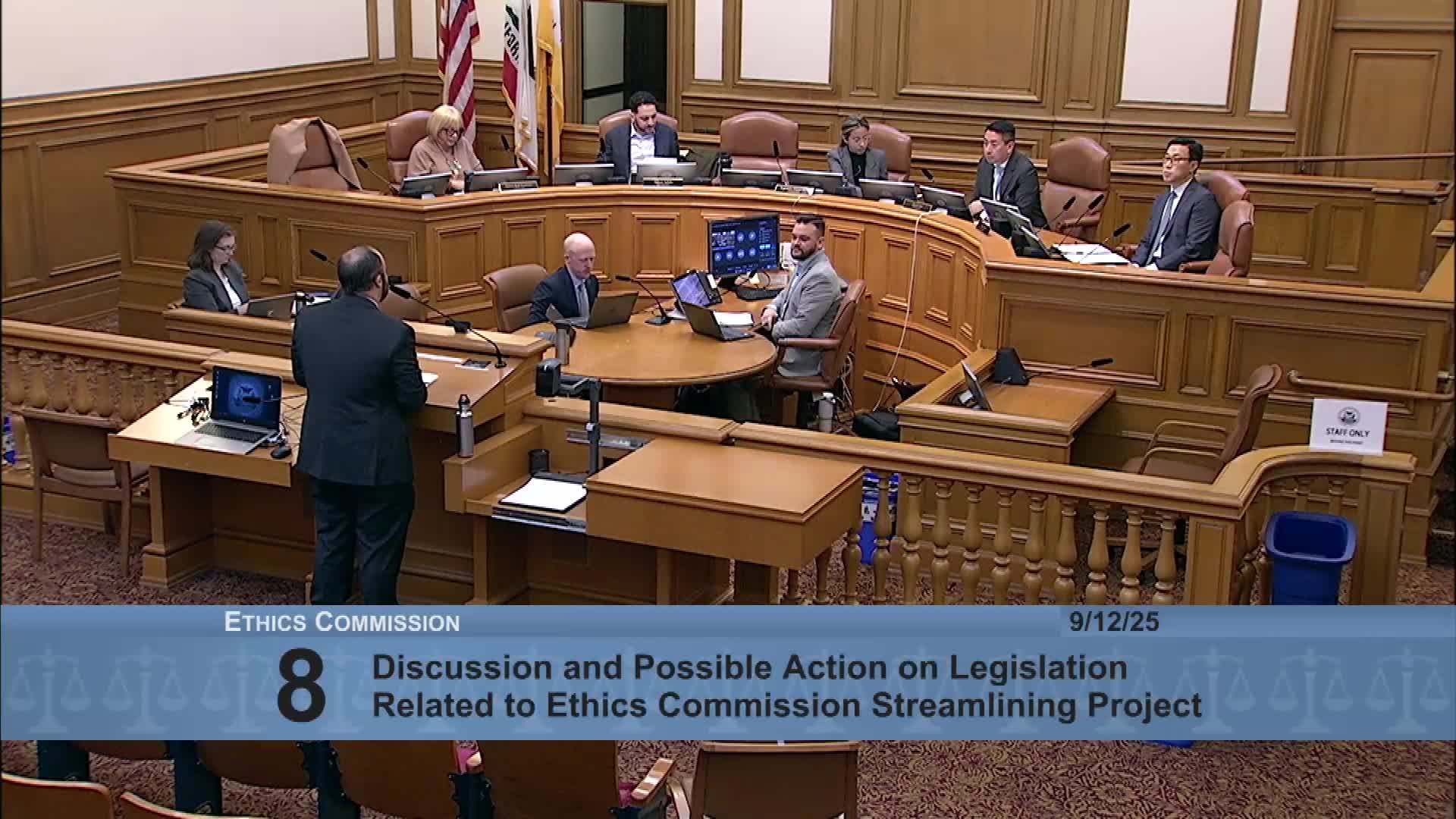
At its Sept. 12 meeting the San Francisco Ethics Commission voted 5-0 to approve two ordinances to streamline consultant and developer reporting and to change how expenditure ceilings are lifted; the package also increases the city's individual contribution limit from $500 to $1,000.
The San Francisco Ethics Commission on Sept. 12 voted 5-0 to approve two ordinances that would remove certain consultant and developer reporting requirements and change how the city's public financing expenditure ceilings are applied, while increasing the individual contribution cap from $500 to $1,000.
The measures, summarized in staff attachments labeled "Attachment 2" and "Attachment 4," were presented by Policy and Legislative Affairs Manager Michael Canning and recommended by Executive Director Patrick Ford. Staff said the changes are intended to reduce administrative burden and make the public financing rules operate more predictably.
"This project is intended to look at various programs and policies administered by the ethics commission to determine if they're effective, efficient, and adding value to the city and furthering the mission of the commission," Michael Canning said as he introduced the two ordinances. Canning told commissioners the package grew from a review that began in February and included two interested-persons meetings in March and staff reports published in June.
Patrick Ford, the commission's executive director, said the proposed change to how expenditure ceilings are lifted would move San Francisco to a single, per-race "one-and-done" model in which ceilings are applied consistently to all candidates in a race and are removed for the race when third-party or nonparticipating-candidate spending crosses a defined threshold. Ford said the change aims to reduce repeated incremental adjustments that staff and participating candidates find burdensome.
"The real utility of expenditure ceilings exists when there are few candidates or when all or most of the candidates in a race are participating in the program," Ford said. He told the commission that under the current process the commission had to raise ceilings frequently; staff cited 295 incremental adjustments in the last November election and said most had no practical effect because the candidate had not raised enough money to be constrained by the ceiling.
Staff proposed a per-race trigger that would lift a ceiling only after independent expenditures in a race exceed $309,000; Canning noted that is higher than Los Angeles's $77,000 trigger. The ordinance would also increase the city's candidate contribution limit from $500 to $1,000 to reflect inflation since the year 2000. Staff emphasized that raising the contribution ceiling would not change the amount of any individual contribution eligible for match payments; the program's matchable amount (currently $150) would remain unchanged.
Opponents said the combination of a one-and-done ceiling rule and a higher contribution cap would weaken San Francisco's matching-funds program and advantage wealthy donors and candidates with access to outside spending. Multiple public commenters representing or working with the California Clean Money Campaign, League of Women Voters of San Francisco and other groups urged delay and more stakeholder consultation.
"One and done is no limits at all and makes public financing a shell of what it used to be," Patrick Cassidy, a volunteer with the California Clean Money Campaign, said during general public comment. Trent Lang, executive director of the California Clean Money Campaign, told the commission his organization and other advocates had only learned of the proposed changes shortly before the meeting and urged the commission to retain San Francisco's incremental approach.
"San Francisco's current incremental approach to lifting expenditure limits is fair and targeted," Trent Lang said. "One and done as used in Los Angeles eliminates expenditure limits in most competitive races, essentially makes them a farce."
Steven Hill, who identified himself as an author of San Francisco's public financing law and an expert on public finance, also urged more time for stakeholder collaboration and warned of unintended consequences if the city adopted a one-and-done model similar to Los Angeles.
Commissioners asked questions about enforcement of the proposed consultant-reporting changes, the mechanics of the ceiling-lift process and the practical effects of raising contribution and loan limits. Michael Canning and Patrick Ford said consultant reporting would shift responsibility to campaign committees to report payments to consultants; staff said audit and complaint processes would remain available to detect and address unreported consultant activity.
Commissioners also discussed an administrative step in the ordinance that gives the executive director authority to determine whether a race has crossed the trigger threshold and a limited, 24-hour period for objections that the commission chair could escalate for Commission review. Staff said the chair could delegate that role in regulation or bylaws if needed.
After discussion, Commissioner Yeh moved and another commissioner seconded a motion to approve the two ordinances (Attachment 2 and Attachment 4). The roll call vote was 5-0 in the affirmative: Commissioners Yeh, Francois, Sy, Salahi and Chair Flores Feng.
Votes at a glance
- Ordinance (Attachment 2): Discontinue city registration and reporting for campaign consultants, remove supplemental recusal filing requirement for board and commission members, and discontinue certain developer disclosure requirements; instead require information be provided to clients or lobbyists so clients can report via existing filings. Outcome: approved 5-0.
- Ordinance (Attachment 4): Change expenditure-ceiling administration to a per-race ("one-and-done") lift when third-party spending passes a racewide threshold; increase individual contribution limit from $500 to $1,000; adjust candidate loan limits for inflation. Outcome: approved 5-0.
What happens next
Staff said both ordinances must also be approved by the Board of Supervisors and that if supervisors make substantive amendments the measures would return to the Ethics Commission for another vote. Staff and President Rafael Mandelmann's office told the commission they had been coordinating with the Board of Supervisors on timing; Melanie Mathewson, a legislative aide to President Mandelmann, told the commission his office supports the streamlining effort and the contribution-limit update.
Commissioners and several public commenters urged continued engagement as the measures move to the Board of Supervisors. Opponents asked for delay to allow negotiations with clean-government groups and said alternatives — including a modified incremental formula now being discussed in state legislation (SB 42) — could reduce administrative burden without adopting a one-and-done model.
The commission's action will take effect only if and when the Board of Supervisors enacts matching ordinances; staff said timely approval by both bodies could allow implementation for the next election cycle but warned delays could complicate administration during an active campaign season.