Get Full Government Meeting Transcripts, Videos, & Alerts Forever!
Get email alerts on the Ems Response topic
No spam. Unsubscribe anytime.
EMS reports high ambulance volume, Narcan use and drop in "medic to follow" delays; community paramedics remain stretched
Summary
Deputy Chief Simon Pang reported a rise in ambulance dispatches and continued high Narcan administrations in August, a reduction in "medic to follow" events from last year and expanding community paramedicine activity including transports to new stabilization centers.
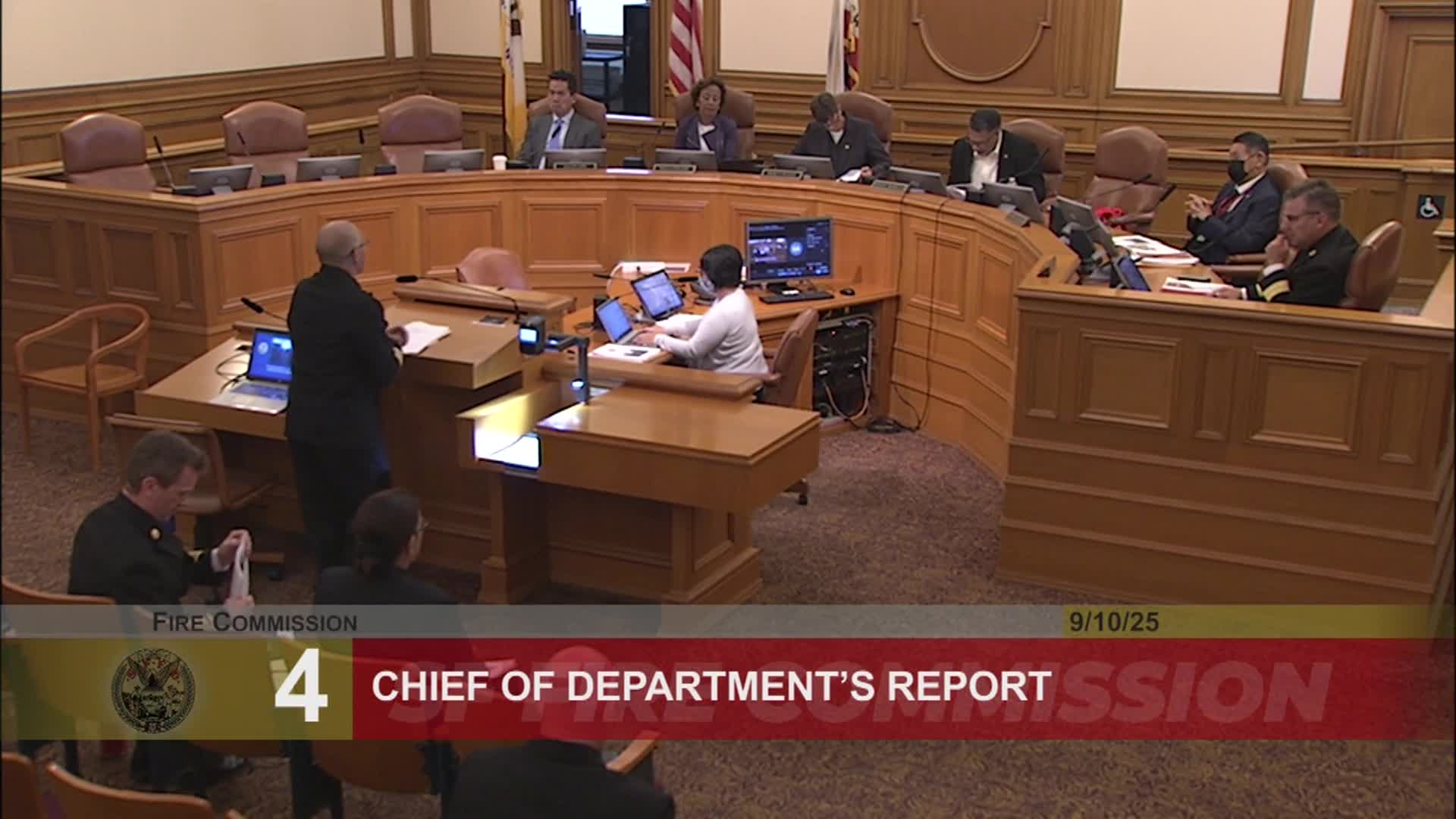
Deputy Chief Simon Pang told the Fire Commission on Sept. 10 that San Francisco Fire Department ambulances were dispatched 8,456 times in August, one of the year’s highest monthly totals, and that overall Fire Department involvement in medical response continues to rise.
Pang said paramedics administered Narcan 267 times in August to 201 unique patients; 63 percent of those later were verified as opioid overdoses. He said cardiac arrest survival at hospital reached 38 percent in August and that cases with bystander CPR and a shockable rhythm (Utstein 2) had roughly a 50 percent survival rate.
Pang described ambulance patient‑offload time and “APOD” dynamics: the reported average offload delay for August was 40.2 minutes but he cautioned that the average was affected by outliers; the number of extreme delays over 120 minutes rose from five in July to nine in August. He also highlighted a 76 percent reduction in “medic to follow” events compared with the same period last year, attributing that improvement to persistent operational messaging, hospital‑impact awareness, schedule adjustments and active crew management.
On community paramedicine, Pang said community paramedics and rescue captains responded to 2,060 calls in August, with an average response time of 18.5 minutes. The division placed 34 involuntary mental‑health holds (gravely disabled) that month. In cases where crews engaged a person face‑to‑face, 23 percent were transported to non‑hospital care (shelter or treatment), 14 percent to hospitals and 63 percent remained in the community because they retained capacity to refuse transport.
Pang noted new destinations and options for field crews: the Sunrise drug sobering center, shelter placements and the Gary stabilization unit at 822 Geary (a recent 23‑hour stabilization site). He said ambulances will begin transporting to Gary in October and expected transports there to increase.
Pang highlighted research and training: the city’s RENDOR study shows an 83 percent bystander Narcan rate in San Francisco (higher than comparable cities), and the department is conducting semiannual ALS in‑service training that includes new protocols and medications such as droperidol for agitated patients. He also said a working group is reviewing violence‑in‑the‑workplace reporting and training to reduce staff injuries.
Commissioners asked for a future list of nonprofit and city partners the department works with on street health intervention; Pang said he will provide that list. Commissioners also asked for further information on droperidol, long‑acting injectables and the Gary stabilization unit’s operations.
Pang concluded that while challenges persist — including frequent 911 users and constrained shelter capacity — department changes in scheduling, messaging and coordination have measurably reduced some operational delays.