Get Full Government Meeting Transcripts, Videos, & Alerts Forever!
Get email alerts on the Public Safety Batteries topic
No spam. Unsubscribe anytime.
Fire department warns of growing lithium‑ion battery hazards; launches inspection and outreach plan
Summary
Deputy Chief Patrick Rabbit briefed the Fire Commission on rising incidents involving lithium‑ion batteries in electric vehicles, scooters and consumer devices, outlining toxic‑gas, thermal‑runaway and reignition risks and the department's response tools and public education plans.
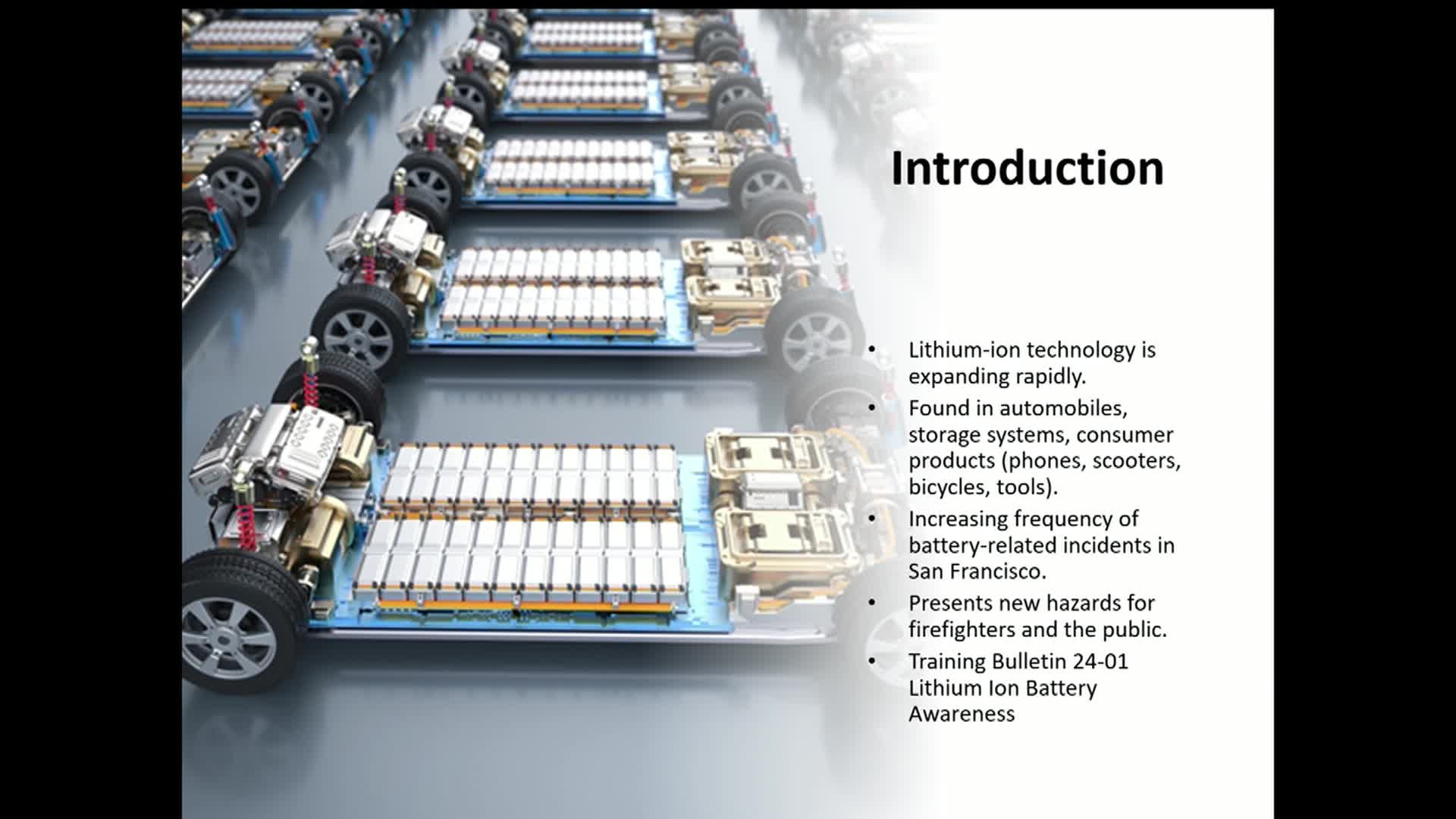
Deputy Chief Patrick Rabbit told the San Francisco Fire Commission on Sept. 10 that the department is seeing more incidents involving lithium‑ion batteries and is expanding mitigation, inspection and public‑education efforts.
Rabbit said lithium‑ion cells “release toxic gases within 2 to 3 seconds” when they fail, including hydrogen fluoride and phosphorus fluorides, and that thermal runaway can produce temperatures up to 3,000 degrees Fahrenheit and may reignite days after an initial event. He warned that some gases have an explosion potential and cited a near‑miss in Colorado in which an attached garage blew out when batteries ignited.
The department’s training bulletin (referenced in the meeting packet) and Rabbit’s presentation say the batteries can burn without atmospheric oxygen, complicating standard suppression tactics. Rabbit told commissioners the department has begun carrying specialized extinguishing agents and disposal equipment, and has issued five‑gallon metal buckets for crews to place extinguished batteries into pending coordinated hazardous‑materials pickup.
The department’s mitigation tools described at the meeting include cell‑block mineral suppressants and an encapsulating agent (F‑500) carried by the Hazardous Materials unit, plus 55‑gallon double‑walled, vented drums for larger pickups. Rabbit said those products provide faster cooling and help prevent thermal propagation, but they are costly and not as readily available as water.
Rabbit also described documented operational challenges: batteries can off‑gas before burning and may reignite up to three weeks after initial damage; improper disposal in municipal collection vehicles can reignite when crushed; and EV battery packs are large assemblies of many cells, increasing stored energy and the hazard when damaged. He cited a non‑San Francisco case in which a firefighter later developed serious health problems following an off‑gassing exposure.
The Fire Department will expand prevention work through its R1/R2 inspection program and a targeted public‑information campaign, beginning with single‑room occupancy hotels, where crews have seen multiple incidents. Rabbit said the department is working with the Department of Public Health and Public Works on collection and disposal logistics and with code and prevention staff to incorporate charging‑station and storage guidance into permit and inspection checklists.
Commissioners asked operational questions during the presentation: one asked whether electric vehicles should be housed in garages; Rabbit said EVs do pose elevated hazards and that code controls such as a one‑hour firewall, heat and smoke detection and appropriate electrical permitting and inspections are important when charging is installed in residential garages. Commissioners also urged multilingual outreach in neighborhoods with many SROs, including Chinatown.
Rabbit said the department will continue to monitor evolving battery technology and revise tactics and public guidance.
The department packet cited an internal training bulletin on lithium‑ion battery response produced by station personnel and command staff; Rabbit recommended that residents and building managers avoid storing charging devices or multiple batteries in hallways and exits and follow permit guidance for charging infrastructure.
The Fire Commission did not take formal action on this item; commissioners requested translations and outreach plans and asked the department to return with materials for commission review.