Get Full Government Meeting Transcripts, Videos, & Alerts Forever!
Get email alerts on the Family Zoning topic
No spam. Unsubscribe anytime.
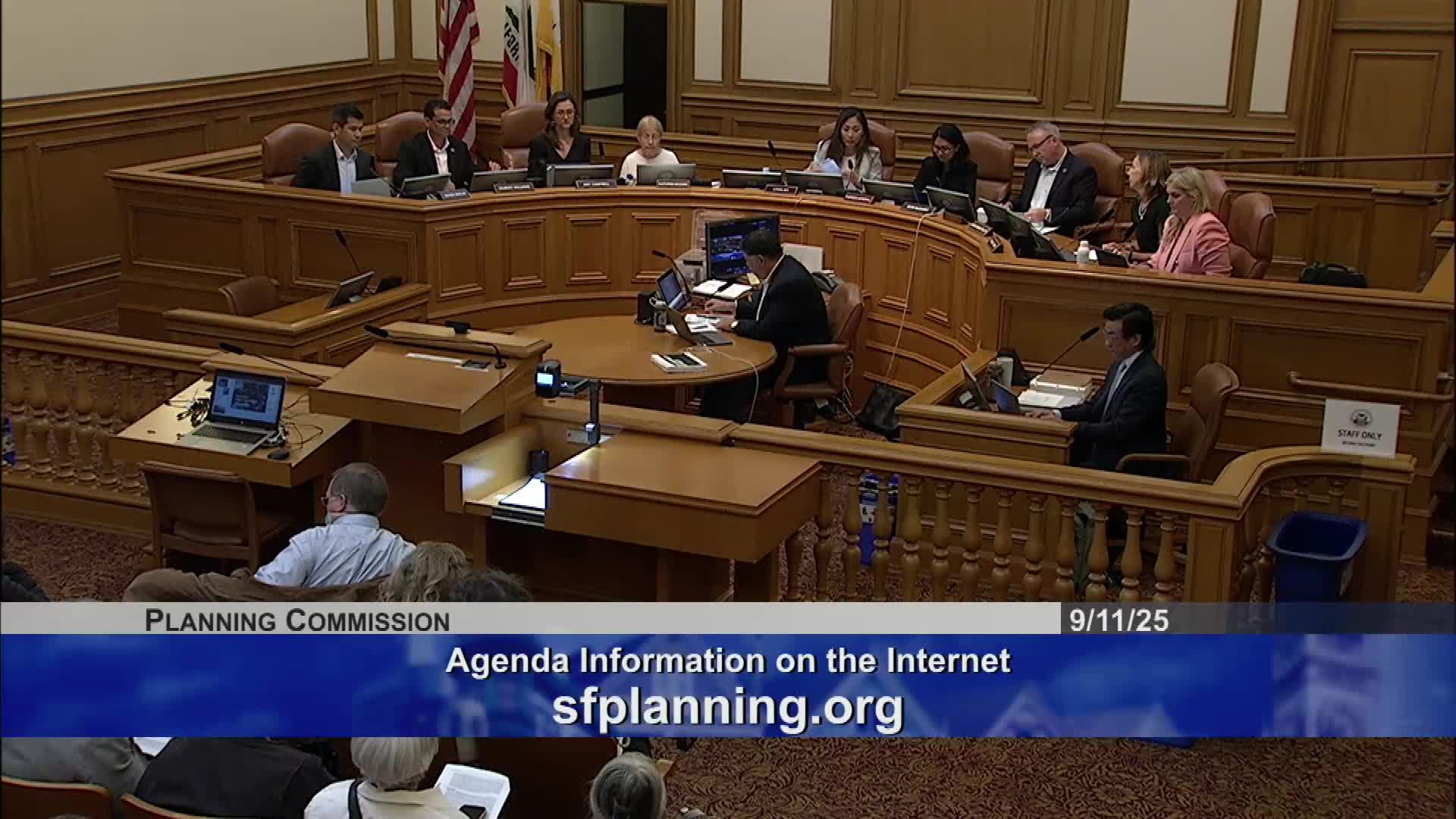
Planning Commission recommends family zoning plan to Board of Supervisors after months of debate
Summary
The San Francisco Planning Commission voted 4–3 on Sept. 11 to recommend the mayor’s Family Zoning Plan — an extensive rezoning package the city designed to meet state housing requirements — forwarding the package to the Board of Supervisors with staff amendments but excluding one staff‑proposed exception.
Planning Commission President Soe and commissioners recommended that the Board of Supervisors adopt the mayor’s Family Zoning Plan, a citywide rezoning package intended to create capacity for the city’s state-mandated housing targets.
The Planning Commission voted 4–3 on Sept. 11 to forward the package to the Board of Supervisors with the planning department’s recommended changes but excluding a single staff proposal the commission removed from its recommendation. The vote came after more than nine hours of public comment at a packed hearing where hundreds of speakers urged both support and opposition.
The Family Zoning Plan package contains general plan amendments, a zoning map ordinance and planning-code text changes intended to add capacity in “housing opportunity” areas, create the optional city ‘Housing Choice SF’ local program, and offer incentives for family-sized units and adaptive reuse. Planning staff said the rezoning is needed for the city to meet its Regional Housing Needs Allocation (RHNA) and avoid state intervention that could allow taller development with fewer local controls.
Lisa Chen, the Planning Department manager for the Family Zoning Plan, summarized the department’s case in a presentation that framed the measure as both a legal requirement and a set of local choices. “To avoid the state’s builder’s-remedy and keep local control — and to create realistic capacity for the 36,000-plus units our region needs — we must rezone,” Chen said. The department also noted it had received a preliminary letter from the California Department of Housing and Community Development stating the proposal, as drafted, would satisfy state requirements.
Commissioners and public members pressed the department on multiple topics during hours of testimony. Supervisors Rafael Mandelman and Myrna Melgar, who addressed the commission before the hearing’s public testimony, urged the commission to advance the plan while also endorsing a set of targeted changes: stronger tenant protections, clearer limits on demolition of rent‑controlled units, support for family-sized (2– and 3‑bedroom) housing, and funding for small-business relocation. Melgar asked commissioners to “opine” on a set of specific fixes so the Board could pursue legislation without returning the matter to the commission and delaying the state-mandated rezoning timeline.
Public comment at the hearing was deeply divided. Supporters — including housing and planning advocates, labor unions that represent construction trades, and affordable‑housing developers — argued the plan is necessary to increase housing supply near transit and make the city more economically diverse. Opponents — neighborhood groups, historic-preservation advocates, and many small-business and tenant representatives — warned the rezoning could encourage demolition of existing rent‑controlled housing, threaten legacy businesses, and put historic resources and waterfront views at risk. Several speakers requested the commission continue the item to allow more study and outreach; that continuation request was not adopted.
Planning staff outlined several last‑minute amendments recommended in response to feedback, including incentives for 3‑ and 4‑bedroom units (a square‑footage bonus or similar), more flexible standards for senior housing, codified early‑notice requirements for commercial tenants when new housing applications are filed, incentives to support ground‑floor “warm‑shell” tenant improvements for small retail and restaurants, and a proposed bonus to encourage adaptive reuse that would preserve historic resources. The commission incorporated most of those changes in its recommendation.
The commission removed from its forwarding recommendation a single staff proposal (item 13 in the staff list) that would have created a limited exception for small hotels in certain locations to avoid conditional‑use review; labor organizers and hotel workers’ unions had urged rejecting that exception and the commission concurred. The commission asked staff and the Board of Supervisors to continue work on tenant‑protection legislation and on funding strategies for deep affordability and small‑business relocation.
What happens next: The commission’s recommendation goes to the Board of Supervisors, which will hold its own hearings and may propose additional amendments — including specific approaches to tenant protection, affordable‑housing funding, historic‑resource safeguards and infrastructure assessments the commission and the public repeatedly requested. Planning staff said the department will continue to provide technical analyses and to coordinate with other city agencies on infrastructure, historic‑resource surveying and financing options.
Ending: The board’s schedule for hearings and adoption will determine whether the city meets the state timeline for rezoning required by the housing element; Planning staff told the commission they will brief the Board and the public about legal and technical issues that could affect the city’s compliance with state law.