Get Full Government Meeting Transcripts, Videos, & Alerts Forever!
Get email alerts on the Graffiti Abatement topic
No spam. Unsubscribe anytime.
Committee recommends ordinance allowing city graffiti removal on private commercial properties at owners' request
Summary
The Land Use and Transportation Committee voted 3-0 to send to the full Board an ordinance that would authorize the Department of Public Works to abate graffiti on private properties in designated commercial areas at no cost when property owners opt in and waive related claims.
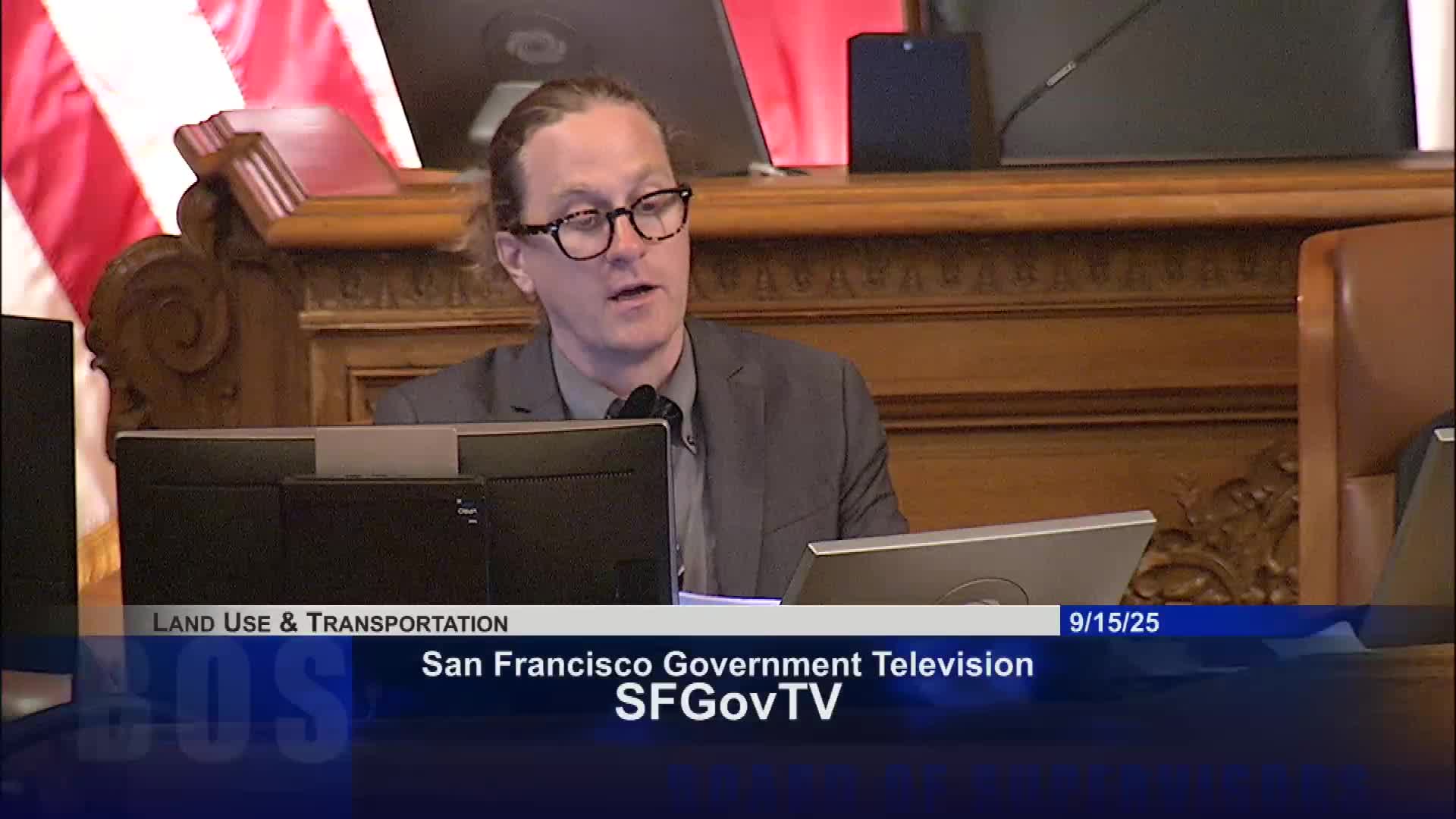
At its Sept. 15, 2025 meeting the Land Use and Transportation Committee of the San Francisco Board of Supervisors voted 3-0 to send to the full Board an ordinance that would amend the Public Works Code to authorize the Department of Public Works to remove graffiti on private properties in designated commercial corridors at no cost to property owners when the owner requests and authorizes the work and waives related claims.
Supervisor Mirana Melgar, chair of the committee, said she introduced the ordinance to “codify a pilot program that I also introduced during the pandemic, in 2022 that allowed the city to remove graffiti on private properties along commercial corridors.” Melgar said the pilot aimed to ease the burden on small businesses that faced fines or were unable to keep up with repeated vandalism.
The ordinance as described in the committee packet would allow Public Works to perform graffiti abatement on private properties in commercial areas solely at the property owner’s request, with the owner providing authorization and a waiver of claims. Melgar said the goal is timely removal so “it doesn't spread” and to protect commercial corridors from repeat tagging.
Vice Chair Supervisor Cheyenne Chen spoke in favor and added herself as a cosponsor, noting the program helps neighborhood shops: “Small business are still struggling to keep up with their enterprise,” and expressing support for ensuring neighborhood businesses can access the program. Wu Ju Chung, street inspection supervisor in Public Works code enforcement, identified himself for the record and was present to answer technical questions from the committee.
Committee members asked about the program’s geographic coverage and eligibility. Chen and Public Works staff said the program’s boundaries are based on planning-code designations for commercial corridors (generally where 50% or more of ground-floor properties are commercial). Public Works staff said exceptions can be made in places where individual businesses are repeatedly victimized by graffiti, and that the department will continue to refine coverage as the program moves from pilot to permanent.
There were no public speakers on the item. Chair Melgar moved to send the ordinance to the full Board with a positive recommendation; the motion passed on a roll call of Vice Chair Cheyenne Chen, Member Bridal Mahmood and Chair Mirana Melgar (3 ayes).
The committee did not provide further amendments; the measure will appear on the Board of Supervisors agenda on Sept. 30, 2025 unless otherwise noted.