Get Full Government Meeting Transcripts, Videos, & Alerts Forever!
Get email alerts on the Digital Government topic
No spam. Unsubscribe anytime.
County outlines digital-innovation push: new 'Fix It Marin' 311 app, rapid accelerator and service inventory
Summary
The county's newly hired chief digital innovation officer described quick-start digital projects including a 311 "Fix It Marin" pilot, a Marin Digital Accelerator and a civic-service inventory intended to improve constituent experience and speed delivery of digital services.
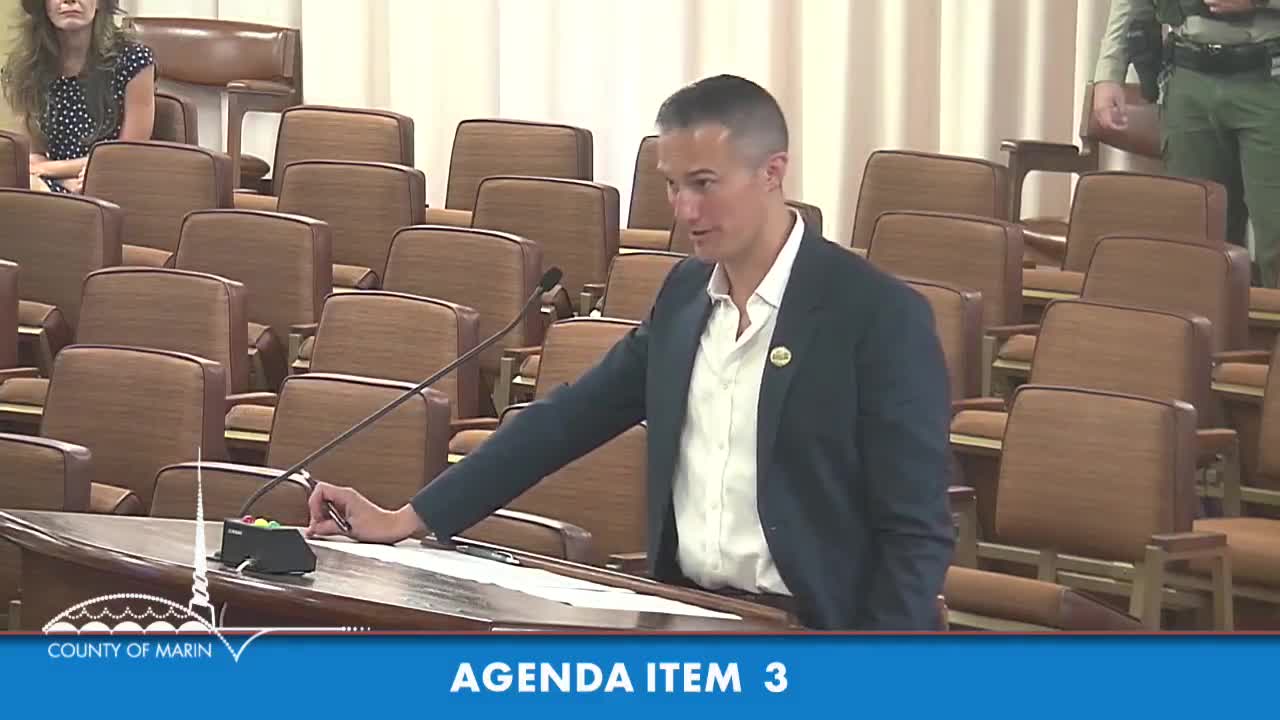
Crosby Burns, Marin County's newly appointed chief digital innovation officer, briefed the Board of Supervisors on a series of early efforts to modernize county services and improve constituent experience, including a rapid pilot of a 311-style app and a cross-agency Marin Digital Accelerator.
Burns said the county launched a pilot "Fix It Marin" app that compresses a typical two-year development timeline to a 2.5-month pilot for five Department of Public Works services, with a pilot launch planned for Sept. 29 in several communities. He described a "Marin Digital Accelerator," a 90-day, cross-disciplinary effort inside the Community Development Agency that pairs technologists, planners and user-researchers to rapidly prototype better permitting and notification workflows.
The county executive, Derek Johnson, and Burns said recent work also included a Civic Center Census of people visiting county buildings to better understand why constituents come to the Civic Center; Burns reported an initial inventory of more than 243 county services and said he believes the list now exceeds 300. Burns also described partnerships with US Digital Response to help with restaurant change-of-ownership experiences and a Harvard Business School volunteer project to map enterprise platforms and identify underused investments.
Supervisors expressed support for accelerating user-focused digital improvements. Burns said the aim is to make county services both "human forward" and tech-enabled, shorten delivery timelines, and break internal silos that slow service delivery. There was no board vote on the presentation.