Get Full Government Meeting Transcripts, Videos, & Alerts Forever!
Get email alerts on the Artificial Intelligence Governance topic
No spam. Unsubscribe anytime.
Grand jury: modernize city tech governance for AI; committee advances response with amendments
Summary
The civil grand jury's "Techs in the City" report asked San Francisco to centralize technology governance, streamline procurement and clarify COIT's role. The GAO Committee amended and forwarded a response resolution on Sept. 18, 2025; the separate AI procurement hearing was continued to the chair's call.
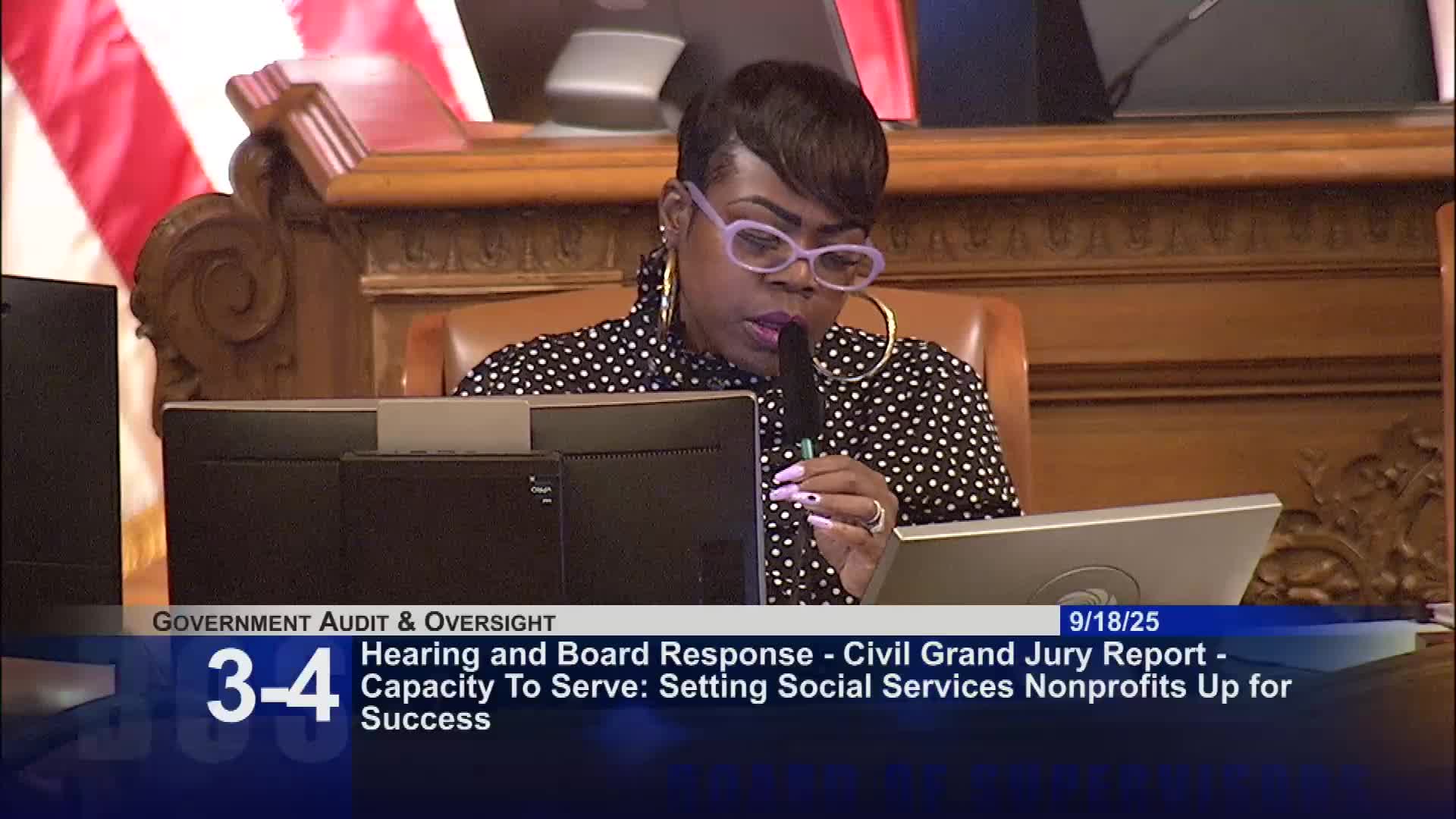
The Government Audit and Oversight Committee on Sept. 18, 2025, considered the civil grand jury's "Techs in the City: Government's Opportunity to Seize the AI Moment" and debated governance, procurement and procurement-risk controls for artificial intelligence and related emerging technology. The committee approved an amended response resolution (item 6) for the full Board of Supervisors and continued a related hearing (item 5) to the call of the chair.
Civil grand jury member Cameron Parker told the committee that rapid public adoption of generative AI and related technologies presents both opportunity and risk. "Doing nothing is a choice, and it does have cost," Parker said. The jury recommended clearer strategic leadership, stronger governance and a coherent road map for AI pilots, procurement and workforce training.
Major points and departmental responses
- Governance and procurement: The jury found that San Francisco's federated technology management and procurement structures have slowed pilots and created duplication. The report recommended consolidating governance where appropriate and empowering a central technology authority to set enterprise procurement standards and interoperability expectations.
- COIT critique: The jury recommended eliminating or substantially revising the Committee on Information Technology (COIT), arguing it lacks executive authority and does not consistently steer departmental technology plans. The mayor's office and COIT leadership disagreed with outright elimination, instead recommending structural clarifications and enhanced reporting and accountability. The committee ultimately amended the response to recommend structural improvements to COIT rather than abolition.
- Department action and pilots: The city's mayoral staff said the administration has been cautious but active: the mayor's office hired a director of emerging technologies, the city has rolled out Microsoft CoPilot capabilities to many employees, and DT pilots include ChatGPT experiments, 311 AI trials and translation tools. Jane Gong, director of emerging technologies, said the DT team is drafting a citywide AI playbook that will emphasize problem definition, data quality, equity, labor impact and environmental considerations before procurement.
- Transparency and inventory: The Department of Technology and the mayor's office noted an existing public inventory of deployed AI tools on the city's open-data portal (28 tools published at the time of testimony under the city's AI-transparency ordinance, Administrative Code chapter 22J). Jane Gong said the team plans a fuller inventory report to the Board by January 2026.
Actions taken at the hearing
- The committee approved amendments to the response resolution on item 6 and forwarded the amended item to the full Board of Supervisors with a positive recommendation (recorded vote: Vice Chair Janie Sauter, aye; Member Steven Sherrill, aye; Chair Cheryl Felder, aye).
- The committee continued item 5 (the separate AI hearing) to the call of the chair to allow further deliberation and for departments to deliver additional materials.
Policy implications and concerns raised
- Public trust and civil liberties: Several supervisors and public commenters stressed that even well-intentioned pilots can damage public trust if transparency and privacy safeguards are not built in. Chair Felder stressed that "we cannot absolve ourselves of the responsibility" to ensure ethical and transparent adoption.
- Environmental and labor impacts: Committee members asked whether AI procurement KPIs should include environmental costs (data-center energy use) and labor impacts. The jury and DT staff acknowledged those concerns and recommended including sustainability and workforce metrics in any comprehensive procurement framework.
Ending and next steps
The committee's amended response will go to the full Board of Supervisors for consideration. Departments agreed to produce further documentation on the COIT role, the DT AI playbook, the city's AI tool inventory and procurement guidance; the committee continued the separate AI hearing to allow that follow-up work.