Get Full Government Meeting Transcripts, Videos, & Alerts Forever!
Get email alerts on the Street Safety topic
No spam. Unsubscribe anytime.
Civil Grand Jury faults enforcement shortfalls in Vision Zero report; supervisors forward response resolution
Summary
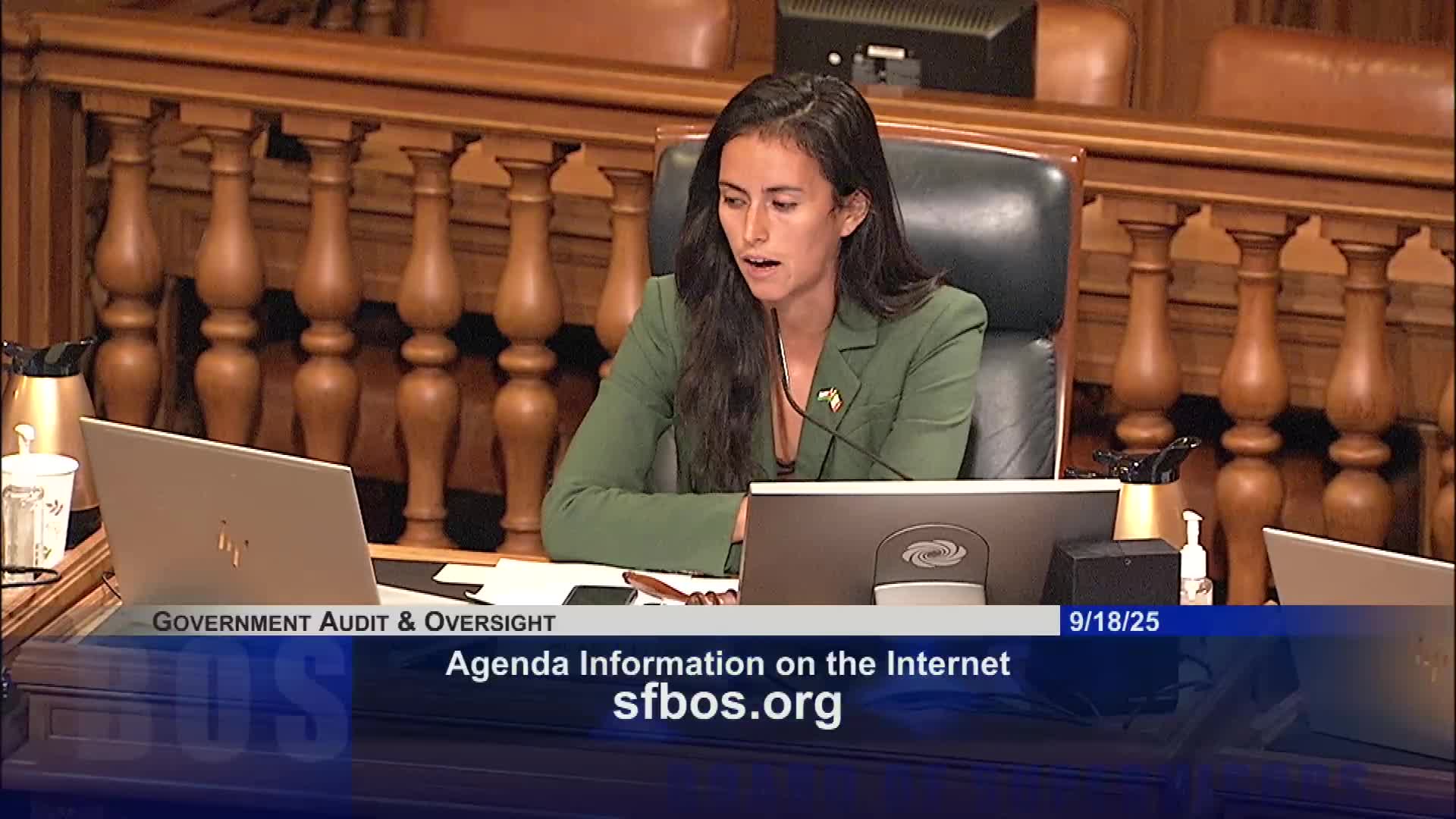
The Government Audit and Oversight Committee of the San Francisco Board of Supervisors on Sept. 18, 2025, heard the civil grand jury's "Failed Vision" report on street safety, filed the report and forwarded a response resolution to the full board after discussion about enforcement shortfalls, fragmented data, and technical barriers to ticketing.
The Government Audit and Oversight Committee of the San Francisco Board of Supervisors on Sept. 18, 2025, heard the civil grand jury's report "Failed Vision: Revamping the Roadmap to Safer Streets," filed findings about drops in traffic enforcement and data problems, and forwarded a response resolution to the full Board of Supervisors.
The civil grand jury foreperson, Michael Carboy, told the committee the jury's investigation found that "the San Francisco Police Department systematically failed to adequately enforce traffic regulation, with ticketing down 95 since 2014," and that the shortfall has real-world consequences: "This is more than a statistic. It means broken bones, hospital experiences, and loved ones in caskets." The committee filed the report (item 1) and sent a related response resolution (item 2) to the full board for consideration.
Why it matters: The jury tied fewer traffic citations and fragmented enforcement data to higher risk on city streets, and recommended a mix of improved enforcement expectations, modernized citation and collision-reporting technology, area-based engineering (includingÂ"hardened daylighting"), and sustained, neighborhood-focused outreach to rebuild community buy-in.
Most important facts
- Findings: The civil grand jury concluded that SFPD enforcement declined sharply over the last decade and that traffic enforcement must be re-emphasized as part of a broader safe-systems approach. Foreperson Michael Carboy said the jury's work found enforcement is a central failing in Vision Zero outcomes.
- Enforcement data and technology: Report presenter Kate Blumberg explained to the committee that enforcement and collision data are publicly available but difficult to use because they are published as PDFs; officers often avoid the department's eCite mobile ticketing system because printers and software do not reliably work in the field. Blumberg said of eCitations and collision reporting, "it's miserable" and that the current paperwork process "really hampers the ability and the interest in an officer taking on that role."
- Police response: Captain Pete Shields of the SFPD's traffic division acknowledged antiquated technology and said the department is pursuing technical integrations so eCite data will feed required state benchmarking systems and the courts. Shields said the traffic division has increased directed enforcement and that recent citation counts are up compared with 2024 levels, but he stressed that motorcycle and other equipment are aging and staffing remains constrained.
- SFMTA engineering and outreach: Shannon Hake, SFMTA livable streets program manager, described projects completed or underway: daylighting at roughly 2,000 school intersections this summer; automated speed-camera warnings and citations (more than 300,000 warnings and then roughly 20,000 citations since switching to citation enforcement in August); signal timing and pedestrian head-starts; and planned expansion of daylighting citywide with updated 20-foot standards.
- Mayor's office: Sofia Kittler, director of the Mayor's Budget Office, said the administration largely agreed with the jury's findings about enforcement declines and outdated collision-reporting technology. Kittler said the mayor's office and departments are revising the 2025 traffic enforcement plan and will review enforcement tools and modernization requests through the budget process.
Key context and details
- Citations timeline: The jury and department witnesses discussed a decade-long drop in citations: more than 120,000 citations in 2014, a steep decline through the 2010s, about 4,000 in 2022 (as cited in the report), then an increase to roughly 15,000 in 2024 as enforcement resumed. The traffic division said recent year-to-date citation totals were about 30% higher than 2024 levels but remain well below mid-decade numbers.
- Admonishments and data gaps: Captain Shields explained that officers often give verbal admonishments or written "admonishments" that are not included in published citation tallies; those actions are currently hard to quantify in published data because the systems do not capture them consistently. He estimated admonishments might represent roughly 20% of enforcement contacts in some operations.
- Legal/formal limits: The committee discussed state rules that require certain paper notices; Captain Shields cited California Vehicle Code section 40518 when explaining why some elements of citation workflow still require paper documentation.
What supervisors said
Vice Chair Janie Sauter, who led questioning on the report, emphasized the human costs reported by the jury and pressed agencies on eCite functionality, printer reliability and why officers often default to paper. Supervisor Steven Sherrill asked about how admonishments were recorded and whether increases in admonishments offset citation declines (department and jury testimony said they do not fully account for the long-term decline in enforcement). Chair Cheryl Felder (committee chair) moved the committee actions and thanked the jury and departments for their work.
Actions taken at the hearing
- The committee voted to amend the proposed response resolution to the presiding judge (item 2); the motion passed (recorded vote: Vice Chair Janie Sauter, aye; Member Steven Sherrill, aye; Chair Cheryl Felder, aye).
- The committee voted to send the amended resolution (item 2) to the full Board of Supervisors with a positive recommendation (recorded vote: Vice Chair Janie Sauter, aye; Member Steven Sherrill, aye; Chair Cheryl Felder, aye).
- The committee voted to file the civil grand jury report (item 1) (recorded vote: Vice Chair Janie Sauter, aye; Member Steven Sherrill, aye; Chair Cheryl Felder, aye).
Next steps
The committee sent the response resolution to the full Board of Supervisors for consideration on the board agenda (item 2). The hearing record also signaled upcoming follow-up at the Board's Public Safety and Neighborhood Services Committee where staff and departments will be asked for additional details on enforcement tools, eCite and data integration.
Ending
Committee members and the jury emphasized that progress so far is a mix of early operational improvements and remaining gaps: better automated enforcement and daylighting work are underway, but the jury and department witnesses agreed that improved incident-level data and reliable mobile citation technology are necessary to make enforcement a measurable, sustainable element of street-safety strategy.