Get Full Government Meeting Transcripts, Videos, & Alerts Forever!
Get email alerts on the Marion Assessor Budget 2026 topic
No spam. Unsubscribe anytime.
Marion County assessor outlines 2026 budget, reassessment plan and GIS responsibilities
Summary
Assessor Joseph O'Connor presented the office's 2026 budget, detailed staffing levels and explained a four-year cyclical reassessment plan and the assessor office's role in maintaining ownership layers of the county GIS.
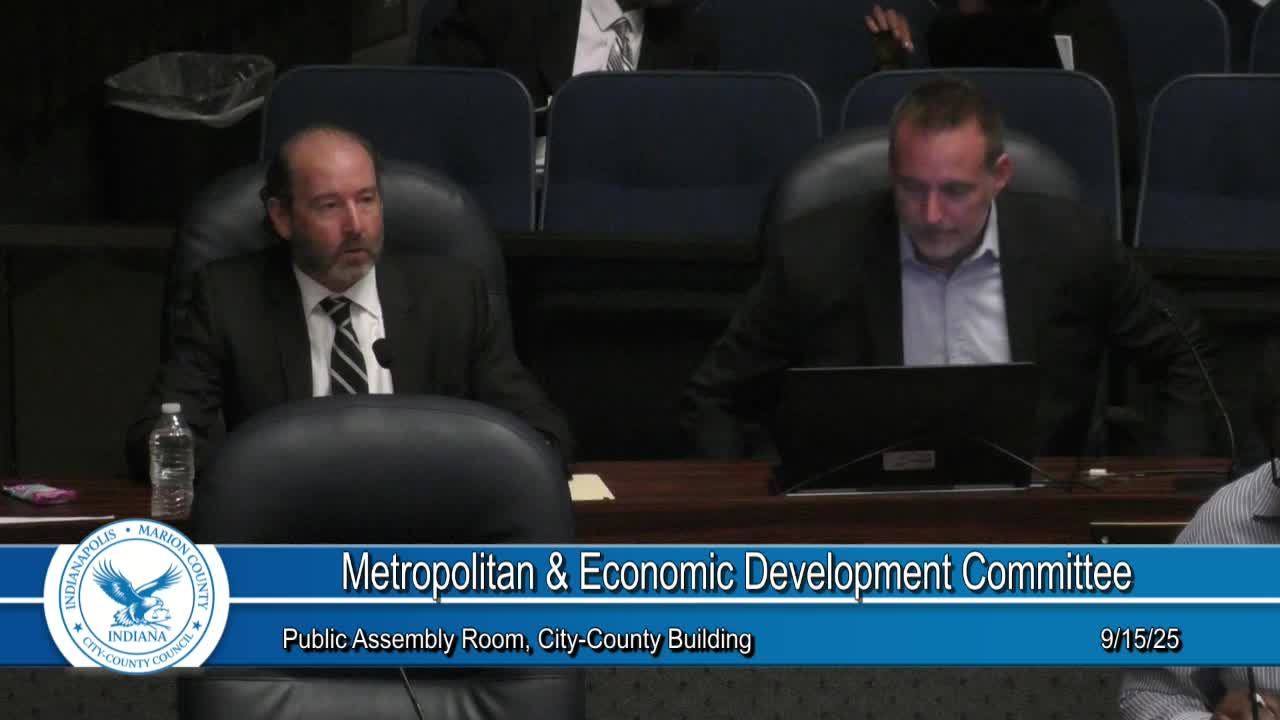
Joseph O'Connor, Marion County assessor, and senior staff presented the assessor's introduced 2026 budget to the Metropolitan and Economic Development Committee on Sept. 15, describing staffing, reassessment scheduling, GIS responsibilities and the budgetary changes for 2026.
O'Connor said the assessor's office has 93 full-time positions, with 75 currently filled and 18 vacant, and described staff diversity and internal training through an "assessor university" program. He said staff promotions from within and telework policies remain in place.
On reassessment, O'Connor said the office is conducting cyclical reassessment that covers one quarter of Marion County each year, completing a full reassessment in four years. He distinguished cyclical reassessment (parcel-level reviews to reflect physical changes) from annual adjustments or trending (neighborhood-level value changes based on recent sales). "When we're speaking to reassessment, we're changing those on a parcel level," O'Connor said, noting the office uses sales data and parcel-level reviews to adjust assessments.
O'Connor described the assessor's role in GIS: the assessor's office maintains the ownership (cadastral) layer, updating boundaries and ownership lines when deeds or plats change; other agencies provide complementary layers. In response to a councilor's question about drones, O'Connor said the office currently does not use drones but relies on desktop review, aerial photography overlays to detect changes and "boots on the ground" field visits in areas where imagery is insufficient.
On the budget, O'Connor reported character-level details including Character 1 (wages and benefits) totaling $5,484,593, an increase of $250,001 in 2026 largely attributable to funding current staffing at COLA and benefits levels. Character 2 (supplies) and Character 4 (capital) were effectively flat; Character 3 (other services and charges) decreased by about $14,502. The office said it has met the DLGF certification schedule required by state law and has assigned commercial appeals to analysts for timely handling.
Why it matters: Reassessment schedules, staffing and appraisal resources affect how property values are calculated and how quickly taxpayers can have appeals resolved; GIS ownership data maintained by the assessor underpins tax billing and public map services.
Councilor questions addressed the assessor's GIS role, frequency of reassessments and methods for detecting physical changes to properties. The committee received the presentation and did not take a budget vote at the meeting.