Get Full Government Meeting Transcripts, Videos, & Alerts Forever!
Get email alerts on the Marion Recorder Budget 2026 topic
No spam. Unsubscribe anytime.
Marion County recorder presents 2026 budget emphasizing digitization and fraud outreach
Summary
Recorder Faith Kimbrough outlined a 2026 budget that includes continued digitization of records, a new same‑day recording pickup process, community fraud-prevention outreach and a small overall budget increase driven by COLA.
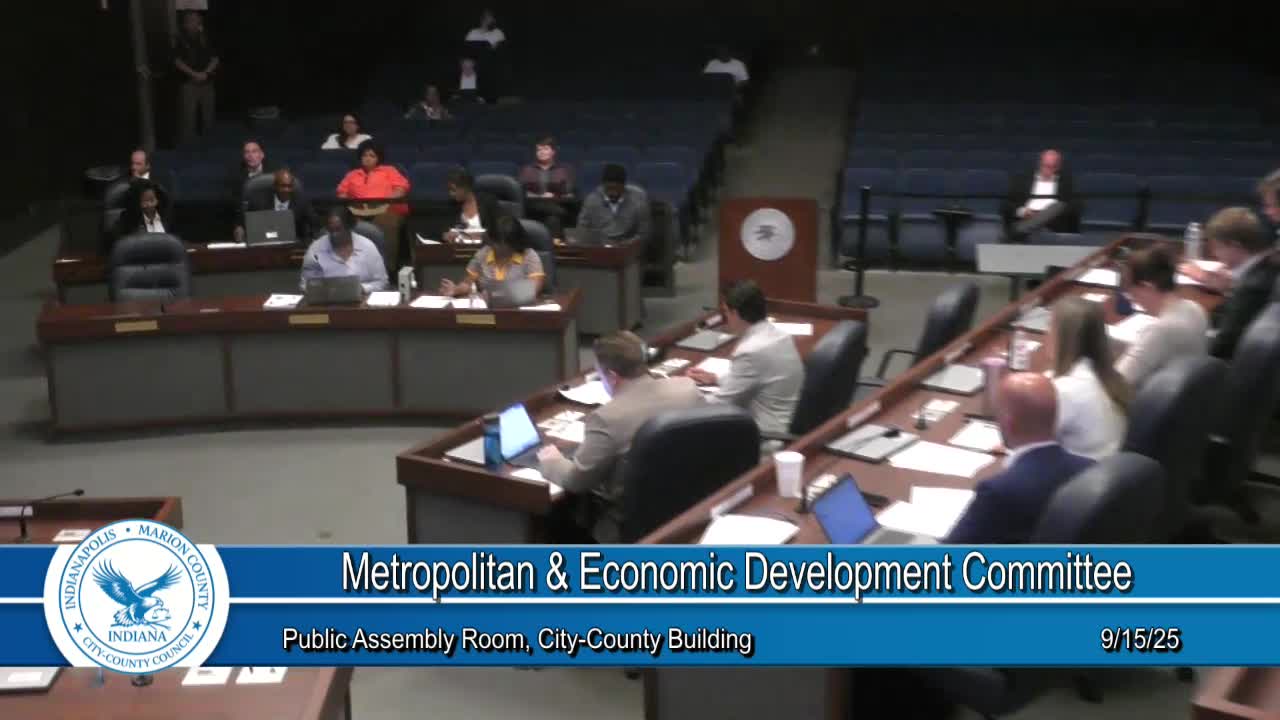
Marion County Recorder Faith Kimbrough and Chief Deputy J.R. Reiter presented the recorder's introduced 2026 budget to the Metropolitan and Economic Development Committee on Sept. 15, outlining plans to expand digitization, launch a same-day document pickup process and fund fraud-prevention outreach.
Kimbrough said the recorder's office has preserved more than 11 million records since 1821 and currently staffs 17 positions, with an open executive assistant role expected to be filled by the end of 2025 or in early 2026. Chief Deputy Reiter described staffing and training investments and said the office completed professionally produced position-specific training videos in 2023.
Starting in October, the recorder plans to implement "doc numbers up front," a recording process that will let customers receive recorded documents the same day they are submitted; previously customers had to wait 24 hours. Kimbrough described the change as a cost-saving and customer-service improvement that will also reduce the need for individual desk printers and related supply costs.
Kimbrough described community outreach and fraud-prevention efforts including a monthly show, On the Record, produced with Channel 16; translated materials and signage in underserved neighborhoods; a free fraud-alarm service; and participation in National Night Out alongside law enforcement. She said the office aims to expand public education and reported a goal to reach 1 million residents; at the time of the presentation she said the office had reached about 987,000 in its outreach metrics.
The recorder also intends to invest a portion of its perpetuation fund in a Trust Indiana account at the Marion County Treasurer to generate revenue for property-fraud prevention and veteran outreach; the office said the investment is expected to generate roughly $3,500 per month in interest revenue for those programs.
On digitization, the recorder reported records are currently indexed back to 1961 and said the office plans to expand its digitization project to reach records back to at least 1920. The office said an earlier county allocation for digitization (reported previously as roughly $150,000–$200,000) completed indexing through 1961.
On the introduced 2026 budget, the recorder said the overall budget increased by $4,787, driven by the cost-of-living adjustment (COLA). Staff noted a typographical error in printed materials for the perpetuation fund figure; the correct 2026 perpetuation fund balance shown on the presentation screen was $1,915,820.
Why it matters: Faster recording, expanded digitization and targeted fraud-prevention outreach affect property owners' ability to verify and protect title records and reduce barriers for residents — particularly in underserved communities — to access recorder services.
Questions from councilors focused on digitization progress and e-certification options on the office’s website; the recorder said digitization is ongoing and pointed to the e-certification feature at indy.gov/recorder that provides PDF delivery of documents.
The committee heard the presentation but took no budget vote at the meeting.