Get Full Government Meeting Transcripts, Videos, & Alerts Forever!
Get email alerts on the Impd Budget topic
No spam. Unsubscribe anytime.
IMPD seeks $358.6 million in 2026 budget; council clashes with administration over fleet, staffing and transparency
Summary
Chief Randall Bailey presented IMPD’s $358.6 million 2026 introduced budget, emphasizing recent declines in violent crime and investments in technology, while council members probed an administration decision to omit a requested vehicle‑replacement loan payment and pressed for staffing and data transparency.
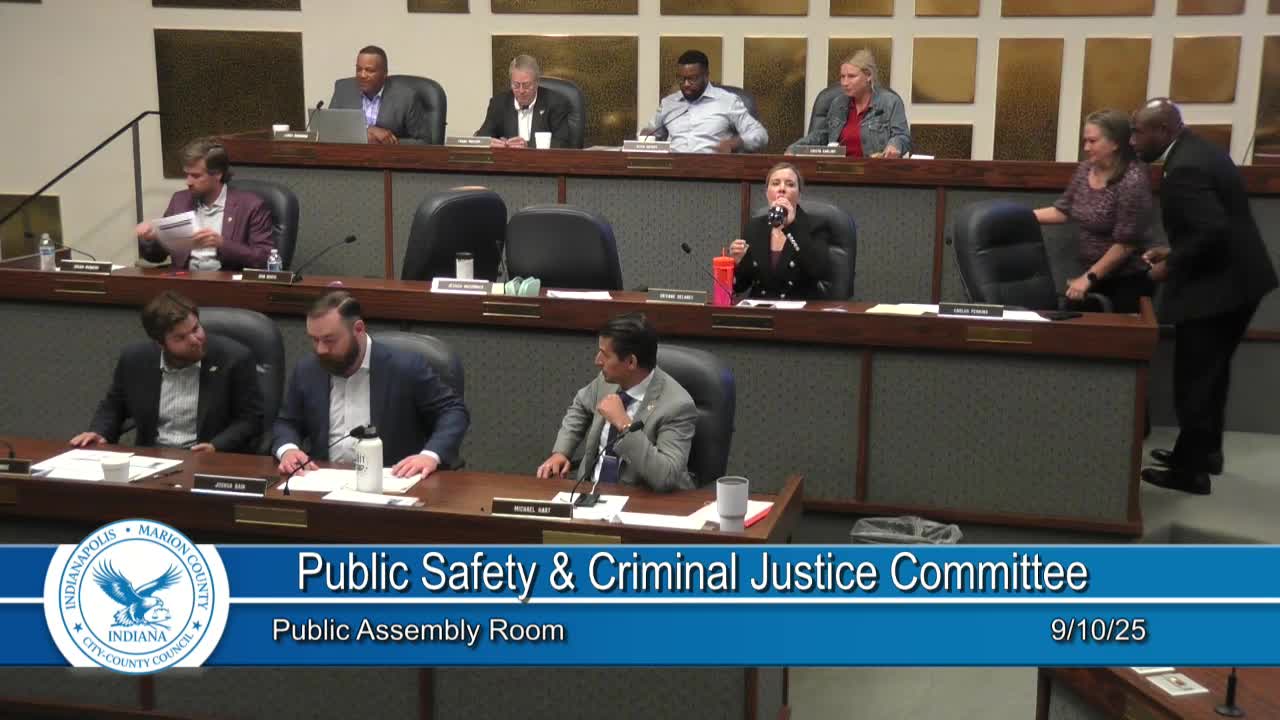
The Indianapolis Metropolitan Police Department presented its 2026 introduced budget to the Public Safety and Criminal Justice Committee, emphasizing recent crime‑reduction metrics, investment in technology and ongoing recruitment, while councilors and public speakers pressed the department and administration on fleet funding, staffing targets and data transparency.
Chief Randall Bailey opened the presentation by citing year‑to‑date and multi‑year trends he described as measurable reductions in violent and property crime. Bailey told the committee “murders in Indianapolis have fallen 50% since 2021” and said overall violent crime and property crime were both down year to date. He described the department’s gun‑violence reduction strategy — including the Crime Guns Task Force, the real‑time crime center and partnerships with public health and community organizations — as central to the department’s approach.
Chief Bailey and CFO Deb Hall presented the department’s introduced budget total of $358,586,352. They reported 1,409 sworn officers on staff versus an authorized strength of 1,743 (leaving several hundred vacancies) and said the budget assumes multiple recruit classes in 2026 (the department discussed plans for at least three classes and said it hoped to hire 120 recruits or more in the year). The department told the committee that vacancies are currently funding overtime; CFO Hall said about 184 vacancies were budgeted for overtime coverage while recruit classes will use other portions of the personnel appropriation.
Technology and analysts received emphasis in the presentation. Bailey described the real‑time crime center and analysts as “force multipliers,” credited them with solving crimes and removing illegally possessed firearms, and said technology investments make officers safer and more efficient. Grants and federal funding were discussed, including state support for the Crime Guns Task Force, Justice Department funding for violence intervention services, and ongoing pursuit of UASI and AFG grants.
Multiple councilors pressed the department on fleet planning and an administration decision to omit a requested vehicle loan payment from the introduced budget. Chief Bailey told the committee that the department had requested an additional loan payment — discussed in the hearing as roughly $1.5–2.0 million depending on estimates — to maintain the vehicle replacement rotation; he warned that stopping the replacement cycle would increase vehicle repair costs and diminish recruit and retention efforts. Council members including Leader Mowery, Councilor Kelsey Honi and others urged the administration and OFM to identify options to restore at least part of the fleet request, noting officers cited vehicle condition in exit interviews and that vehicle reliability affects response and safety. The department said it would provide follow‑up figures, including the expected proceeds from selling surplus vehicles (presenters estimated roughly $300,000, market dependent) and the net delta to restore the loan payment.
Council members and presenters also discussed officers’ use of overtime and off‑duty employment, the reach and hours of Mobile Crisis Assistance Teams (MCAT), and whether major events such as the Indianapolis 500 reimburse the city for the full cost of policing. The department said MCAT units operate roughly from 6 a.m. to 6:30 p.m. and that there are seven MCAT teams (one district has two teams). On special events, Chief Bailey said the department staffs hundreds of officers for race week and other large events and that reimbursement for event security depends on contractual arrangements with venues (the department said some off‑duty work inside private venues is paid by those organizations but that the city does not receive a direct reimbursement for every event policing hour it provides across Marion County).
Public comment reflected a wide range of viewpoints: Local 416 urged approval of the fire budget earlier in the meeting; community groups (including the Black Church Coalition and Live Free Indiana) urged more fiscal scrutiny and called for investments in alternative crisis responses rather than relying solely on police; other speakers urged tougher criminal penalties and more police resources. Several speakers raised privacy concerns about license‑plate reader and in‑car camera vendor relationships (Flock Safety), asking for assurance that data is not being shared with federal immigration enforcement; Chief Bailey said local policy controls data sharing and that the department does not share Flock data with ICE or similar federal immigration enforcement.
No formal vote was taken. Committee members asked for follow‑up, including detailed vehicle‑fleet financials, a historical staffing chart, vacancy and overtime breakdowns, clarification on grant carryover and reimbursements for special events, and confirmation of crime statistics by full calendar years versus year‑to‑date figures.