Get Full Government Meeting Transcripts, Videos, & Alerts Forever!
Get email alerts on the Fire Department Budget topic
No spam. Unsubscribe anytime.
Fire department presents $283.3 million 2026 budget, flags SAFER grant rolloffs and station projects
Summary
Indianapolis Fire Department outlined personnel, grants and capital plans for 2026, citing a 4.5% increase driven largely by SAFER grant transitions and salary commitments; fire leaders highlighted accreditation and community risk programs.
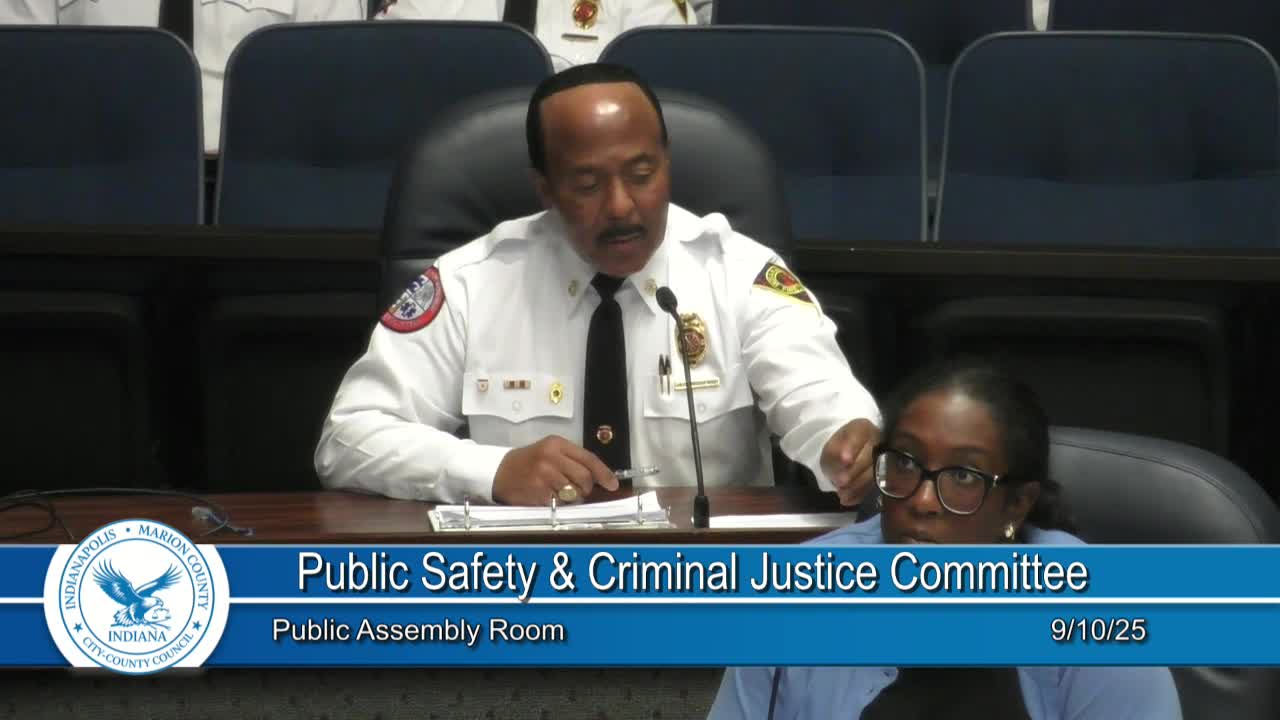
Fire Department leaders presented the Indianapolis Fire Department’s introduced 2026 budget to the Public Safety and Criminal Justice Committee, describing personnel needs, the end of key grant funding, capital plans and community safety programs.
Chief Malone (Indianapolis Fire Department) and the department’s CFO, Dawn Sykes Bridal, told the committee the 2026 introduced budget totals $283,300,000 and represents an approximate 4.5% increase over the 2025 revised budget. The department said the largest driver of the personnel increase is the end of a SAFER grant that currently funds 50 firefighters; those positions will need to be absorbed into the general fund beginning in 2026 unless new federal funding is awarded. Malone said another SAFER grant that funds 50 firefighters expires in January 2027 and the department has a pending SAFER application that, if awarded, would fund an additional 50 positions for a January 2026 recruit class.
Bridal described funding sources and the department’s approach to grants: the department seeks federal grants for task force deployments, equipment and training and has secured roughly $57,000,000 in grant awards over the past decade. She told the committee that the fire general fund pays most operating costs and that the department collected between $500,000–$600,000 in revenue from inspections and plan reviews.
Chief Malone highlighted staffing and operations details: the department reported an authorized staffing level (recommended) of 1,276 firefighters with a day‑of staffing figure that varied slightly in the slides (12,64–12,76 depending on snapshot used); the department said about 94% of firefighters are stationed at neighborhood stations, and it operates 88 frontline apparatus. Leadership described ongoing and planned capital projects including station replacements (Station 32 in Broad Ripple, Station 20 on North Emerson, and a proposed Station 33 replacement) and ongoing work on a 20‑year station replacement plan that aims for 10 new stations over two decades.
The department said it recently completed international reaccreditation and holds an ISO Class 1 rating, placing it among a small number of U.S. departments with both distinctions. Chief Malone also described programs and outreach: a College Bridge program that translates department training into college credits, smoke detector distribution and installation efforts, “smoke detector blitzes,” community risk reduction teams, expanded technology (including software purchases) and a planned PulsePoint rollout to improve cardiac arrest response.
On personnel costs, Bridal said the introduced budget reflects a planned 2026 personnel increase of roughly $6,000,000 related to the SAFER grant transition and an additional projected $5.5 million to cover collective bargaining cost increases, civilian cost‑of‑living adjustments and a pension contribution increase. The department noted it is not a revenue‑generating department and relies mainly on property and income taxes.
Union leadership (Local 416) provided public comment in support of the budget, emphasizing continued funding for health and wellness programs and the planned recruit class to maintain station staffing. Committee members asked about residency of firefighters, station apparatus placement, and the department’s approach to grant applications and equipment lifecycle planning. Malone and Bridal said they will provide follow‑up details (for example, counts of firefighters living outside Marion County) if requested by councilors.
No formal committee vote was taken. The presentation will inform subsequent budget deliberations and any council decisions on amendments.