Get Full Government Meeting Transcripts, Videos, & Alerts Forever!
Get email alerts on the Disability Access Traffic Stops topic
No spam. Unsubscribe anytime.
Marion County rolls out 'Blue Envelope' for drivers with disabilities to ease traffic stops
Summary
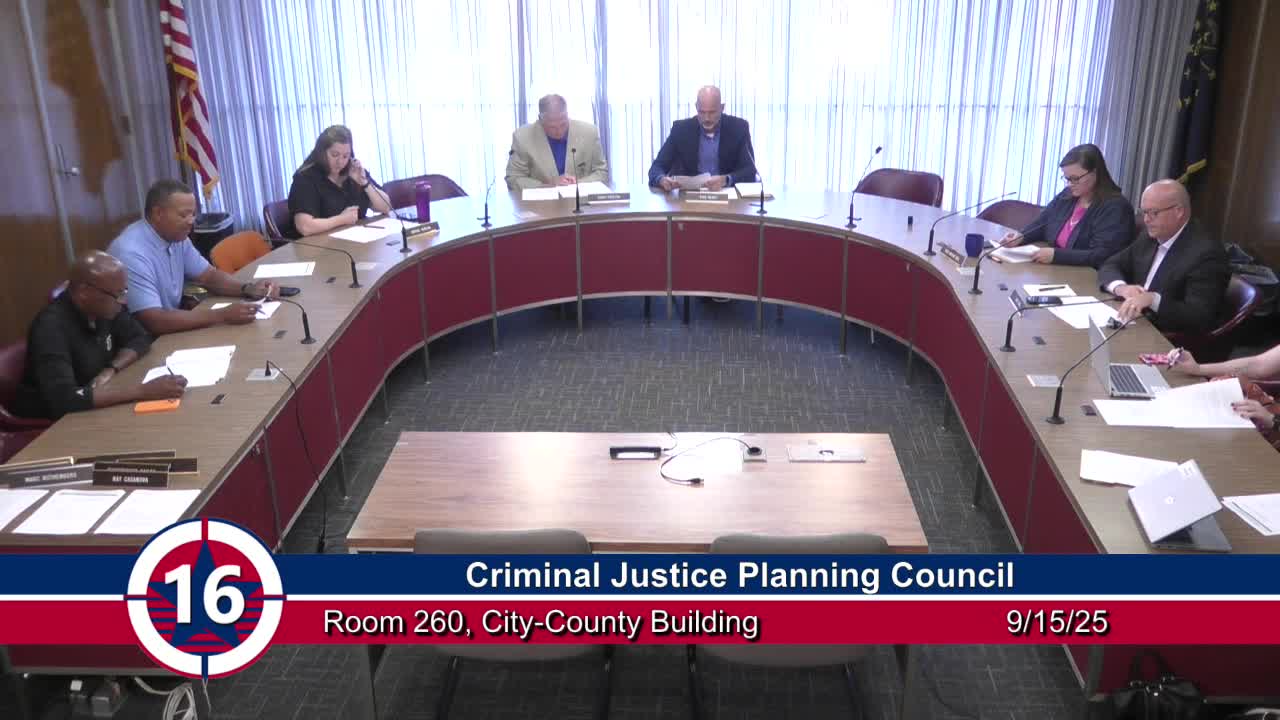
Marion County prosecutors and the Arc of Indiana described the Blue Envelope program at the Sept. 15 Criminal Justice Planning Council meeting, saying the packets — distributed statewide since April — are intended to speed communication and reduce risk during traffic stops for drivers with disabilities.
Marion County prosecutors and disability advocates described a new program aimed at making traffic stops safer for drivers with disabilities during the Sept. 15 meeting of the Criminal Justice Planning Council.
Natalie Miller, constituent services coordinator at the Marion County Prosecutor's Office, said the Blue Envelope provides a visible place for drivers to keep medical information, accommodations and guidance officers can use during a traffic stop. "It's a place where they can list their medical accommodations and any considerations they might have," Miller said, adding that the envelope helps officers understand that some reactions to lights or sirens may reflect a disability rather than intentional resistance.
The program launched in April and, Miller said, the office has distributed 543 envelopes to date. Miller said early publicity generated rapid demand: "We had over 300 requests in that first couple of weeks" after media interviews and social media promotion.
Kim Dodson, chief executive officer of the Arc of Indiana, said the organization reviewed materials with people with disabilities and helped assemble an included resource list. "This program has given people a lot of peace of mind as they are driving," Dodson said. She added that families of people with disabilities have reported the envelope reduces stress during stops because it allows the driver or a family member to quickly show an officer information about communication needs or sensory sensitivities.
Miller said the Arcp partnership and outreach also included a co-hosted webinar that produced an influx of requests. She said the Indianapolis Metropolitan Police Department (IMPD) was an early partner; Miller met with IMPD’s chief and, she said, the department incorporated information about the Blue Envelope into training through either a web-based video or routine in-service training.
The envelopes are bilingual in Spanish and English; Miller said Marion County worked with a Latino services director, Maria Wildridge, to produce Spanish-language materials. The packet also includes guidance for drivers and brief instructions for officers. Miller said the materials recommend clipping the envelope to the vehicle visor so drivers do not have to rummage in a glove compartment.
Council members and law enforcement representatives at the meeting suggested complementary outreach ideas — including bumper stickers or decals — and contrasted the Blue Envelope with other programs that notify officers about medical needs, such as the Yellow Dot program. Dodson and Miller said they are open to further coordination with other programs and with local enforcement to avoid confusion about signals and to encourage consistent recognition.
Miller said the prosecutor’s office and Arc of Indiana would continue outreach and that the program is intended as a lasting resource rather than a temporary campaign. No formal vote or policy change was recorded during the discussion.