Get Full Government Meeting Transcripts, Videos, & Alerts Forever!
Get email alerts on the Land Use topic
No spam. Unsubscribe anytime.
Wake Forest planning board OKs Wegmans PUD amendment to add 30 employee parking spaces, 5-0
Summary
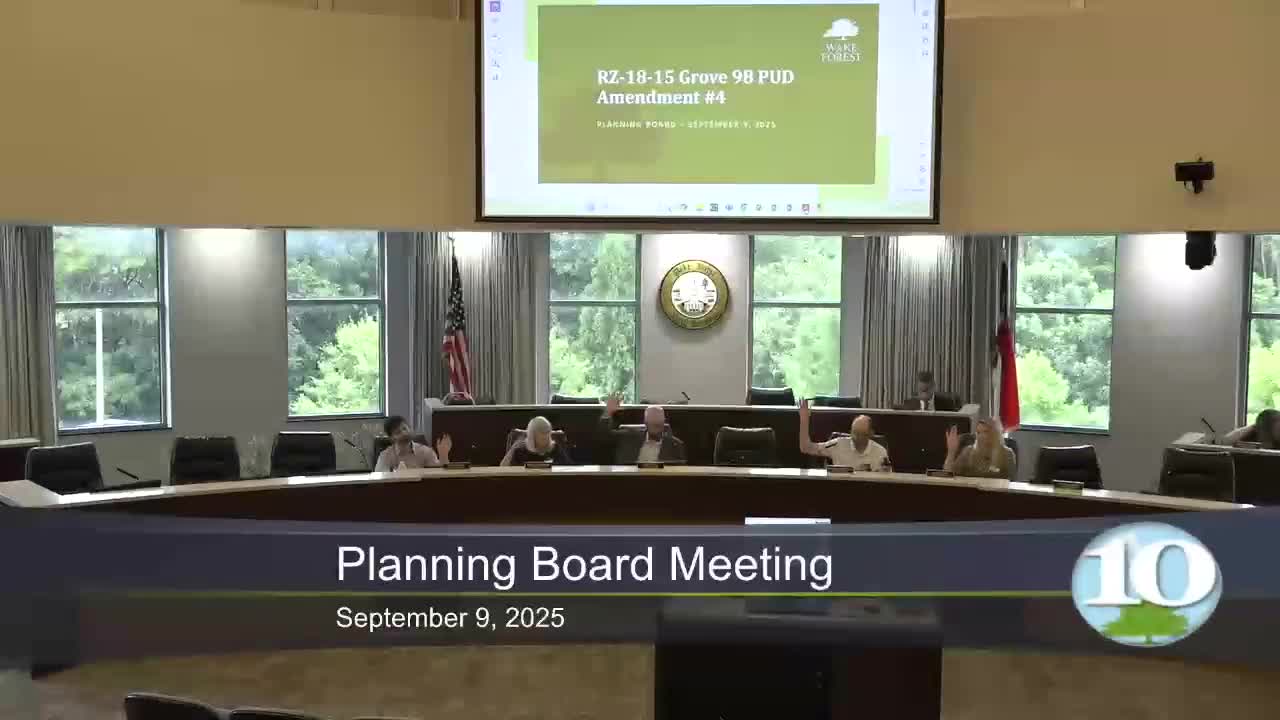
The Wake Forest Planning Board on a 5-0 vote recommended approval of Grove 98 PUD Amendment No. 4, allowing Wegmans to add an employee-only parking area between the store and Forbes Grove Way with permeable paving, expanded landscaping and an 80-foot driveway channelization in lieu of the UDO's 100-foot standard.
The Wake Forest Planning Board recommended approval of RZ-18-15, Grove 98 Planned Unit Development Amendment No. 4, by a 5-0 vote, allowing Wegmans Food Markets Inc. to add a 30-space, employee-only parking area on the west side of its store and related text changes to the PUD.
Planning staff had recommended denial. Tim Richards, planning department staff, told the board that the amendment “is generally inconsistent with the comprehensive plan and not in the public interest because it is inconsistent with community plan direction 4, commercial corridor areas, commercial area 5, parking lots, and community character.”
The applicant said the change is intended to address ongoing demand and to shift employee vehicles away from customer-facing spaces. Art Pierce, project manager for Wegmans site development, said the lot would be right-in only with a clockwise circulation and right-out exit and described the addition as a response to growth: “We have about 28,500 generally, for a year…4,000 a week is typical for all of our North Carolina division stores.” Jordan Peterson, design professional with Bolton & Mink for the project, said the proposal adds about 30 spaces — roughly a 5.7% increase in total parking — and that the new area would use pervious paving, bioretention/rain gardens, and twice the minimum tree plantings required by the UDO.
Board discussion centered on three technical trade-offs: (1) driveway channelization, where the UDO requires 100 feet of separation for large commercial sites and the applicant proposed an 80-foot measurement (applicant said an engineering concept supports roughly 83–85 feet as the practical maximum); (2) visibility and community character along the 98 Bypass; and (3) whether an “employee-only” designation would be enforceable by town staff. Richards confirmed the PUD text (section 6.2 of the proposed amendment) does identify the lot as employee-only, but also told the board that such a restriction would be difficult for town staff to enforce.
At public comment, resident Margaret Watkins opposed adding parking and urged more trees and use of greenway investments, saying the amendment “goes against the plans and the ordinances that we have in place” and questioned spending on greenways while adding parking.
The applicant emphasized mitigation measures included in the amendment: permeable vehicular-rated pavers for the parking spaces and drive aisle, rain gardens tied to three curb cuts for stormwater infiltration, and enhanced landscaping in the lot perimeter and bioretention cells. Peterson said the proposed parking area covers about 12,000 square feet of the site and that roughly 60% of the green area between the sidewalk and the building would remain as softscape.
Motion and vote: Miss Shepherd moved to approve RZ-18-15 Grove 98 PUD Amendment No. 4, finding the amendment reasonable and in the public interest; Mr. Almquist seconded. The board voted 5-0 in favor. The motion language and vote tally are included below.
Next steps and limits: The board’s favorable recommendation moves the amendment forward in the town’s approval process; the PUD text and attached figures show a plan for exactly 30 spaces as illustrated in the amendment package. Town staff noted they will continue discussions with the applicant about whether the employee-only language should remain in the binding PUD text, because staff generally avoids adding conditions it cannot enforce.