Get Full Government Meeting Transcripts, Videos, & Alerts Forever!
Get email alerts on the Drowning Prevention topic
No spam. Unsubscribe anytime.
Palm Beach County Fire Rescue and Drowning Prevention Coalition outline swim-voucher program and water-safety guidance
Summary
Amanda Vomero of Palm Beach County Fire Rescue and Anna Stewart of the Drowning Prevention Coalition described response-time metrics and a county program providing reduced-cost or free swim lessons and water-safety outreach; Stewart emphasized adult supervision and layers of protection around water.
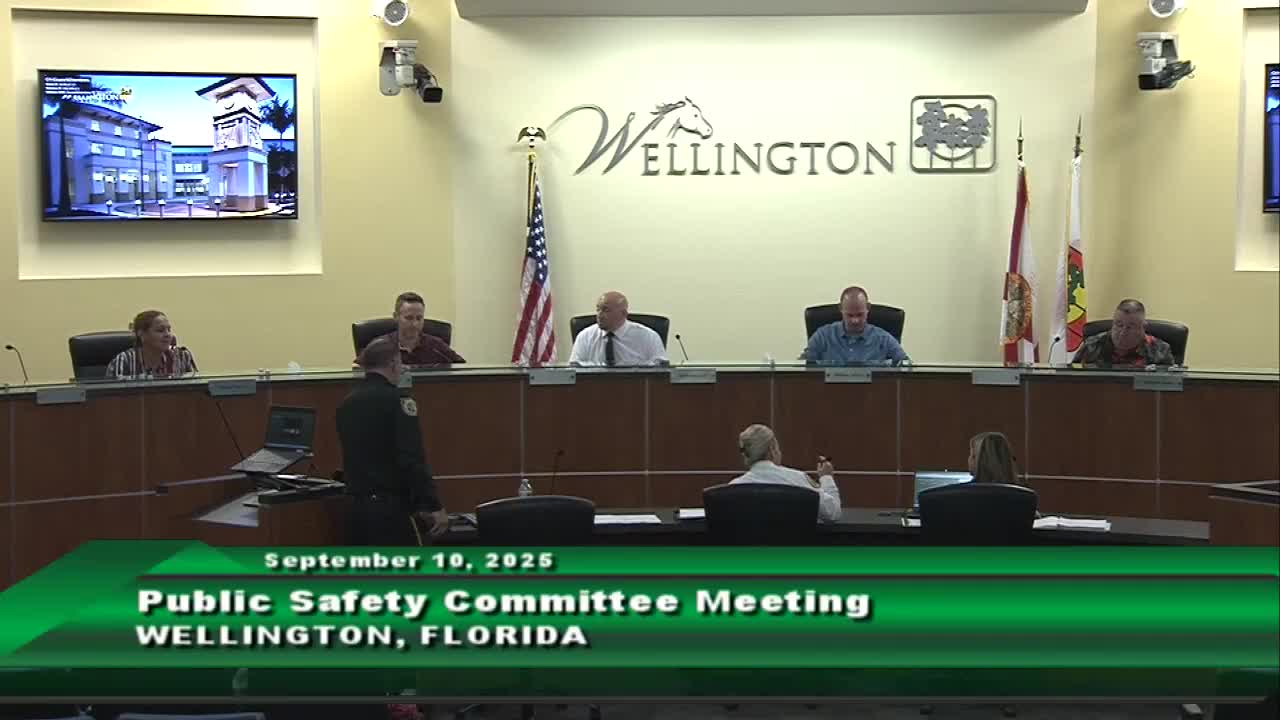
Amanda Vomero, district 28 representative for Palm Beach County Fire Rescue, presented the department’s recent response metrics to the Village of Wellington Public Safety Committee and introduced Anna Stewart, manager of the Drowning Prevention Coalition of Palm Beach County, who reviewed drowning-prevention outreach and swim-voucher programs.
Vomero told the Sept. 10 committee that from June 10 through Sept. 9 Wellington had 1,603 emergency response calls; average dispatch handling time and turnout time were each 45 seconds, average travel time was 5 minutes 9 seconds, and overall average response time was 6 minutes 39 seconds. Vomero said medical calls comprised roughly 75% of responses in that period.
Anna Stewart described the Drowning Prevention Coalition’s free and reduced-cost swim program, which countywide provides vouchers for swim lessons and is funded by the Palm Beach County Board of County Commissioners and the Children’s Services Council of Palm Beach County. Stewart said the program’s age eligibility had been expanded from 2–12 to 2–17. She said the coalition requires a caregiver or parent to attend one of its educational sessions to receive a voucher and that eligibility may be automatic for children with autism or based on participation in certain public-assistance programs (Medicaid, Florida KidCare, Healthy Kids, SNAP, Section 8) when not eligible through autism criteria.
Stewart stressed that drowning is often quick and silent and gave prevention guidance summarized by the ABCDs framework used by the coalition: adult supervision; bathroom/barrier/boat safety; calling 911 and classes (swimming and CPR); and drain/drive (safety around pool drains and escaping a sinking vehicle). She advised “reach or throw, don’t go” when rescuing a drowning person and recommended U.S. Coast Guard–approved life jackets rather than inflatable “floaties.”
During committee Q&A, members asked about voucher eligibility and starting ages. Stewart said aquatic facilities’ recommendation is to begin parent-and-child lessons at age 2; facilities typically issue one voucher for parent/child lessons at age 2 and additional vouchers at age 3. For children with autism she said programs may provide up to three vouchers. Vomero and Stewart offered to provide further county statistics and printed Be Water Smart booklets and said they can deliver free in-person or virtual water-safety presentations to schools, HOAs and community groups.
Stewart also noted that her coalition records drownings differently from the Florida Department of Health because the Medical Examiner’s determinations of drowning in motor-vehicle–into-water crashes are included in the coalition’s count but identified as motor-vehicle fatalities by state health statistics.