Get Full Government Meeting Transcripts, Videos, & Alerts Forever!
Get email alerts on the Government Audit Oversight topic
No spam. Unsubscribe anytime.
City auditor outlines expanded FY26 audit plan and recent completed reports
Summary
City Auditor Gilbert presented an expanded audit plan that includes new one-time audits (homelessness/housing; IT; revenue) and provided an update on completed audits and a special budget analysis.
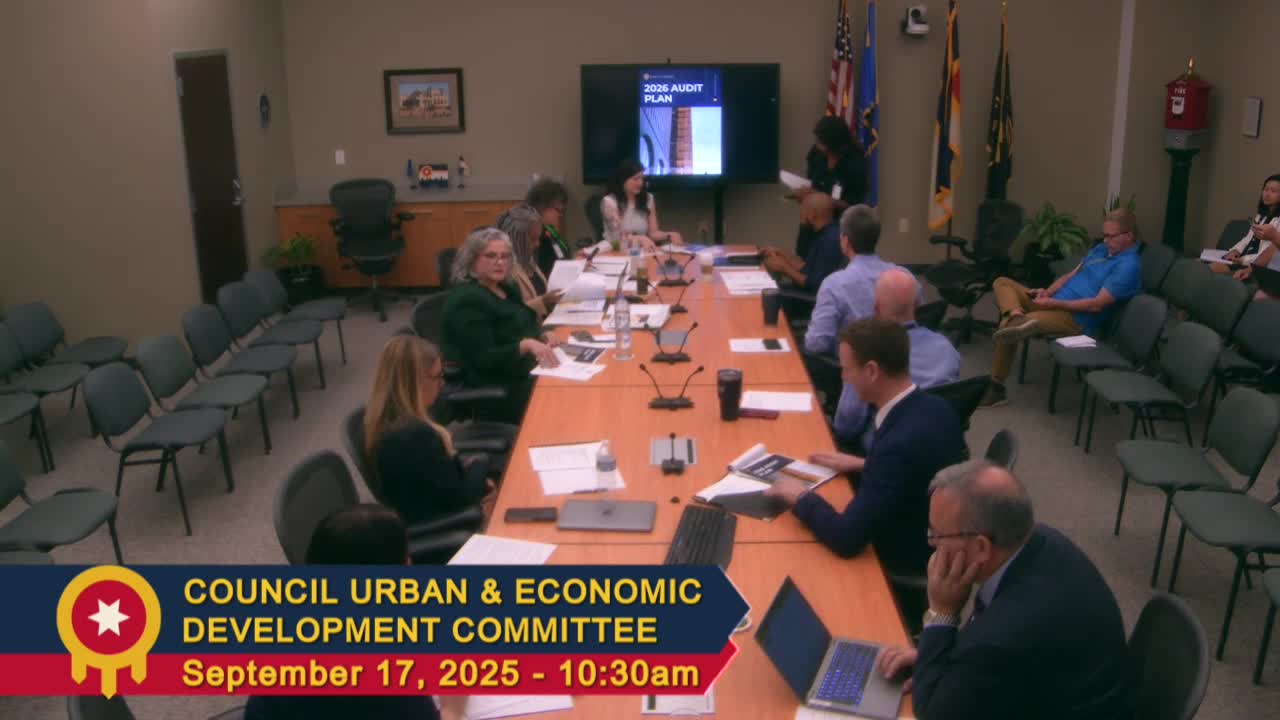
The city auditor appeared before the Urban Economic Development Committee on Sept. 17 to present the office’s audit plan and an update on completed work.
The auditor (identified in committee remarks as Gilbert) said the FY26 plan includes a mix of carryover audits—segregation of duties, purchasing and maintenance of assets, 311 customer service and community engagement—and several new one-time audits planned for the year, including homelessness and housing, revenue, utilities billing, and IT/business systems work. He said the office will perform risk refinements that include 2–3 weeks of community and employee engagement to focus each large audit where it will have the most impact.
Gilbert said the office is beginning an Authorities, Boards and Commissions audit next week and noted a larger set of one-time audits that may roll into FY27 depending on prioritization. He described the office’s intention to improve community-engagement methodology and said the audit team has added a deputy auditor with research and community-engagement experience to help design representative surveys and outreach.
The auditor also summarized completed audits and a special project: a budget analysis the office completed that compared FY25 budgeted expenses and revenue and compiled comparative sales-tax rate data for surrounding municipalities. That special analysis found budgeted expenses exceeded budgeted revenue by an estimated $15.2 million (noting fund-balance mechanics), and it identified approximately $21 million in unbudgeted financial needs and obligations that arose during the year.
Committee members asked for district-level breakdowns of citizen-survey responses, for clearer online access to authorities/boards membership rolls, and for coordination with other concurrent reviews (for example, a consultant-led 9-1-1 review). The auditor agreed to use risk-refinement sessions to collect those inputs and to post audit materials and status trackers on the auditor’s website.