Get Full Government Meeting Transcripts, Videos, & Alerts Forever!
Get email alerts on the Economic Development topic
No spam. Unsubscribe anytime.
Council holds public hearing on Southern Villa District mixed‑use project plan
Summary
City staff and the project developer presented a multi‑phase, mixed‑use development and a project‑specific tax increment finance plan for the Southern Villa District; hearing drew questions about housing mix, school impacts and financing; no council approval of the plan occurred at the meeting.
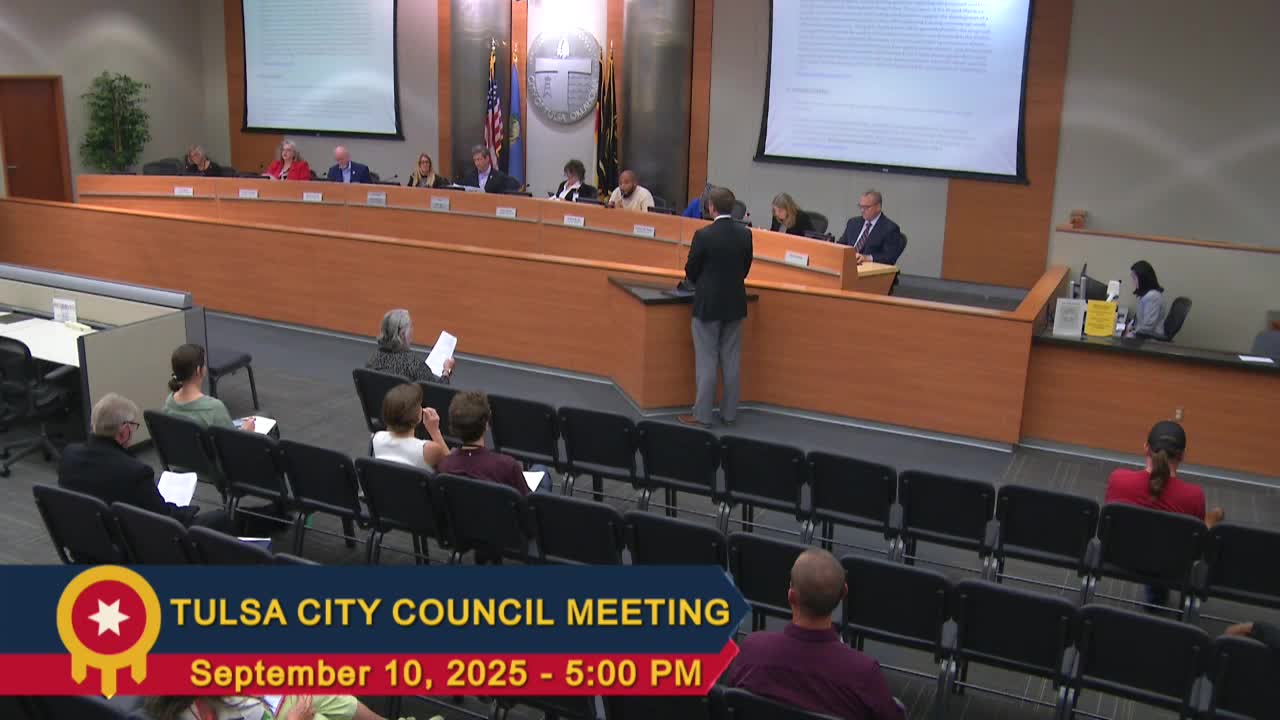
A public hearing on a proposed Southern Villa District economic development project plan was held during the Tulsa City Council’s 5 p.m. meeting, where city advisors outlined a project-specific tax increment finance (TIF) structure intended to support a multi‑phase vertical mixed‑use development in southwest Tulsa.
Jeff Sabin, of the Center for Economic Development Law in Oklahoma City, presented the project plan as economic development counsel for Partner Tulsa. He said the development would be built in three phases, each with its own ad valorem and city sales‑tax increment districts, and described the project as a regional center combining multifamily housing and retail and commercial space.
Sabin told the council the combined project is estimated at roughly $400 million in development costs and that Partner Tulsa projects about $425 million of increment revenue over 25 years across the three districts. He said the plan allocates 10% of increment revenues to Jenks Public Schools and anticipates about $45 million for public infrastructure and about $362 million in development financing assistance to the developer, with financing anticipated to be issued in phases.
The developer, David Neer, described a range of possible multifamily yields and said the plan shows between 652 and 780 multifamily units in total, with about 280 units fixed in the first phase. Sabin and Neer said the first phase would include roughly 280 multifamily units and roughly 120,000 square feet of retail; later phases would add additional units and retail space. Sabin said the proposed increment districts would be deferred for up to 10 years so the full 25‑year capture could be used once each phase is near completion.
Council members asked for more detail on the housing component, including whether any units would be reserved for affordable or workforce housing. Sabin and Neer said the proposal as presented is market‑rate housing and no affordable set‑aside had been specified in the draft project plan before the council at this meeting.
Public comment included concerns that public resources could subsidize market‑rate housing rather than address homelessness or housing instability. Aaron Griffith, a member of the public, urged the council to require a percentage of units be affordable and to involve housing and social‑services staff and tribal partners in negotiations. He also noted that the TMAPC review found inconsistencies with the comprehensive plan and urged further work before approval.
Sabin said the review committee and the Tulsa Metropolitan Area Planning Commission (TMAPC) had recommended approval; he added that a specific provision in an earlier draft that would have prohibited subsidized housing was removed following review committee recommendations.
No final council vote to adopt the project plan or create the increment districts occurred at the meeting. Sabin said a second public hearing is proposed for Oct. 8 at the council’s regular 5 p.m. meeting and that a notice will be published Sept. 17.
The council took the item under public hearing, received testimony and questions, and left further action for a future meeting.
Details from the presentation and public comments will be included in the record ahead of the Oct. 8 hearing.