Get Full Government Meeting Transcripts, Videos, & Alerts Forever!
Get email alerts on the Housing topic
No spam. Unsubscribe anytime.
Toledo housing officials outline development projects and local barriers; Fair Housing Center reports 2,000+ intakes
Summary
Speakers at a Toledo housing briefing described local housing needs, homelessness system capacity and planned public-housing projects. The Fair Housing Center reported more than 2,000 intakes and flagged source-of-income discrimination; Lucas Metropolitan Housing outlined several development and modernization projects and key program metrics.
Speakers at a Toledo housing briefing on Sept. 4 described a range of housing challenges and development plans, saying federal CDBG funds, public-housing renovations and local zoning changes will be needed to address shortages, homelessness and barriers to homeownership.
The Fair Housing Center reported more than 2,000 intakes for housing assistance over the past year and cited source-of-income discrimination against tenants using Housing Choice Vouchers as a persistent barrier. Lucas Metropolitan Housing (LMH) Chief Executive Officer Siguor Vance gave an overview of LMH programs, wait-list data and a slate of renovation and new-construction projects.
The Fair Housing Center representative said the center completed an analysis of barriers to housing choice that drew on outreach, surveys, focus groups and demographic data. The representative listed access to homeownership, investor purchases of housing stock and limited lending products for low-income buyers as major obstacles. The representative also said “source-of-income discrimination” — where landlords refuse tenants who plan to pay with Housing Choice Vouchers — remains a significant local problem and noted that other Ohio jurisdictions, including Columbus, have adopted protections addressing that issue.
The representative said work to address these barriers includes recommendations for outreach, zoning and an action plan to target the identified barriers. The transcript indicates the center received “more than 2,000 intakes” for housing-related assistance during the last year.
Speakers described the local homeless services system as strained. A briefing participant reported roughly 588 total beds across the system and said emergency shelter capacity was full at the time of the presentation; female shelter wait lists were cited as having about 70 people waiting. The presenter also described efforts to expand permanent supportive housing and improve discharge planning with institutions, and said medical-respite options and additional flexible funding sources are priorities.
LMH CEO Siguor Vance provided program-level details and an inventory of development and modernization projects. Vance said LMH manages about 2,414 public-housing units and reported a wait list figure of 1,539 families at the time of the briefing, with an average annual turnover of about 300 units. He said LMH’s strategic plan runs from 2024 through 2028 and includes goals such as employee investment, diversified revenue, and increasing accessible housing in Toledo and the region. “Our vision is to be the leading in the development and sustainability of housing accessible to all,” Vance said.
Vance described units in “modernization” status that require HUD approval; he said about 66 units were in that status and that HUD must approve the designation that allows LMH two years to turn those units. He also reported roughly 322 units with an elderly designation (generally HUD’s 62-and-older standard) and summarized several projects with projected unit counts and estimated development or renovation costs as stated during the briefing:
- Koma Gardens: approximately 75 mixed units, including seniors; an estimated $22,000,000 project with an expected completion target in 2027. - Tenite Towers: about 154 units (senior/disabled potential), with a projected $38,000,000 investment; the presenter described the plan as tentative. - Collingwood Green (multiple phases): a 42–45-unit complex for homeless transition-age youth and a separate 75-unit senior building under construction, with an anticipated construction milestone in early 2026. - Mission Point: a 65-unit project serving people experiencing homelessness, with an estimated $21,000,000 cost; financing was described as near finalization. - Washington Village: proposed new-construction single-family projects on five sites in the Junction area (details not specified). - Thurgood Marshall: reuse of a closed school (details on scope and timeline not specified). - McClinton 9: described as a 379-unit family and senior facility with about $10,000,000 in planned façade and mechanical improvements beginning in 2026. - Resuela Manor and Wyler Holmes/Speaker Terrace: various exterior and interior renovations and HVAC work were described; project scopes and budgets were not fully specified.
Vance also described an on-site Financial Opportunity Center (FOC) designation and partnership with LISC (Local Initiatives Support Corporation) to provide financial coaching and employment services. He said the FOC served 111 residents and provided more than 800 coaching sessions in the prior year; outcomes cited included benefit approvals, net-worth improvements for some residents and instances of clients obtaining living-wage employment.
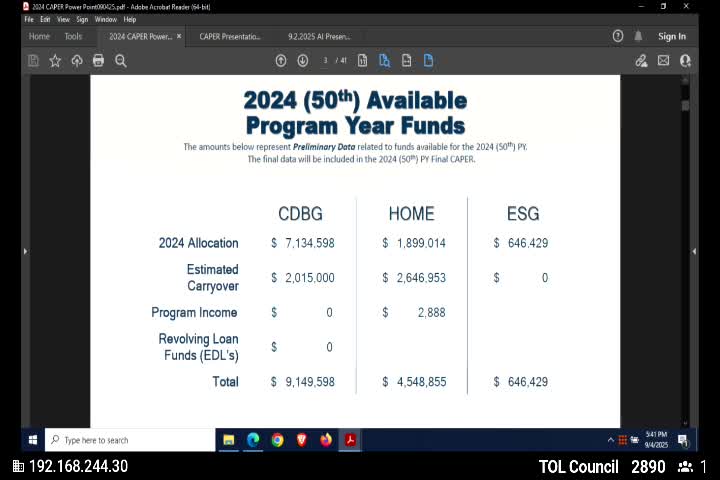
Speakers discussed federal funding sources and deadlines. An early presenter said CDBG-funded program allocations for the fiscal period included $7,100,000 in CDBG allocations and an estimated carryover of about $2,000,000, for a combined total of roughly $9.1 million available to program priorities. The presenter also noted a Consolidated Annual Performance and Evaluation Report (CAPER) submission deadline to the U.S. Department of Housing and Urban Development of Sept. 29 and provided the local submission address for comments.
No formal votes or ordinance actions were recorded in the provided transcript excerpts. The briefing included discussion items, program updates and requests for continued interagency and community collaboration to address homelessness, source-of-income discrimination and housing modernization needs.
The meeting concluded with staff noting next steps on CAPER submissions and continued coordination among the City of Toledo, LMH and Fair Housing stakeholders.