Get Full Government Meeting Transcripts, Videos, & Alerts Forever!
Get email alerts on the Lodging Tax Grants topic
No spam. Unsubscribe anytime.
Spokane Valley details 2026 lodging-tax grant rules; Sept. 30 application deadline
Summary
City staff walked applicants through eligible uses, application requirements, insurance and reporting rules, and the in-person presentation requirement for the City of Spokane Valley's 2026 lodging-tax grants.
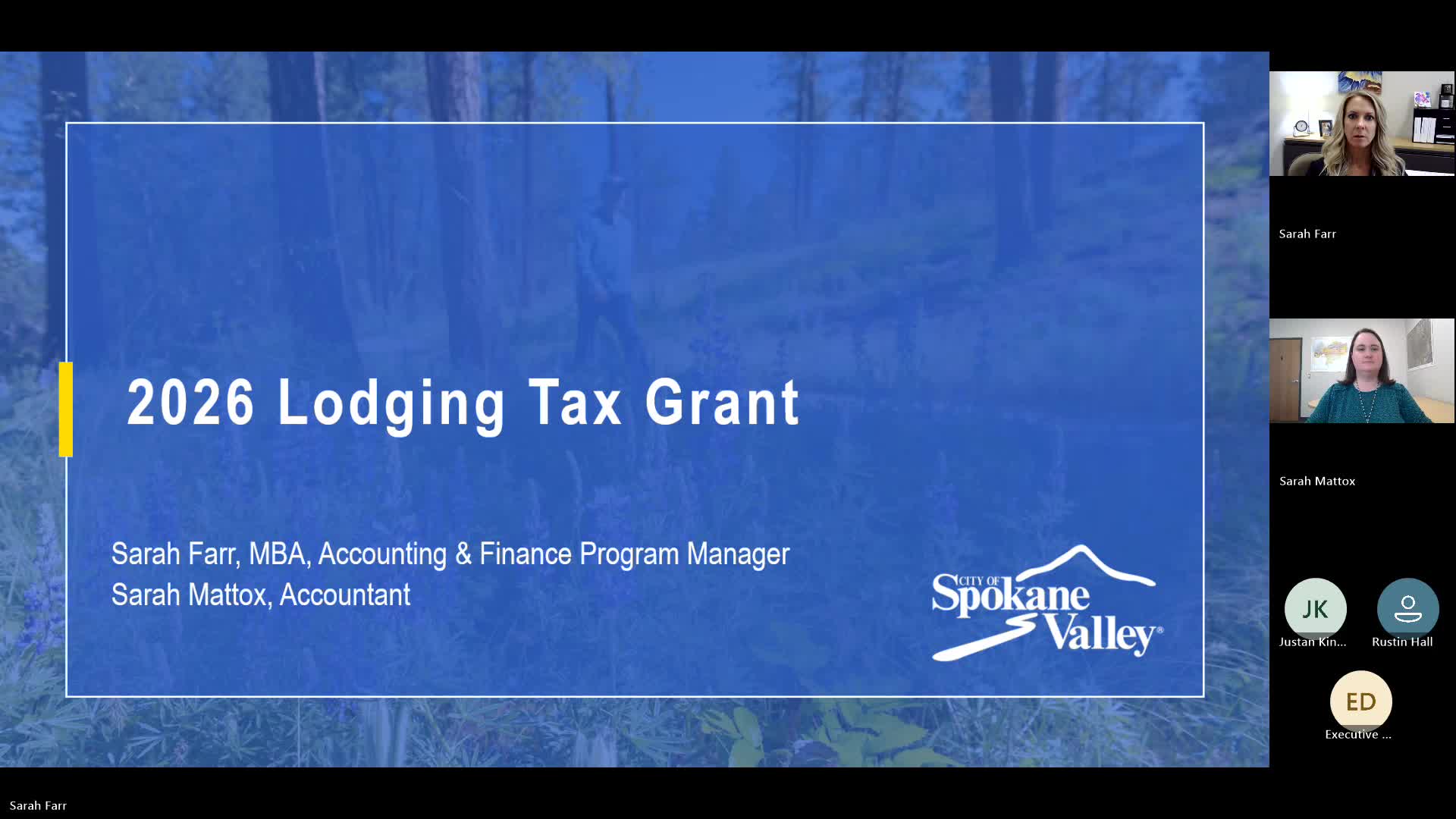
City of Spokane Valley staff on a technical assistance webinar detailed rules and deadlines for the city's 2026 lodging-tax grant program, emphasizing a Sept. 30 application deadline and a required in-person presentation to the city's Lodging Tax Advisory Committee (LTAC).
The presentation, led by Sarah Farr, accounting and finance program manager for the City of Spokane Valley, explained who may apply, what expenses are eligible under state and local rules, and key submission requirements. Farr said, "This is our 2026 lodging tax grant, technical assistance workshop." She repeated that "This year is 09/30/2025 before 4PM," and that the required presentation to the LTAC "is an in person presentation."
The detail matters because Washington law allows municipalities to impose lodging taxes and to spend those revenues only on enumerated tourism-related purposes. Farr told attendees the city's lodging tax total is 3.3 percent, split into a 2 percent portion that may be used for any state-authorized lodging-tax purpose and a 1.3 percent portion that the City Council has limited to capital expenditures for large sporting venues or tourism-related facilities that generate overnight lodging.
City staff walked applicants through the application packet and upload requirements. Required attachments include: a business statement; a one-page project summary; a detailed project budget; a scope of work; the state-mandated Impact on Tourism form (item 5); documentation authorizing the project (such as minutes); and a one-page listing of board members/principal staff. Optional materials include an annual operating budget and presentation materials. Farr warned that the online portal does not save drafts: applicants must have all PDFs prepared before starting because the form cannot be saved and resumed.
Sarah Maddox, the city accountant who works on grant programs, described the Impact on Tourism form and reporting methods. She said, "This is the form you will use as your item 5 upload during the application process." The form requires applicants to supply attendance estimates, the method used to derive those estimates, and anticipated paid lodging nights; the state (via JLARC guidance cited on the form) requires those estimates for application eligibility.
Staff reviewed other contract and insurance requirements applicants should expect if awarded. The sample grant agreement on the city website lists insurance limits the city typically requires: $2,000,000 general aggregate and $2,000,000 per occurrence for commercial general liability; applicants must confirm during application that they can provide that coverage if awarded, though coverage does not need to be in place to apply. The city also requires proof of workers' compensation if an applicant has employees, and applicants must provide valid proof of payment to obtain reimbursements because awards are paid on a reimbursement basis.
Farr outlined the anticipated funding categories and schedule. Under the City Council's guidance, the LTAC and staff expect to prioritize (1) capital expenditures for tourism destination facilities (municipally owned or public-facilities-district projects) and (2) tourism marketing, operations for special events and festivals, and operations/maintenance of tourism destination facilities. Farr said the capital category could be up to about $2,000,000 (depending on transfers between the 2 percent and 1.3 percent funds) and the operating/marketing category roughly $446,000, though the LTAC can adjust those amounts.
Key dates reiterated on the webinar: the grant materials were released Sept. 2; applications are due Sept. 30, 2025, by 4 p.m.; LTAC presentations are scheduled for Oct. 29, 2025 (the meeting begins at 8:30 a.m.); LTAC funding recommendations will be presented to council (administrative report) in mid-November; and City Council is expected to make final award determinations in mid-December. The period of performance for awards was described as likely Jan. 1'Dec. 31, 2026.
Staff said they will review applications for completeness in October and notify applicants if their submission is accepted as complete. Farr and Maddox encouraged applicants to submit early so staff can request clarifications before the deadline. Farr closed by noting the webinar recording and materials will be posted to the City's grant funding web page and by offering staff contact information for questions.
The webinar focused on instructions for filing a compliant application and did not include formal LTAC actions or council votes; staff repeatedly distinguished between the LTAC's recommendation role and the City Council's final decision.