Get Full Government Meeting Transcripts, Videos, & Alerts Forever!
Get email alerts on the Public Safety topic
No spam. Unsubscribe anytime.
Council signs off on police vehicle surcharge for secondary employment; $6.80 per hour, $3.40 commute
Summary
After a lengthy discussion about liability, equipment costs and funding, council signaled consensus to adopt a stand-alone policy (4.6.0.1) setting a vehicle surcharge of $6.80 per hour and a $3.40 one-time commute charge; staff said charges would take effect Oct. 1, 2025.
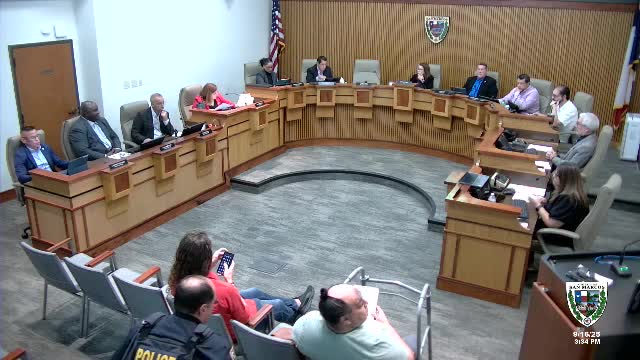
San Marcos City Council discussed and signaled consensus on a police department policy setting vehicle surcharges for officers working secondary employment and on related liability and insurance questions at a Sept. 16 work session. The council arrived at a $6.80-per-hour surcharge for city vehicles used during secondary employment and a $3.40 one-time commute charge for officers traveling from outside the city; staff said the charges are expected to take effect Oct. 1, 2025.
Chief Stan Standridge presented the draft standalone policy 4.6.0.1 and the proposed rates, describing staff analysis that compared a high-end full-size SUV rental market rate to local fleet costs. Standridge said the department used a Central Texas rental-market benchmark — citing a full-size SUV daily rate of $171.90 (reduced to $163 after a 5% law-enforcement discount) — to derive a $6.80 hourly vehicle surcharge. He said the $3.40 charge covers a one-time commute to a secondary job when the officer was not already commuting into San Marcos for work.
Standridge told council the department has 42 officers working secondary employment, representing roughly 34% of sworn personnel, and noted there are 54 recurring in-city secondary jobs, including school and private contracts. He said the department concluded the visible presence of officers working secondary employment can reduce social harm and provide operational efficiency, and that some secondary employers require use of a city vehicle.
Council discussion focused on liability, insurance and whether officers should be required to carry supplemental occupational accident insurance. Finance and risk staff explained that Texas Municipal League Intergovernmental Risk Pool (TML) is the city's liability carrier and that coverage for injuries and vehicle damage depends on the facts of each incident. Staff said workers' compensation generally will not cover injuries that occur while an officer is performing separate secondary employment; conversely, if an officer intervenes in a crime while off-duty, that action may fall within the scope of their duties and could be covered. Staff said they cannot require officers to purchase supplemental occupational-accident policies but "should and are encouraged" language remains in the policy for voluntary purchase.
Councilmember Garza asked whether the $6.80 calculation accounted for the police-specific equipment that upfits vehicles (lights, radios, computers). Staff and the chief acknowledged the rental comparison does not capture all upfitting amortization and offered an illustrative amortization: spreading a roughly $22,000 upfit cost over five years would add about $2.11 per hour, producing an $8.91 effective rate if council chose to require officers to cover equipment amortization. Some councilmembers opposed adding equipment amortization to the hourly charge on equity grounds, noting that the equipment benefits the entire community. After discussion, council did not add the amortization charge and instead left the policy at the $6.80 hourly rate with the $3.40 commute charge.
Chief Standridge and staff said the adopted charges would be reviewed annually and updated based on market data from a crime analyst and finance staff. Staff also noted that the department will continue to carry liability on city vehicles and that TML may subrogate third parties where appropriate. Staff confirmed they will implement the vehicle surcharge policy as written and to notify secondary employers in advance of the Oct. 1 effective date.
The work session clarified how liability, workers' compensation, supplemental insurance and vehicle insurance interact in different incident scenarios and provided council with the information needed to adopt the surcharge rates through an administrative policy.