Lifetime Citizen Portal Access — AI Briefings, Alerts & Unlimited Follows
Olathe council approves rezoning for Lineage Logistics cold-storage center over neighborhood objections
Loading...
Summary
The Olathe City Council on Sept. 16 approved an ordinance to rezone roughly 145.78 acres northeast of West 170th Street and Lone Elm Road to community center and general industrial zoning to allow an employment park anchored by Lineage Logistics, despite neighborhood concerns about truck traffic, refrigerant use and building height.
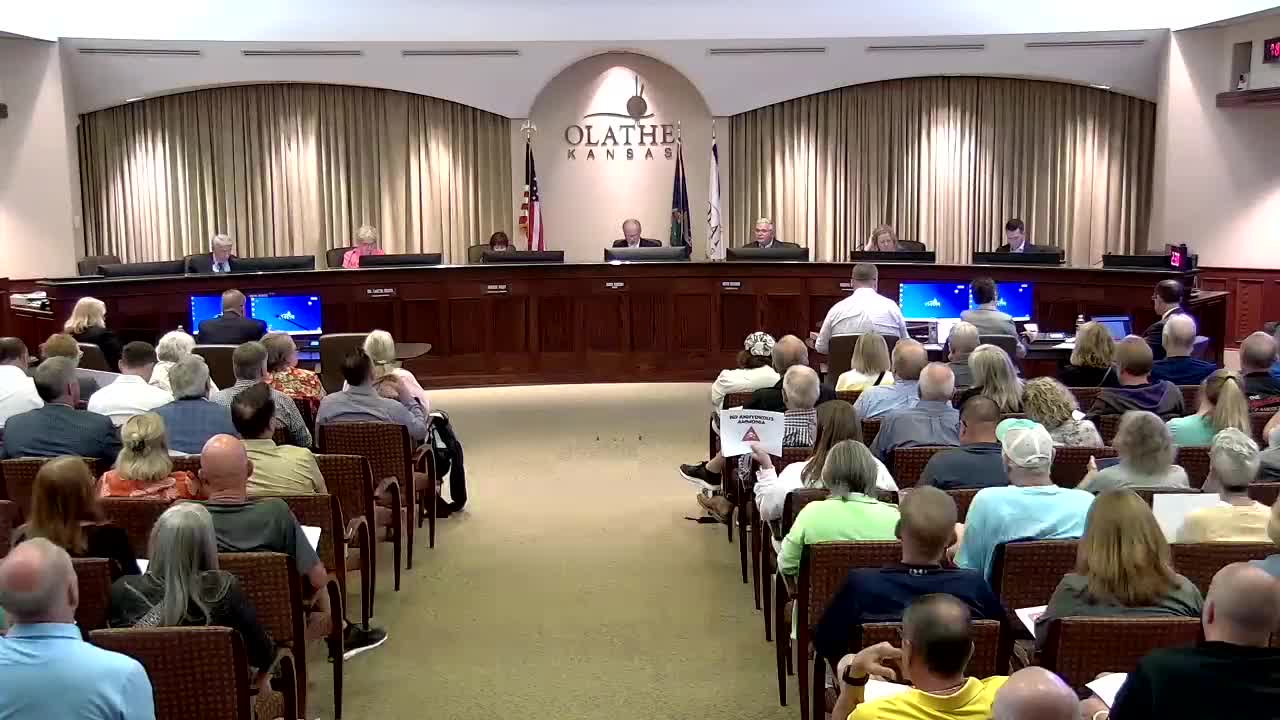
The Olathe City Council on Sept. 16 approved an ordinance to rezone roughly 145.78 acres northeast of West 170th Street and Lone Elm Road to community center (C2) and general industrial (M2) zoning to allow an employment park anchored by Lineage Logistics, an automated cold-storage operator. The council approved Ordinance 25-31 (RZ25-007) by a 5-2 vote after a public hearing and extended staff presentations.
Staff and the applicant said the rezoning aligns with Olathe’s comprehensive plan and the city’s Lone Elm vicinity plan, and described site design, traffic mitigation and emergency-response measures intended to limit impacts on nearby Nottingham Creek. Senior Planner Jessica Schuler told the council the proposed building would be up to 140 feet tall to accommodate automated racking, that the structure is permitted under the Unified Development Ordinance without waivers, and that it would be set more than 1,000 feet from Lone Elm Road and roughly a half-mile from the nearest Nottingham Creek home. “Staff is recommending approval of the rezoning and preliminary site development plan as the proposal aligns with our comprehensive plan and unified development ordinance,” Schuler said.
Developer and applicant representatives presented technical studies and visual simulations and said they had worked with staff on stipulations that limit certain high-intensity uses on future lots and require screening and setback measures. Curt Petersen and Kirk Peterson (both identified in the record as representing the applicant and the master developer) said the facility would bring jobs and investment and that the project team had designed staging and access to avoid trucks queuing on public arterials. Peterson described the refrigerant and operations used in modern cold-storage facilities and defended Lineage’s safety record: “Lineage has outperformed its peers in the industry continually when it comes to inspections of regulations. . . . They have never once had ammonia get outside of a building and hurt someone. Not once,” he said.
City staff and the developer cited a traffic-impact study that estimated about 500 average daily truck trips for the phase-1 Lineage use (presented as 250 inbound and 250 outbound truck trips on average), and staff said that required turn lanes and other access improvements would be built as part of the project. Chief Development Engineer Charlie Love told the council the study met city requirements and that, with required turn lanes, Lone Elm and 170th would operate within the Highway Capacity Manual’s level-of-service thresholds. Love also said private on-site staging would allow roughly 2,600 linear feet of private driveway providing space for about 30 trucks before the gate.
Fire Chief Jeff DeGraffenreid outlined Olathe Fire Department capabilities and automatic mutual-aid arrangements, noting the department’s ISO Class 1 rating and countywide hazardous-materials support agreements. “If a resident needs us because of a fire or medical emergency, we send the closest fire truck,” DeGraffenreid said, describing evacuation and shelter-in-place procedures and mutual-aid practices.
Opponents, who spoke during a 15-minute public-comment period, pressed council members on truck volume, the use of anhydrous ammonia as a refrigerant, building height and roadway capacity. Residents said they feared impacts to Lone Elm and to Nottingham Creek, including noise, truck staging, and the risk of a hazardous-release incident. Speakers said planning commission members had voted 2-5 against approval and urged the council to deny rezoning or require additional protections. Several residents said Lineage offered payments to the subdivision’s HOA; the developer and council discussions characterized payments and negotiations differently. The planning commission’s denial and residents’ comments were included in council packets.
Council members who voted to approve the rezoning cited long-term land-use planning, infrastructure commitments and the view that control of development is better exercised by Olathe than by another jurisdiction. Council members voting no said they were not convinced the site’s impacts to nearby residents were adequately mitigated. The roll-call vote recorded five yes (Councilmembers Felter, Vakas, Bakas, Gilmore and Bacon) and two no (Councilmembers Schoonover and Essex).
The approval includes staff-recommended stipulations, required traffic-turn-lane construction, updates to the traffic study for future phases, on-site stormwater detention and treatment that staff said would meet Title 17 stormwater requirements, and state permitting requirements including KDHE reviews. Staff also recommended limiting heights for unspecified future lots in the M2 district to 55 feet and in the C2 district to 35 feet, while allowing the Lineage facility to use the 140-foot building envelope permitted in M2 for automated cold storage. Staff indicated architectural waivers for articulation and glass percentage would be recommended due to the building’s unique function.
The developer said phase 2 remains conceptual and subject to additional review and that city-required updates to traffic and stormwater plans would be required before later phases proceed. The council’s approval allows the applicant to move forward with the preliminary site development plan for phase 1.
Votes and next steps: Ordinance 25-31 (RZ25-007) passed 5-2; staff will continue to manage stipulations, required roadway improvements, state permitting reviews, and future site development plan reviews for subsequent lots and phases.