Get Full Government Meeting Transcripts, Videos, & Alerts Forever!
Get email alerts on the Affordable Housing topic
No spam. Unsubscribe anytime.
Panelists tell Lexington planning commissioners: subsidy, infrastructure and land availability are bottlenecks to affordable housing
Summary
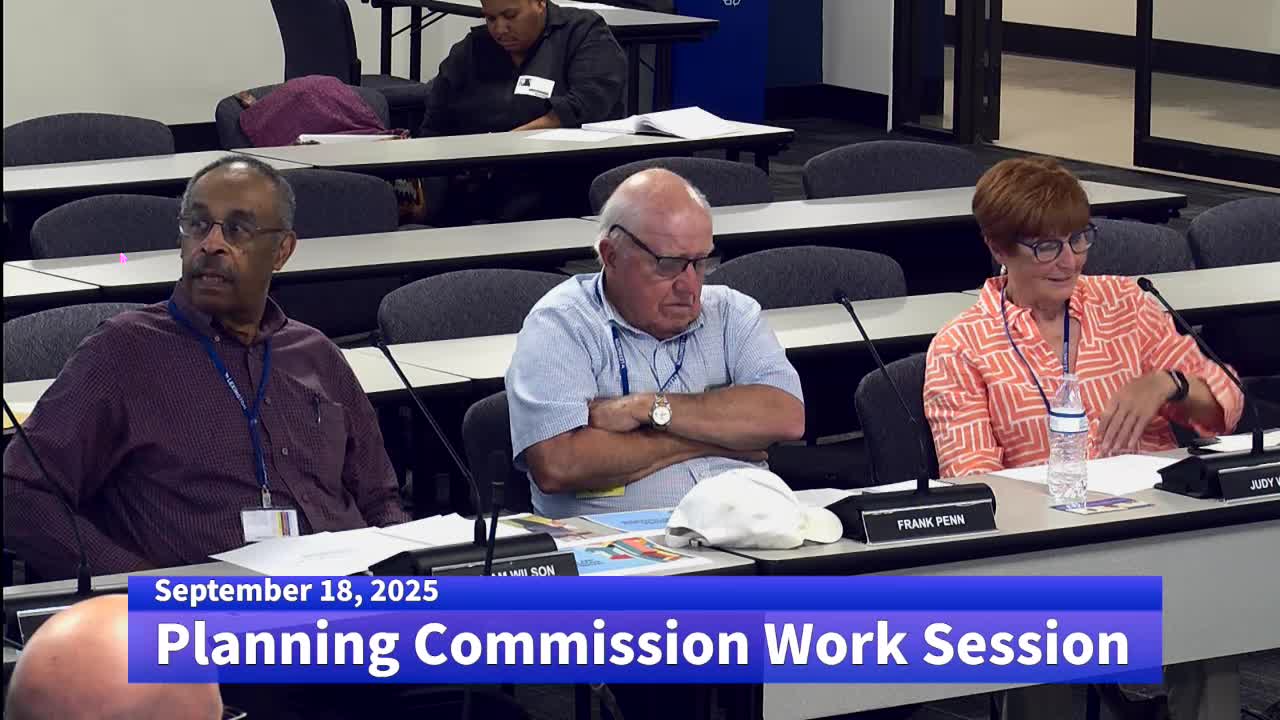
At a Sept. 18 planning-commission roundtable, Lexington housing providers, developers and nonprofit builders told commissioners the city faces a large shortfall of affordable housing and recommended a mix of local subsidies, state infrastructure financing and better land-use coordination to increase production.
Lexington planning commissioners on Sept. 18 hosted a roundtable on affordable housing with local developers, nonprofit builders and housing authority leaders who described a large gap between current production and community need, and urged a mix of local subsidy, state policy changes and infrastructure financing to scale production.
Panelists and staff cited state and federal programs and local pilots that could be combined to increase supply. "For a family of 4, the area median income is $102,400," said Gerald Neer of Lexington Habitat for Humanity when discussing income bands used in local housing programs. Panelists agreed the term "affordable housing" is generally used for housing serving households at 30%–80% of area median income (AMI); "workforce housing" commonly refers to roughly 80%–120% of AMI.
Speakers cited the Kentucky Housing Corporation (KHC) analysis discussed during the session: KHC estimated a total need of roughly 30,823 new housing units by 2029, including about 17,000 units considered "affordable" under the study’s definitions. City planning staff reported permitting has averaged about 1,500 dwelling units a year since 2017, a pace panelists said is far below projected needs.
Panelists described production constraints and possible policy responses. Johan Graham, owner of AU Associates, listed four practical levers: expand the local affordable-housing trust fund (he said the city recently committed $4 million–$5 million), push the state to create a housing tax-credit program like neighboring states have, identify ways to reduce upfront infrastructure and permit costs for affordable projects, and address land availability and neighborhood resistance that can slow family housing projects.
Several panelists pointed to an unusual local financing model used for a large redevelopment site tied to Transylvania University: local banks purchased a 12.5-acre parcel with roughly $3 million in private funds and held it interest-free while a coalition of developers assembled financing and rezoning. Panelists said the state has allocated $10 million for site infrastructure on that project, reducing per-unit costs for developers. "They put $3,000,000 into it, bought the land, and are holding it interest free for this group of developers," said a panelist describing the bank fund structure; another panelist added the $10,000,000 state infrastructure allocation is meant to help make parcels pad‑ready and reduce total project costs.
Speakers repeatedly said subsidy is the binding constraint. "If we look at the 22,000 units that are an objective or what we're short of, it'd be about $6.6 billion to build it," Austin Sims, executive director of the Lexington Housing Authority, said in describing a rough order-of-magnitude construction cost tied to the scale of need. Habitat for Humanity described developing single-family homes that required roughly $100,000 of subsidy per sale to be affordable to buyers at or below 80% AMI; the speaker said average single-family construction bids in Lexington were about $300,000 at the time of the meeting.
Panelists also described the limits of current federal tools: low-income housing tax credits and other federal programs are effective for multifamily rental production but require expertise and investor partnerships that many market-rate builders do not use. Panelists estimated that, with current subsidy levels, local nonprofits and developers collectively might produce in a strong year roughly 300–350 affordable units (single-family and multifamily combined), far short of the KHC estimates.
Commissioners and staff discussed next steps: better aligning local planning and state scoring for tax-credit awards (Qualified Allocation Plan priorities), lobbying the state for an infrastructure financing tool modeled on programs in Indiana and Tennessee, setting aside public land or partnering to make city-owned parcels available with infrastructure support, and convening follow-up meetings on financing and development plan process improvements. No formal action or legislation was voted on during the session; commissioners asked staff to organize follow-up briefings and to share reference materials discussed at the roundtable.