Get Full Government Meeting Transcripts, Videos, & Alerts Forever!
Get email alerts on the Gun Violence Prevention topic
No spam. Unsubscribe anytime.
Council approves contracts to fund 1Lexington crisis mediators and survivor liaison
Summary
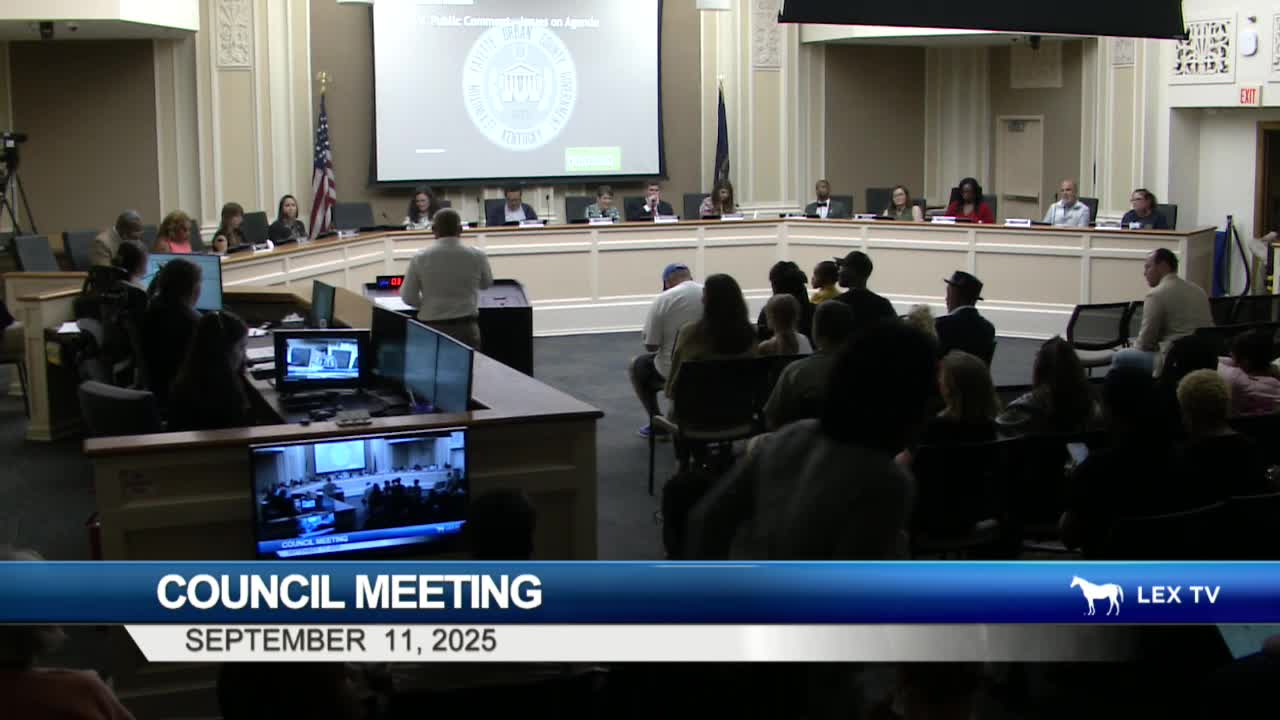
Lexington-Fayette Urban County Council voted to authorize agreements to fund crisis response mediators and a survivor liaison for 1Lexington — authorizing up to $50,000 for crisis mediators and $20,000 for a survivor liaison — after hours of public comment from survivors, community groups and program staff.
Lexington-Fayette Urban County Council on Sept. 11 approved agreements to fund crisis response mediators and a survivor liaison associated with 1Lexington, the city-supported violence-interruption program.
Council action authorizes the mayor to sign a contract not to exceed $50,000 for crisis response mediators and a separate agreement not to exceed $20,000 to fund a survivor liaison, the council packet shows. The two measures together allocate up to $70,000 for contracts described in the meeting as direct support for survivors and for on-the-ground outreach.
Why it matters: Supporters told the council the local program provides immediate, trauma-informed help after shootings and connects people to services that reduce future violence. During a lengthy public-comment period, survivors, service providers, teachers and parents described street outreach, counseling referrals and wraparound help that they said would disappear without continued funding.
Multiple speakers described personal or neighborhood experience with the teams. "Survivor support and street outreach saves lives, heal trauma caused by gun violence, and prevent future harm," said Cadetia Jackson, founder of Keys to Brotherhood. "They were there every step of the way ... even providing transportation while I'm at work to get to the summer programs," Jackson said. Robin Anderson, who identified herself as a victim advocate from District 9, told the council: "They are boots on the ground ... offering compassion."
Several speakers gave specific examples of services. Neil (listed in the record as "Neil Jackson") said that within a month of contact 1Lexington connected him to therapy and counseling. Corey Dunn, who identifies as a member of Lexington’s street-response team and as a survivor, said the program lets formerly involved people use lived experience to intervene: "I can teach a young dude who is involved in gun violence and then say, hey look, you don't have to go get retaliation."
Some commenters urged safeguards. Tanya Lindsey, who identified herself as the mother of a 16-year-old homicide victim, urged the council to require a vetting process for volunteers who work directly with survivors: "This process is not about creating barriers for volunteers. It's about protecting those we serve — victims and survivors," she said, and asked for reference checks, clear ethical guidelines and training.
The council action and context: Resolution language in the meeting packet identifies specific named crisis mediators and a named survivor liaison and authorizes the mayor to execute the contracts. At the meeting council members moved and seconded a package of resolutions (motion made by Councilmember Reynolds; second by Councilmember Higgins Hoard), and the roll call that followed approved the items that included the 1Lexington agreements.
Council members later addressed public concern about program continuity. Councilmember Jennifer Reynolds told speakers the council was not seeking to eliminate 1Lexington programs and said the extra information requested during the meeting was to ensure proper oversight, not to cut services. Councilmember Morton echoed that reassurance.
What happens next: The authorizations allow the mayor’s office to sign the contracts described in the packet; the agreements (as written in the packet) are limited-term service contracts tied to the fiscal-year budget items listed in the council materials. The council did not change program design at the meeting; several public speakers asked the city to add a formal volunteer vetting and training requirement before expanded roles are funded.
Community reaction: Dozens of community members — survivors, youth, educators and nonprofit leaders — urged the council to preserve or expand survivor support and street outreach. Speakers cited counseling, transportation to programs, mediation between conflicting parties, and long-term contact as program strengths. Several said the services produced measurable changes in individuals within weeks.
The council’s approvals fund immediate, limited contracts rather than create permanent new city positions; staff will return with standard contract documents for the mayor to sign and the funded organizations to begin or continue service delivery.