Get Full Government Meeting Transcripts, Videos, & Alerts Forever!
Get email alerts on the Nonprofit Policy Federal topic
No spam. Unsubscribe anytime.
Kentucky Nonprofit Network warns federal policy shifts could disrupt local nonprofit services
Summary
Danielle Clore of the Kentucky Nonprofit Network told the committee Sept. 16 that executive orders, rescissions, grant pauses and legislative proposals at the federal level are creating funding uncertainty that could affect nonprofits’ ability to deliver services in Lexington and statewide.
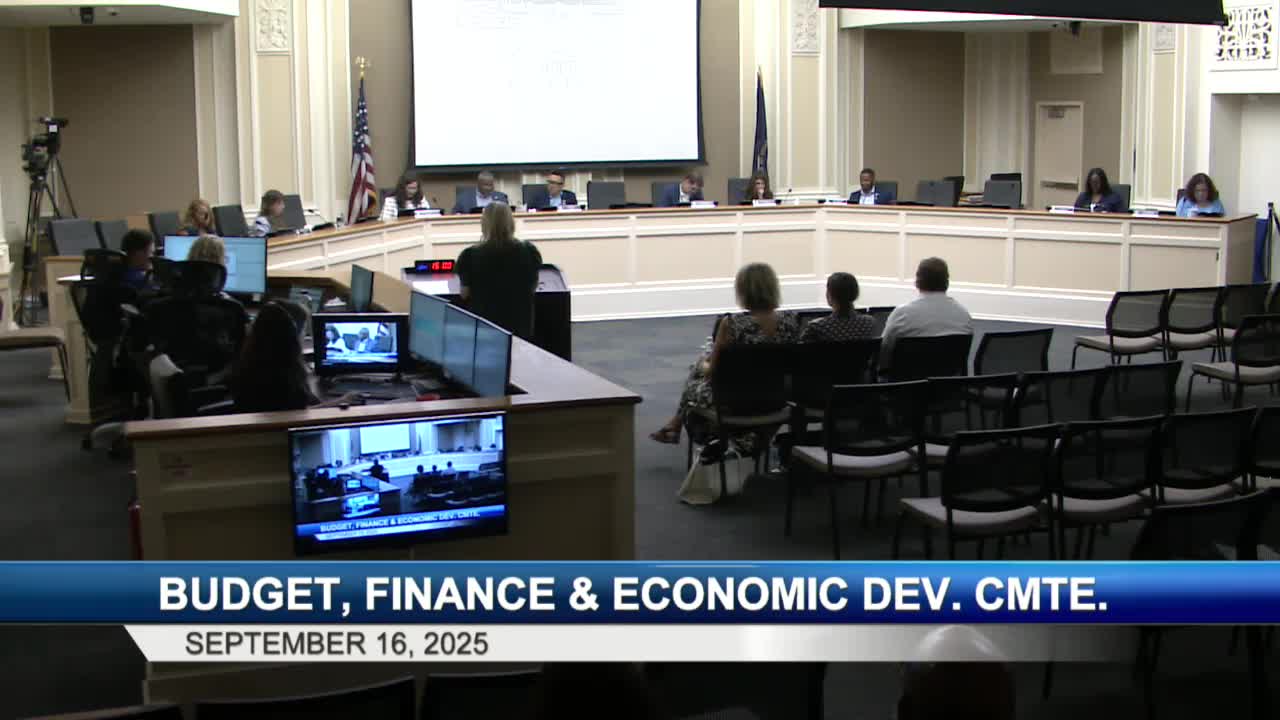
Danielle Clore, executive director and CEO of the Kentucky Nonprofit Network (KNN), told the Budget, Finance and Economic Development Committee Sept. 16 that a series of federal actions and proposals are creating immediate and longer-term risks for nonprofit service delivery.
Clore said KNN represents more than 1,100 member organizations statewide and that more than 300 of those serve Lexington. She summarized several nationwide developments: a January 2025 pause on certain federal grants and subsequent litigation; executive orders issued in August that insert political appointee review of grantmaking and create discretion to terminate grants; rescission memos that would claw back previously appropriated funds; and provisions in the recently enacted federal tax bill (referred to in the presentation as the “1 big beautiful bill”) that both expand a universal charitable deduction for most taxpayers and add caps and other changes that could reduce deductions for some high-income donors.
Clore cited specific service impacts reported to KNN members: arts-and-humanities organizations experiencing frozen National Endowment for the Arts and Humanities awards, refugee and immigrant services facing program contractions and layoffs, and environmental and local-service organizations encountering paused state pass-through funds because state agencies are uncertain whether federal funds will be received. She said a recent August executive order on federal grant-making discourages covering core administrative and infrastructure costs and could disincentivize nonprofits from charging full allowable overhead in grant budgets.
Clore also raised concerns about Department of Justice guidance on diversity, equity and inclusion (DEI) policies and potential criminal or civil enforcement implications, and about proposals that would allow quicker revocation of tax-exempt status without robust due process. She described the cumulative effect as destabilizing for a sector that accounts for thousands of jobs and billions of dollars in local economic activity: in the Bluegrass local workforce area, Clore said charitable nonprofits total over 3,000 organizations, employing roughly 26,000 people and generating roughly $1.5 billion in wages and more than $5 billion in annual expenditures.
Council members asked about KNN’s work with state legislators and with local philanthropic funders. Clore said KNN has shared the impact report with multiple legislators but had not yet done a formal presentation in Frankfort and encouraged the committee to brief the state delegation. She said philanthropic responses vary: some funders are increasing flexibility and payout rates, but Kentucky has relatively few private foundations and philanthropic capacity varies across the state.
Ending
Clore asked council members to share resources with nonprofit constituents, to invite nonprofits to the table on policy decisions, and to advocate with the federal delegation and state legislators for funding certainty. Committee members thanked KNN and said they would continue the conversation with future presentations from other stakeholder groups.