Get Full Government Meeting Transcripts, Videos, & Alerts Forever!
Get email alerts on the Public Comment Foreign Policy topic
No spam. Unsubscribe anytime.
Students, residents tell council Lexington should end ties to weapons manufacturers, condemn civilian deaths in Gaza
Summary
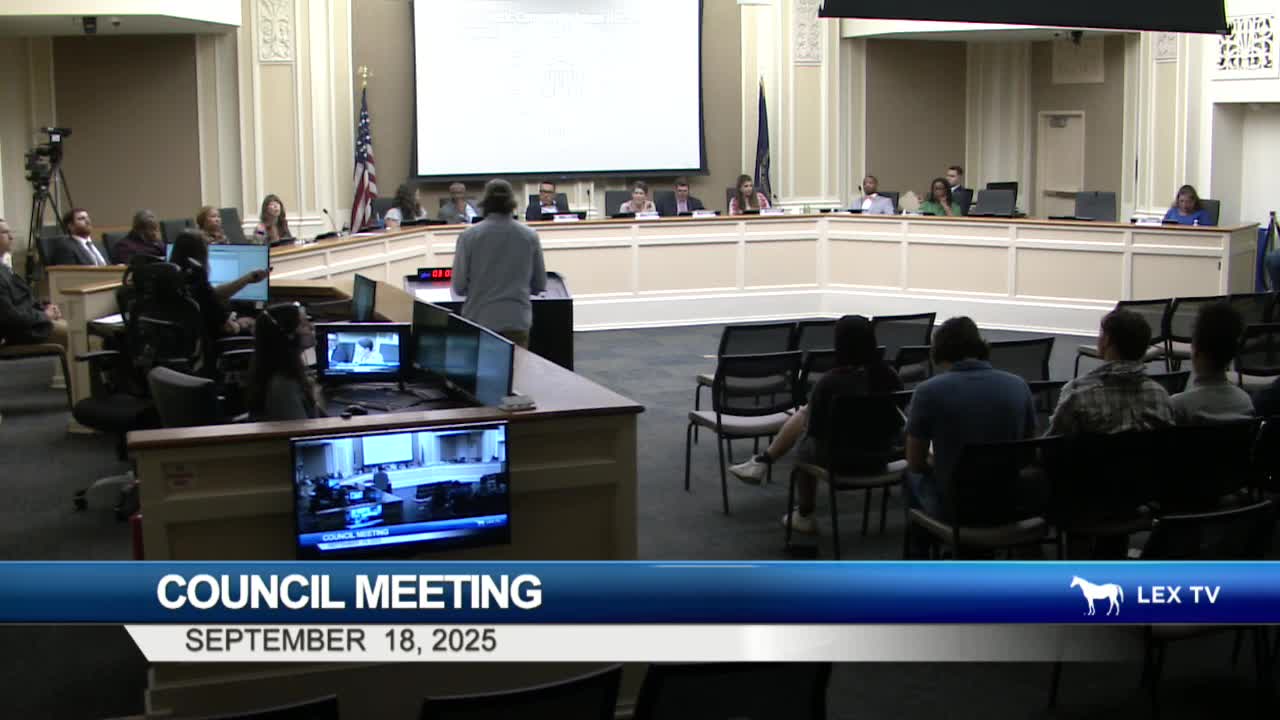
During public comment at the Sept. 18 Lexington Urban County Council meeting, multiple speakers urged the council to cut partnerships with Lockheed Martin and other military contractors and to publicly acknowledge civilian suffering in Gaza.
Multiple public commenters at the Lexington Urban County Council meeting on Sept. 18 urged the council to end partnerships with weapons manufacturers and to take a public stance on civilian deaths in Gaza.
Speakers included Kalyn Reynolds (District 10), Liam Sturgill (District 9), Logan Robertson (identified with Students for Justice in Palestine and as from District 3) and Eli Wren (District 5). Each speaker criticized what they described as the city’s “complicity” with arms manufacturers and called for concrete action from local government.
Kalyn Reynolds told the council she was “personally appalled” at Lexington’s alleged complacency regarding civilian deaths in Palestine and urged council members to use their authority to act. Liam Sturgill referenced a United Nations inquiry he said determined that Israel is committing genocide in Gaza and called on council members to sever ties with companies he described as complicit. Logan Robertson told the council Lexington’s partnership with Lockheed Martin should end; he named Lockheed Martin as “the world’s largest weapons manufacturer” and said its products are being used in the conflict. Eli Wren urged the council to take an early, courageous step to end such partnerships and said doing so would be historically significant for the city.
Speakers framed their remarks as moral and humanitarian appeals rather than requests for specific municipal ordinances; none of the speakers presented a formal motion or ordinance to the council during the public-comment period. Council members did not make formal commitments on the record in response to the remarks during the meeting.
The public-comment speakers also asked the council to reach out to Lexington’s Palestinian, Arab and Muslim communities and to provide recognition or support following repeated local demonstrations and vigils. Logan Robertson said he had not seen city outreach to the Palestinian community and asked the council to engage.
Speakers used strong language—“genocide,” “complicity”—and tied the city’s institutional relationships and recruiting pipelines to the harm they described, including references to career recruitment by defense contractors at the University of Kentucky. The council allowed the speakers their allotted public-comment time but did not schedule further debate on the topic during that session.