Get Full Government Meeting Transcripts, Videos, & Alerts Forever!
Get email alerts on the State Legislation Implementation topic
No spam. Unsubscribe anytime.
Carson City staff outline plans to implement 11 state laws effective Oct. 1, including animal-handling training ordinance
Summary
City staff told supervisors they are prepared to implement most state laws effective Oct. 1, but said they are still developing the training program required by AB 418 (animal handling) and will use broad ordinance language to allow flexible approaches and reduce burden on small businesses.
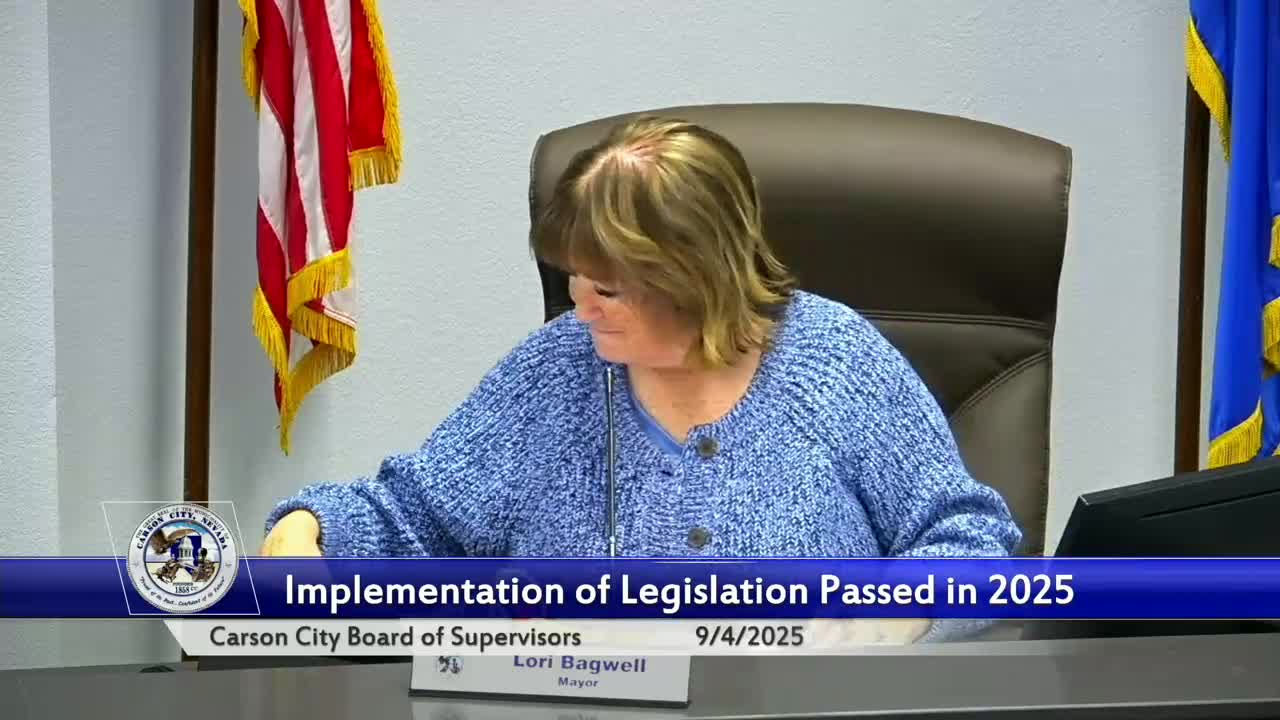
Carson City staff briefed the Board of Supervisors Sept. 4 on implementation steps for 11 state laws that take effect Oct. 1. Cameron Gresch, the city's implementation lead, told the board most new requirements are procedural and the city is largely prepared, but one item ' AB 418 ' will require a locally adopted ordinance setting animal-handling training standards for certain businesses.
The memo covers changes to election timelines, child-labor hours, emergency-management AI prohibitions, juvenile probation limits and courthouse fee collection, among others. Gresch said the city already complies with several provisions and is prepared to update administrative procedures where needed.
AB 418: animal-handling training AB 418 requires counties and incorporated cities to adopt ordinances mandating that owners or operators of kennels, animal rescue organizations and some pet-related businesses complete approved animal handling training every two years. Gresch said Carson City 'unlike many Nevada jurisdictions' does not have an animal services division, so staff is developing a locally tailored training program in consultation with outside experts and the contracted humane society.
Gresch told the board the law "only states that owners and operators of these businesses are the ones receiving the training," and the city has identified 12 businesses it expects would be affected. Staff said the city is not expected to be penalized for taking additional time to finalize meaningful training; the goal is to create a program that is "minimally impactful to the Carson City businesses that would be required to undergo training."
Enforcement and contract questions Supervisors asked whether the city must modify its contract with the humane society (NHS) to require the contractor to participate. City legal and administrative staff said the state law does not require NHS to deliver the training; the ordinance could be written broadly to allow online courses, in-person classes or other approved materials, and the city could delegate program approval to staff. Legal counsel said the board can set minimum content requirements (for example, what the training must include) or adopt broader language delegating specifics to staff for future updates.
Other bills covered in the report - AB 148, AB 491: Election-related procedural changes (sample/mail ballot and candidate filing timelines). Staff said Clerk-Recorder office is prepared to implement changes. - AB 215: Child-labor hour reductions and night-work restrictions for 14- to 18-year-olds. Carson City said it was already in compliance and has notified hiring managers. - AB 325: Prohibits use of artificial intelligence to make final emergency-response decisions; staff will add language to emergency plans disclaiming AI-based decision-making. - SB 120: Prohibits courts from collecting interest/fees on payment plans for fines and repeals ability to recoup public defense costs; courts are updating staff procedures. - SB 241, SB 273, SB 358, SB 380: Juvenile probation limits, expanded confidentiality for some law enforcement employees, required electronic payment acceptance, and law-enforcement autism-awareness training; staff said offices are prepared or nearly prepared to meet these requirements.
Next steps Staff will draft the ordinance language for AB 418 and bring it to the board for first reading. Supervisors signaled preference for broad ordinance language that sets minimum training content and allows staff to approve training providers or formats, which staff said could reduce administrative burdens on small businesses.
Speakers and sources: Remarks by Cameron Gresch and city staff at the Sept. 4 board meeting. Direct quotes are attributed to Gresch where used in text.