Get Full Government Meeting Transcripts, Videos, & Alerts Forever!
Get email alerts on the Housing Rental Inspection topic
No spam. Unsubscribe anytime.
Committee forwards residential rental inspection ordinance after lengthy public hearing, recommends amendments
Summary
The Land Use, Housing and Transportation Standing Committee voted to send Ordinance 2025‑161 establishing a residential rental inspection program to full council with a recommendation to amend after several hours of public testimony from tenants, advocates, landlords and health officials.
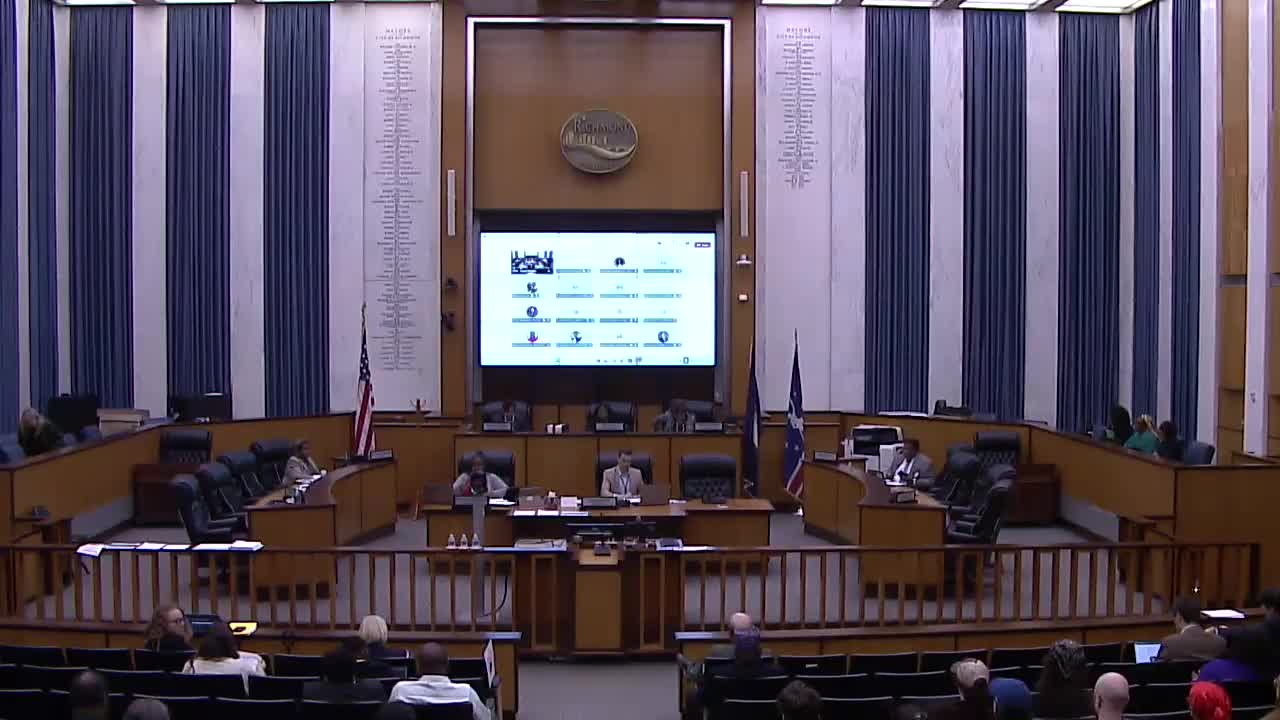
The Land Use, Housing and Transportation Standing Committee on Aug. 27 voted to forward Ordinance 2025‑161 — a proposal to authorize residential rental inspection districts — to the full City Council with a recommendation to approve the ordinance as amended.
The committee’s action came after a public hearing that included more than a dozen speakers: tenants and tenant advocates urged the city to adopt inspection districts to address unsafe and unhealthy rental housing, while some landlords and property owners said the program is overdue but sought clarity about thresholds and costs. City staff provided data and answered questions about implementation.
Supporters described recurring maintenance failures in rental units, including mold, pests, faulty wiring and broken appliances, and said a proactive inspection program would protect tenants who fear retaliation when they report problems. Thomas King, a building-code specialist and member of Richmond Democratic Socialists of America, told the committee inspection districts ‘‘give both inspectors and renters peace of mind’’ and pushed back on claims that inspection districts increase displacement. Tenants and organizers said the program was tenant‑led and widely requested across districts.
City health staff said proactive inspections can improve public health outcomes. Bob Becker, housing equity adviser for the Richmond‑Henrico Health District, said inspections can reduce childhood lead poisoning by identifying chipping or flaking paint before it becomes a hazard.
Staff presented implementation options and data used to evaluate districts. The planning department said maps and data cover a six‑month window and reported roughly 4,700 calls for service and about 630 confirmed building‑code violations in that period; staff recommended retaining a 48‑month look‑back period for prior violations to allow a multi‑year ‘‘grace’’ process similar to other Virginia localities, while some committee members and advocates suggested shorter look‑back windows. Committee members also discussed thresholds for which properties would be included (3‑unit versus 5‑unit buildings), whether adjacent parcels owned by common owners but different LLCs could be grouped, and the need for a fiscal impact analysis before designating districts.
After questions and discussion, the committee voted to forward the ordinance to the full council with a recommendation to amend. The motion to forward passed with recorded aye votes from Committee Member Breton, Vice Chair Robertson and Chair Jones.
Committee members and staff said the next steps include drafting specific amendment language, refining district‑designation criteria, and conducting fiscal impact estimates to determine inspection staffing and program costs before districts are designated.
The committee’s action does not itself create any inspection district; it authorizes the council to consider an amended ordinance and directs further drafting and analysis.
Several tenants and tenants’ organizations who testified specifically referenced experiences of retaliation and unsafe conditions in public housing and privately owned properties. Legal Aid Justice Center organizers and Gilpin residents also used the public‑comment period to press for tenant leadership in any redevelopment plans for public housing (see separate article). City staff and the committee emphasized that the ordinance’s adoption and each district designation would be followed by additional planning on implementation, resources and protections for tenants.