Get Full Government Meeting Transcripts, Videos, & Alerts Forever!
Get email alerts on the Arts And Culture topic
No spam. Unsubscribe anytime.
Wake County receives final "Cultivating Creativity" arts and culture master plan
Summary
United Arts and Cultural Planning Group presented "Cultivating Creativity," a countywide arts and culture master plan that recommends municipal capacity building, support for the creative economy, and expanded access across all 12 Wake County municipalities. Commissioners discussed priorities and asked about funding and implementation steps.
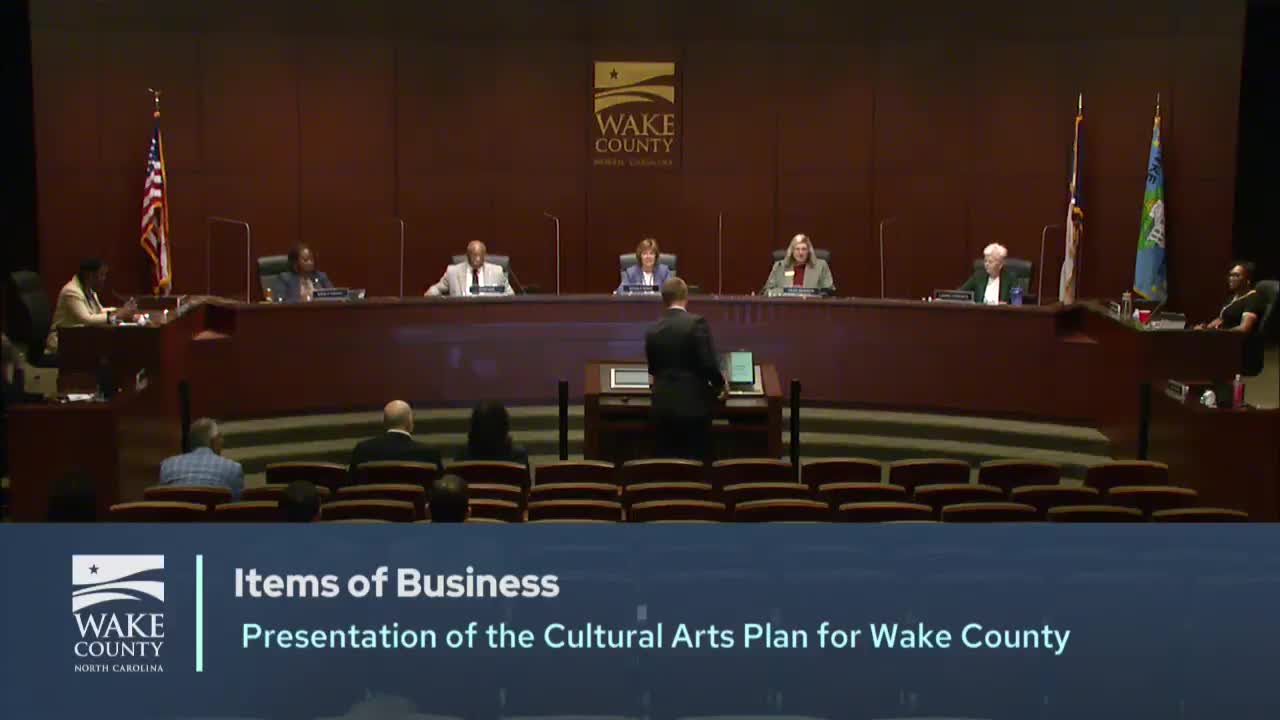
Wake County commissioners heard a presentation Sept. 15 on "Cultivating Creativity," the countywide arts and culture master plan developed by United Arts for Wake County and Cultural Planning Group.
The plan calls for three strategic goals — enhancing municipal infrastructure and capacity, supporting a sustainable creative economy, and building access and awareness — and proposes programs such as a Municipal Arts and Culture Collaboration Program, a Cultural Technical Assistance Program, a Wake Murals expansion, cultural districts, artist residencies embedded in county departments, and targeted multilingual marketing. Martin Cohen, partner with Cultural Planning Group, presented the final framework and said the plan was shaped by 18 months of outreach and an 18-member advisory task force.
The plan responds to Wake County’s rapid growth and aims to spread arts opportunities beyond Raleigh and Cary to all 12 municipalities. It highlights the creative sector as an economic engine: the consultants reported roughly 51,000 creative-sector jobs, $1.5 billion in industry earnings and about $105 million in nonprofit cultural spending based on 2023 data. The plan notes municipal cultural spending currently totals more than $38 million annually across the 12 municipalities and that United Arts historically raises about $3 in private support for every $1 invested by the county.
Commissioners asked for clarifications about definitions, municipal participation and facility inventories. Martin Cohen said the “creative economy” includes nonprofit arts organizations and for‑profit creative industries such as graphic design, architecture, film and related support services. He said municipalities — especially smaller, faster‑growing ones such as Holly Springs and Fuquay Varina — told planners they want more in‑community programming, technical assistance and help with facilities and affordability.
Commissioners praised the outreach and said the plan fit Wake County’s economic development and quality‑of‑life goals. Questions included how the plan aligns with peer counties, the role of arts in education and health programs, and how the county might fund plan implementation. Cohen and Michael James, staff with the county manager’s office, said implementation will be a mix of county actions (including potential increased general fund allocations managed through United Arts), United Arts‑led programs, and private‑sector partnerships; the plan suggests establishing cultural matching funds to leverage private contributions.
The presentation did not request formal action by the board at the meeting. Commissioners said they would review the final document and consider next steps, including budget choices that may be required to implement the plan’s funding framework.
Cultivating Creativity’s authors said the plan builds on existing programs — Wake Murals and Diwali festival examples were cited — and is intended to strengthen arts’ connections to workforce development, tourism and other county strategic priorities. Commissioners asked staff to share the plan document publicly; United Arts confirmed the plan will be posted on its website and copies were provided to the board.