Get Full Government Meeting Transcripts, Videos, & Alerts Forever!
Get email alerts on the Ferry Fares topic
No spam. Unsubscribe anytime.
Skagit County Public Works recommends 30% ferry fare increase for 2026 to approach revenue target
Summary
Public Works presented the 2025 Ferry Fare Revenue Target Report Sept. 16 and proposed a 30% fare increase for 2026 to move toward a 65% fare-recovery goal by Dec. 31, 2028. Staff outlined methodology under Resolution 2023-0152, projected road-fund subsidies, and a timeline for public hearings and possible adoption.
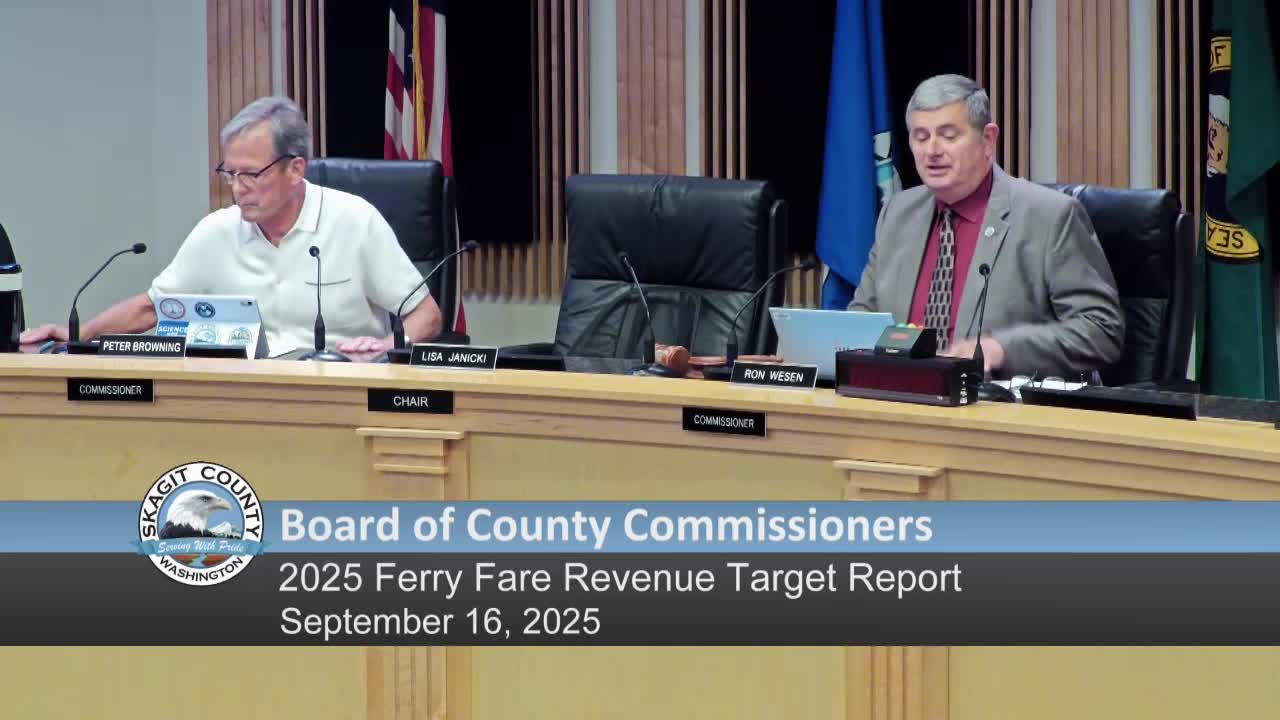
Skagit County Public Works presented its 2025 Ferry Fare Revenue Target Report to the Skagit County Board of Commissioners on Sept. 16, 2025, recommending a 30% increase to the operations-and-maintenance portion of fares for 2026 and setting public hearings on the proposal in October and November.
The report, prepared under Resolution 2023-0152, updates the county’s revenue-target methodology and projects a 2026 adjusted operations-and-maintenance (O&M) target of about $2.4 million. Public Works staff said the 2026 fare-recovery requirement is 55% (the board’s longer-term goal is 65% recovery by Dec. 31, 2028). Staff recommended a 30% increase on O&M fares for 2026; with that increase they estimate fare-box revenue of roughly $2.3 million and an estimated 54.7% recovery, short of the 55% requirement. The proposal has not been adopted and will proceed through the county’s public-notice and hearing process.
Public Works Director Michael See and Ferry Operations Division Manager Rachel Rowe described the method set by Resolution 2023-0152 (signed 7/27/2023): the evaluation period uses actuals for 2023–24, an adjusted 2025 budget, and projected 2026–27 figures; the Seattle CPI is applied for escalation; and the five-year average used to set the revenue target now includes two future years instead of looking only backward. Capital expenditures are excluded from the target calculations.
Rowe explained how haul-outs and dry-dock years are annualized in the calculation. The division’s adjusted O&M figure used in 2026 planning is about $4.2 million; the preliminary ferry O&M budget submitted for 2026 is $6.1 million because the budget shows full maintenance years rather than the annualized amounts used in the target calculation. Rowe said the report assumes two maintenance years (2026 and 2027) with dry-dock costs averaged into the five-year target.
Staff summarized recent revenue and expense history: fare-box revenue for 2024 was about $1.346 million; motor vehicle fuel tax and deficit reimbursements reduce the O&M total when computing the adjusted O&M; and the Ferryboat Program (FBP) funds were used for operations in 2023 and 2024 to avoid losing those funds to expiration. Public Works reported a projected shortfall for 2025 (estimated fare-box revenue $1.6 million vs. budgeted $1.796 million) and said unanticipated outages and an extended dry dock in 2025 reduced vehicle revenue.
Examples from the proposed 2026 fare schedule shown to the board: an adult walk-on posted fare now shows $5.50 (including a $1 vessel-replacement surcharge); staff calculate a nonpeak O&M fare of $4.50 that would increase to about $5.75 (posted fare would reflect surcharge). For vehicles, the O&M fare for a vehicle and driver under 22 feet is $15 (nonpeak) now and is proposed to increase to about $19.50; posted fares include the vessel-replacement surcharge. Rowe emphasized that multi-ride passes and surcharges are calculated differently and that the vessel-replacement surcharge (approved by the board in 2018) is restricted to vessel replacement, purchase of a used vessel, and related debt service.
Commissioners and staff discussed broader implications. Commissioner Browning said the projected road-fund contribution (estimated by staff at about $3.167 million for 2026) means a heavy per-household subsidy for island residents and called the trajectory “not sustainable.” Commissioner Janicki asked about ridership; Rowe said ridership has remained relatively stable since 2021 aside from expected dips during haul-outs, but staff reported anecdotal signs of riders changing behavior (leaving cars on both sides, walking on more) that could create elasticity in future revenue. County Engineer Tom Weller and other staff described how a multi-year local contribution could unlock federal grant matches (staff estimated that a $3 million local contribution could enable participation in roughly $25–$30 million of federal grant projects depending on required match percentages).
Staff also described operational constraints that limit cost savings: a 45-year-old vessel requires Coast Guard-mandated dry docks and inspections; maintenance costs have risen; many operating costs are labor and staffing related (more than half of O&M is salaries/wages/benefits); after-hours emergency runs require a captain plus two deckhands and are dependent on staff availability under the union contract (a three-hour minimum overtime pay applies when staff are called out). Public Works said it is exploring modest service adjustments, technology improvements (ticket kiosks, Stripe), vehicle fleet reductions, and deferred vs. capital repair tradeoffs, but that large capital replacements (e.g., repowers, out-drive replacements, new vessel) require one-time funding.
Next steps and timeline presented by staff: if the board decides to post a resolution calling for public hearing, legal notice would run and a public hearing is scheduled for Oct. 21 at 1:00 p.m.; the public comment period will remain open through the end of that hearing. A final resolution and the fare-proposal hearing are scheduled for the Nov. 10 stand-alone agenda session at 2:00 p.m., where the board could move to adopt a new fare schedule. Staff requested at least six weeks from adoption to implement technical changes before new fares take effect.
Why it matters: the ferry system serves Guemes Island and Skagit County commuters and relies on a combination of fare-box revenue, motor-vehicle fuel tax, deficit reimbursements, Ferryboat Program funds and a substantial road-fund subsidy. Staff warned that projected fare increases and continuing maintenance requirements make reaching a 65% fare recovery goal by the end of 2028 challenging under current assumptions; commissioners raised concerns about household burden, alternatives such as passenger-only service, and the county’s ability to match federal grants for capital work.
Public comment on the fare proposal is open, and Public Works is accepting applications for a short-term technical advisory committee on ferry fuel and propulsion options.