
Parents, students and unions urge Santa Clara Unified to rehear teacher appeal; board upholds investigator findings in closed session
Get AI-powered insights, summaries, and transcripts
Sign Up Free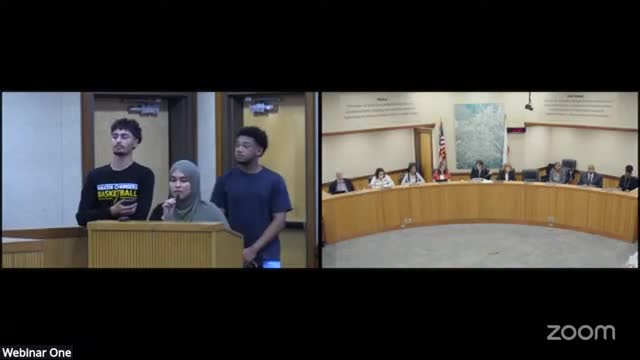
Summary
Dozens of students, colleagues and civil‑rights groups on Aug. 28 urged the Santa Clara Unified School District board to allow an appeal by Kauser Adenwalla, a social‑science teacher at Wilcox High School, after an investigator concluded a classroom resource was "more likely than not discriminatory."
Dozens of students, colleagues and civil-rights groups on Aug. 28 urged the Santa Clara Unified School District Board of Trustees to allow an appeal by Kauser Adenwalla, a social‑science teacher at Wilcox High School, after an investigator concluded a classroom resource was "more likely than not discriminatory." Board members heard public comment during the meeting’s public‑comment period and took related appeals up in closed session later that evening.
Supporters said the lesson and the resource were part of a larger unit taught to encourage critical thinking and that no students in Adenwalla’s class reported feeling uncomfortable. "I respectfully ask that the findings be rewritten and that I be provided a space to voice my appeal in‑depth," Adenwalla told the board during public comment.
Why it matters: The dispute centers on how the district applies its rules about "controversial issues" and the threshold used by outside investigators to find a policy violation. Teachers and union leaders said a broad or vague policy threatens academic freedom and chills classroom discussion about current events. Civil‑rights and professional groups argued that allowing outside organizations with no connection to students to drive complaints could reduce students’ access to historically grounded instruction.
What speakers told the board: Current and former students of Adenwalla described her classroom as a space that encouraged analysis and independent thought. "She always created a warm and welcoming space for all students," said Yousef Iktish, a Wilcox graduate. Sean Allen, president of the San Jose Silicon Valley NAACP, told the board the NAACP was "profoundly concerned about the chilling effect of the complaints against" Adenwalla and urged the board to hear her appeal.
Teachers and union leaders said the district’s rules lack clear guidance. Sarah Smith, history department chair at Mission Early College High School, asked the board to clarify Administrative Regulation 13.12.1 and Board Policy 6144, saying the AR and BP are "so broadly written" that teachers cannot tell what constitutes acceptable instruction. Margie Wysocki, president of UTSC, said outside groups had "no admitted connection to our students" and that their complaints were saddling teachers with risk while lacking educational credentials.
Board action: The board went into closed session and later reported it had considered appeals related to two complaints under Administrative Regulation 13.12.1. According to the closed‑session report, on a motion by Trustee Vicky Fairchild, seconded by Trustee Andy Rotterman, the board voted to uphold the superintendent designee’s decision on one complaint and directed the superintendent or designee to send appropriate notices; the board recorded a 7‑0 roll call vote. For a second appeal (employee ID 9885), the board voted on a motion by Fairchild, seconded by President Bonnie Lieberman, to conduct that appeal at a future, appropriately noticed board meeting; that vote passed with one nay (Trustee Jody Muirhead).
What the board did not do publicly: Trustees said the appeals required closed‑session consideration under state law; details of investigative findings and personnel matters were not disclosed in open session beyond the motions and voting outcomes. Speakers had asked the board to rehear the findings in public or at least provide a clear roadmap for how AR 13.12.1 and BP 6144 will be applied in classrooms going forward.
Context and next steps: Multiple teachers and union leaders asked the board to revise the district’s controversial‑issues policy to provide concrete examples and protections for classroom instruction. The board’s public report said one appeal was upheld and another will be scheduled for a noticed meeting; staff were directed to send the required notices. Community advocates said they will continue to press the district for policy clarification and for the opportunity for teachers to present contextual evidence in appeal hearings.
Ending: The district’s policies and any revisions will be decisive for how teachers approach current‑events instruction across Santa Clara Unified; the board did not announce a timeline for policy changes.