Get Full Government Meeting Transcripts, Videos, & Alerts Forever!
Get email alerts on the Brown V Board Scholarship Fund topic
No spam. Unsubscribe anytime.
Brown v. Board scholarship committee reviews fund status, eligibility and appeals after public testimony
Summary
Committee staff reported the Brown v. Board scholarship has 35 enrolled students and approximately $3.09 million in available funds; members discussed whether to change eligibility to cover Virginia domiciled students attending out-of-state institutions and affirmed that institutions should determine satisfactory academic progress and appeals.
Committee staff provided an update on the Brown v. Board of Education scholarship fund, reporting current enrollment, recent spending and the fund balance while members debated eligibility rules for applicants who attend out-of-state institutions.
Scott Kemp, representing committee staff, told members the program enrolled 35 students for the fall semester, including 14 renewals and two students described as directly affected. Staff reported the committee allocated about $182,000 so far this year and that last year the program spent about $230,000. Kemp said the committee’s current fund balance stands at just over $3,091,000 and that the committee also received $500,000 in federal funding that must be spent by 01/03/2028.
Kemp explained the scholarship is limited by statute to tuition and fees (and books as prescribed) and therefore is treated as a last-dollar award that depends on institutions’ financial-aid reporting. "We have to wait until the student has gotten their financial aid packages and ... make sure that we do a last dollar determination," Kemp said, describing why disbursements sometimes wait for institutions to verify enrollment, credit load and aid packages. He noted institutions vary in responsiveness; one institution in the fall delayed reporting until the add/drop deadline, which delayed payment processing through the department of accounts.
Members discussed program longevity and fiscal planning. Several members asked whether the committee should begin budget conversations in advance of 2028, when the $500,000 federal tranche expires. One member said projections indicate funds could last four to five years under current award rates and renewal patterns but recommended bringing fiscal planning into the 2026 budget year to avoid a future lapse in appropriations.
A prolonged policy discussion focused on whether the scholarship should be limited to in-state institutions as the current legislation requires or whether Virginia domicile should permit awards for students who attend out-of-state colleges. Staff and members agreed the statute currently requires in-state institutions; several members argued for allowing graduates or domiciled Virginians who leave the Commonwealth to continue their education elsewhere. Others urged a domicile requirement to limit budget exposure and preserve funds for residents who remain in state.
On satisfactory academic progress (SAP), staff summarized that the committee has relied on institutions’ determination of SAP, which follows the criteria used for federal student aid. Kemp said SAP has both a quantitative (pace toward degree completion) and grade-based component; institutions report whether a student meets SAP and maintain an internal appeal process. "For a student that does not pass satisfactory academic progress ... the institution, at this point, are the ones that are determining that," Kemp said, and staff reported at least one student this year whose SAP appeal had been denied by their institution.
Members expressed general agreement that SAP should remain a condition of award and that institutions’ appeal processes are appropriate, while acknowledging the committee could refine guidance to institutions on handling appeals and life-impact circumstances raised by students.
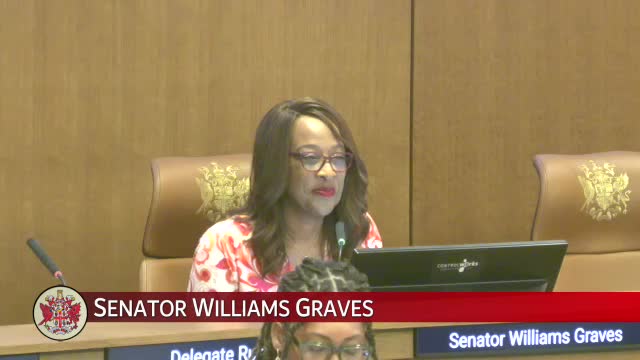
During public comment, Ozetta Sylvester Smith Ransom, who identified herself as a descendant of people affected by the Prince Edward County school closings, described her family history and urged the committee to consider descendants who live out of state. She also raised communication concerns: she said her 19-year-old granddaughter was awarded the scholarship but had difficulty getting responses from staff and the school, and that the school had notified her granddaughter of an impending collections action. "Why just can't somebody call her back? Why didn't somebody call me back?" Ransom asked. Committee members acknowledged the complaint; Senator Williams Graves apologized for the experience and said the committee would take Ransom's input into account while working to improve communications.
Committee members agreed to continue discussion of the out-of-state eligibility question at least one more time before the General Assembly session and to keep members informed about fund levels and potential budget requests. Staff said they would continue to prioritize spending the federal $500,000 so it is spent before the 2028 deadline.