Get Full Government Meeting Transcripts, Videos, & Alerts Forever!
Get email alerts on the County Budget topic
No spam. Unsubscribe anytime.
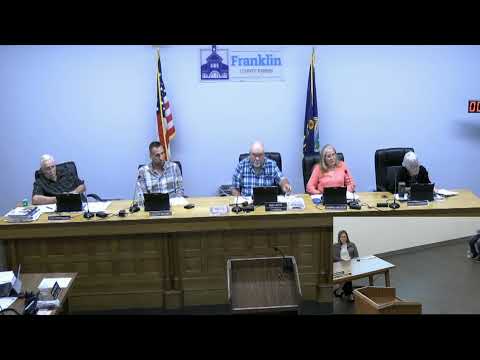
Franklin County adopts 2026 budget, approves mill levy above revenue-neutral rate
Summary
The Franklin County Board of Commissioners voted unanimously to adopt a 2026 budget that sets an estimated mill levy of about 45.142 mills and is projected to generate $18,738,692 in ad valorem property taxes.
The Franklin County Board of Commissioners voted unanimously to adopt a 2026 budget Tuesday evening that sets an estimated mill levy of about 45.142 mills and is projected to generate $18,738,692 in ad valorem property taxes.
County staff presented the budget and explained the board also adopted Resolution 25‑34 to exceed the revenue‑neutral rate, setting the rate used in the resolution at 45.121 mills. County staff told the board the proposed levy represents a reduction from an earlier published 46.4 mills and from the prior year’s levy by roughly 2 mills, but that the budget is not revenue neutral and would require roughly $441,000 in additional taxes compared with the 2025 levy.
Why it matters: The budget funds statutory county services the staff said the county must provide, while building reserves for equipment replacement and addressing pay gaps for county employees that officials said have contributed to turnover. County staff described the increase as roughly 2.4% of the 2025 budget and said it is below the 12‑month Consumer Price Index measured by the Bureau of Labor Statistics (2.7% through July, as cited by staff).
County presentation and key numbers Derek, a county staff presenter, reviewed the budget timeline and the staff process. He said staff began developing the budget in March, held two public budget study sessions on June 9 and June 10, and worked line‑by‑line with department heads. He summarized the chief drivers of the 2026 increases as: restoring market adjustments for county employees outside of public works and the sheriff’s office, rising costs to house inmates, higher insurance costs, and continued investment in equipment replacement to avoid long‑term financing costs.
Derek said the published mill rate began at 46.4 mills and staff later identified roughly 1.2 mills of additional reductions, arriving at a rate staff described as 45.14 mills in the version presented to the board. He told commissioners the budget before them would require roughly $441,000 in additional property tax revenue, which staff characterized as a 2.4% increase over the 2025 budget.
On staffing and capital priorities, Derek said Franklin County has reduced headcount over time and seeks to “pay cash” for replacement motor grader blades and similar equipment to avoid multi‑year financing interest costs. He noted that the county has reduced its workforce roughly 10% since 2017 and said the county’s mill levy is down “almost 18 mills” since the board and staff began their budgeting efforts in 2017.
Public comment: property appraisals and tax burdens Multiple residents who spoke during the combined budget and revenue‑neutral‑rate hearing objected to rising property appraisals and the resulting tax bills.
Susan Hughes of Ottawa said the overall effect of multiple small tax increases and rising assessments is “quite a bit of money out of our pockets,” and asked the board to trim the budget to the revenue‑neutral rate. Vicky Burgrath, a resident of Louisiana Road and a Social Security recipient, said her appraisal rose by $31,360 and that she is “seriously considering” leaving the county because she cannot afford the increase. Shawn Wilson reported his appraisal rose about $26,000 despite “doing absolutely nothing” to his property and described a frustrating experience contesting the appraisal.
Several other speakers raised related concerns about appraisal methods, whether nearby sales and changing neighborhood conditions drive assessments, and the economic pressures on retirees and fixed‑income households.
Board response and statutory context Commissioners and staff described limits on local authority over appraisal methods. A commissioner noted appraisers must follow state law and standards and that the state evaluates counties’ appraisal performance for substantial compliance; the presenter and other board members urged residents to pursue formal appeals of assessments when appropriate. The board and one commissioner said they will continue to press the state legislature for policies to address appraisal and tax fairness while retaining local control.
Formal actions and votes - The board opened a combined public hearing for the 2026 budget and the intent to exceed the revenue‑neutral rate. (Motion to open hearing: passed.) - The board adopted Resolution 25‑34 to exceed the revenue‑neutral rate, recorded in the meeting as set at 45.121 mills. (Motion adopted; roll call votes recorded as yes from Commissioners Sottlemyer, Weymier, Meador, Dickinson and Chair Harris.) - The board closed the combined hearing. (Motion to close hearing: passed.) - The board adopted the 2026 budget as presented, described in the meeting with an estimated mill levy of 45.142 and an estimated $18,738,692 in ad valorem taxes. (Motion adopted by recorded roll call; all commissioners voted yes.)
Board members repeatedly framed the decision as balancing competing priorities: limiting the mill levy, preserving core services the county must provide under state law, and maintaining competitive pay to retain employees. County staff highlighted the ongoing cost of housing inmates as an especially significant expenditure that has increased materially year over year.
What’s next The board adopted the budget and closed the hearing; staff said they will implement the 2026 budget as approved. Multiple residents were directed by commissioners and staff to use the county’s formal appraisal appeal process or consult with the appraiser’s office where they believe assessments are incorrect. A commissioner said she will continue to raise property‑tax issues at the state level with legislators.