Get Full Government Meeting Transcripts, Videos, & Alerts Forever!
Get email alerts on the Public Safety Fire Rescue topic
No spam. Unsubscribe anytime.
Miami-Dade commissioners question fire department carryover, capacity to lower rising response times
Summary
Commissioners pressed Miami-Dade Fire Rescue leaders and OMB officials about how much carryover and capital reserve is available to staff suppression units and reduce worsening response times, but no new funding actions were taken at the meeting.
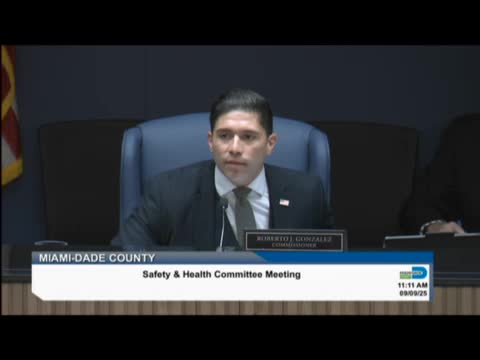
Chairman Gonzales and several commissioners questioned Miami-Dade Fire Rescue leaders and Office of Management and Budget (OMB) staff on whether the department has available funds and facilities to place additional suppression units into service to address rising emergency response times.
The discussion opened when Commissioner Higgins asked Fire Chief Ray Dedala and Chief of Public Safety James Reyes to clarify how much of the department’s reported carryover is ‘‘unencumbered’’ and therefore available to address response-time shortfalls. Chief Ray Dedala said ‘‘approximately $44,000,000’’ of carryover is encumbered. James Reyes and Chief Dedala told the commission that some of that carryover is already spoken for because the department added units after the proposed budget was published.
Why it matters: Commissioners said response times have increased and that the department’s five-year operations plan shows a documented need for more suppression companies. Commissioners and fire leadership agreed that strategically placed units and available station space, not just trucks, are required to reduce response times.
Commissioners pressed staff for specifics on how many additional suppression units the five-year plan lists and how many have been opened since the plan’s most recent revision. Chief Dedala said the plan identified ‘‘24 suppression companies’’ spread over multiple years and that the department opened six units in the current fiscal year, some of which are suppression units. Chief James Reyes said many listed units require land acquisition or station construction that can take years; in other cases temporary quarters can accelerate placement of apparatus.
OMB staff described multiple budget lines the commission could use. David Cloudfield of OMB (identified in the meeting transcript as representing OMB) summarized the relevant balances: a contingency reserve in the fire district operations fund of $21,400,000, approximately $14,000,000 in a capital reserve that could be freed by financing instead of cash, and a change-memo return to the district (air-rescue related) of roughly $13,800,000. Cloudfield said those pieces, combined with the carryover figures discussed by the department, produce an aggregated total the meeting cited as $49,200,000 (participant arithmetic shown in the discussion).
Commissioners and fire leadership emphasized constraints beyond pure dollars. Chief Dedala and other department speakers said stations and suitable quarters are often the limiting factor: adding staffed units without appropriate location or station capacity will not reduce response times. Several commissioners discussed public–private approaches with developers — for example, requiring or negotiating dedicated station space within larger developments or using a model home temporarily — as ways to secure sites more quickly.
Several commissioners said apparatus are arriving in coming months and could be put into service quickly at stations that already have space. President McAllister (as recorded in the transcript) and Chief McAllister (meeting references vary) stated the county is expecting deliveries of new suppression apparatus and rescues and that at least 10 existing stations could accept additional units when vehicles arrive. The meeting record includes a department estimate that ‘‘1,100 units are dispatched every 24 hours’’ and an annualized estimate the commission used of roughly 300,000 emergency calls per year.
No formal budget vote or new funding authorization occurred during the discussion. The meeting included requests for follow-up: commissioners asked OMB and fire leadership to map service gaps and identify parcels and potential zoning or developer agreements that could speed station siting. OMB agreed to provide more detailed breakdowns of available capital and operating reserves and to continue exploring financing strategies that could free cash for near-term unit placement.
"We do have issues that will take five or ten or twenty years to resolve," Chief McAllister said during the discussion, "and we need the board's help to solve those to give us the best chance to save lives. But currently, right now, we have the ability to put units in service that'll drive that response time down." (Attribution to full names and roles is recorded in the speaker list below.)
The commission did not adopt an immediate funding action in this meeting; the discussion closed after commissioners requested follow-up information and additional coordination with zoning and developer negotiations.