Get Full Government Meeting Transcripts, Videos, & Alerts Forever!
Get email alerts on the Land Rights Royal Patents topic
No spam. Unsubscribe anytime.
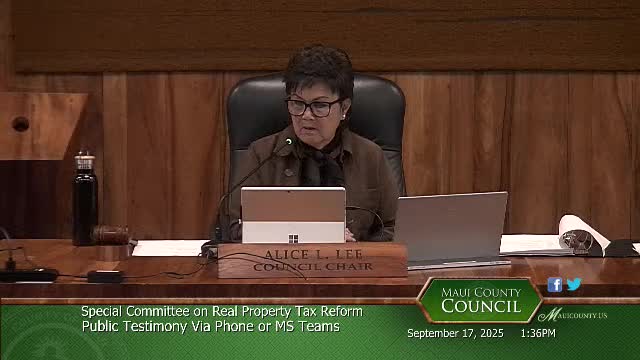
Multiple testifiers tell Maui County committee that royal patents and crown land claims affect land policy
Summary
Several public commenters, identifying as royal patent heirs or descendants, urged the committee to recognize royal patents, said Tax Map Key records erase heirship and called for the county to contact descendants before approving land-use changes.
Three public testifiers who identified themselves as royal patent heirs or descendants told the Special Committee on Real Property Tax Reform that the state's modern land records and Tax Map Key (TMK) system obscure or erase royal patent claims established under the Mahele of 1848 and royal patents issued during Kamehameha III's reign.
A speaker logged as "Royal House of Hawaii" told the committee that "every parcel of land in Hawaii is held and is under a royal title patented by the government of the [Kingdom of Hawaii]" and argued that modern transfers cannot extinguish hereditary royal patents. That testifier said TMK paperwork hides this information from parcel histories and urged officials to locate descendants of royal patent holders.
Elise Madison, who identified herself as a descendant of the Royal House of Hawaii and a royal patent heir of Kiawea Mahi, told the committee that royal patents are "perpetual" and cited historical law. Madison read language and history of the Mahele and said Hawaii Revised Statutes 172-11 requires that land patents endure for heirs and assigns of the original awardee. She urged the committee to treat royal patents as existing legal interests and to notify descendants when land decisions affect their ancestral properties.
A third testifier described encountering long-standing confusion when seeking county records and county code language; that speaker asked why some nonprofit uses (they referenced County Code section 3.48.0495 and the Hawaiian Cultural Restoration Revolving Fund, chapter 3.38) receive exemptions while sites remain vacant. That testifier also said county clerk staff had refused requests for a hard-copy county code and raised concerns about public access to county records.
Committee members did not take action on any of the claims during the meeting. Staff said the county clerk's office maintains meeting and legislative records and that members would follow up with the clerk's office about public access matters. The committee did not offer a legal determination on the speakers' claims about royal patents, which touch on state and historic law beyond the county's administrative role.
Speakers and staff frequently used the meeting's public-comment period; the committee's chair and staff reminded testifiers of three-minute limits and the distinction between testimony and items the committee may act on.