Lifetime Citizen Portal Access — AI Briefings, Alerts & Unlimited Follows
Marion County adopts tentative millage rates and budgets after two-hour public hearing over rising property taxes
Loading...
Summary
After more than two hours of public comment focused on rising property tax bills, the Marion County Board of County Commissioners adopted tentative millage rates and tentative budgets across countywide and special taxing authorities. Commissioners also set a final public hearing for Sept. 22, 2025.
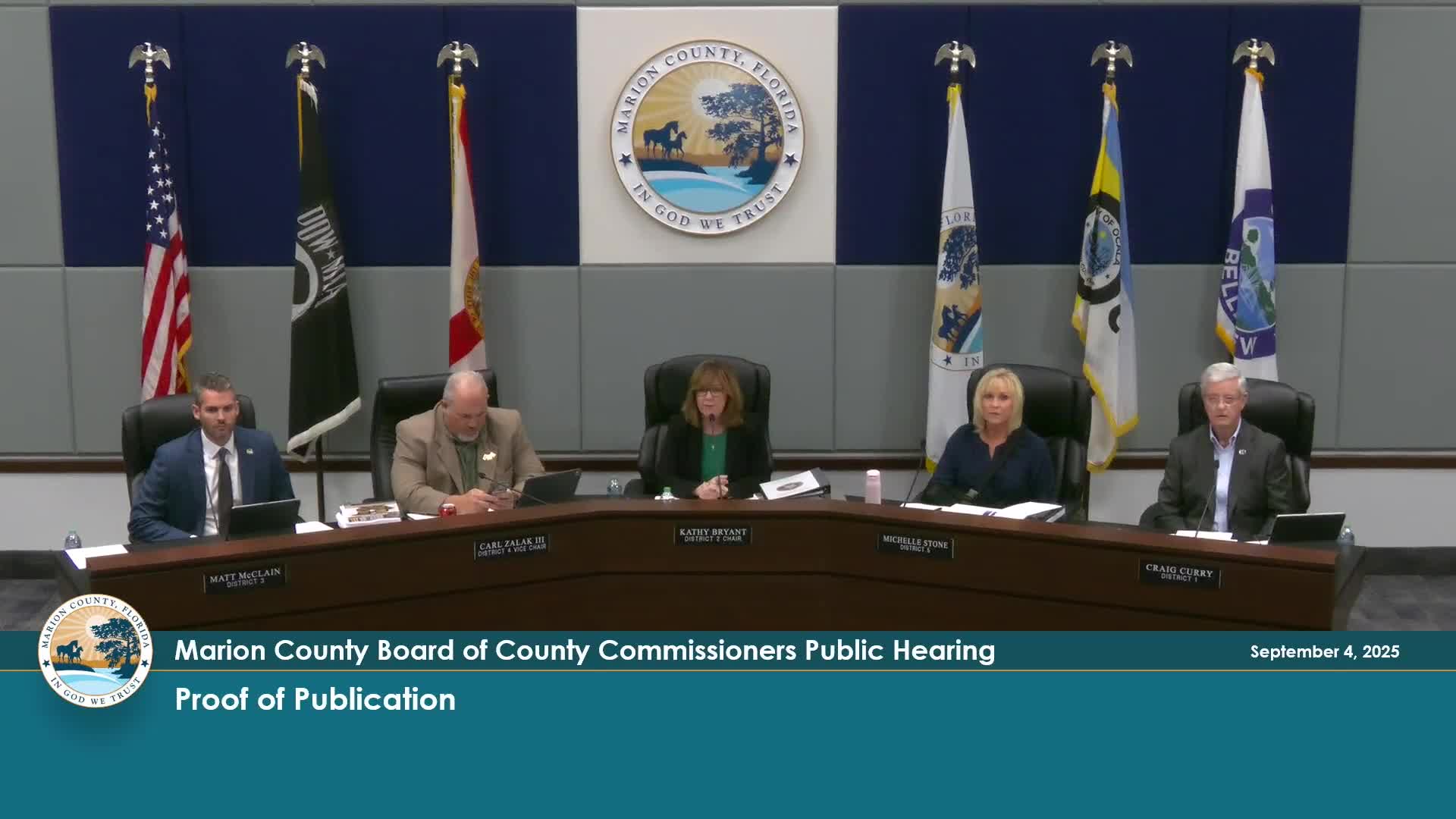
Marion County commissioners on Monday adopted tentative millage rates and tentative budgets for the countywide government and multiple special taxing districts after a public hearing in which scores of residents urged cuts or relief from rising property taxes.
Budget Director Audrey Fowler opened the hearing by reading a letter from Clerk of Court Gregory C. Harrell outlining the statutory requirements for the session under Section 200.065, Florida Statutes and noting that these are the first of two public hearings required before final adoption. The board adopted a countywide tentative budget of $1,119,303,974 and announced a total tentative countywide millage of 4.29 mills.
Why it matters: Hundreds of homeowners described steep increases in assessed values and tax bills during more than two hours of public comment, urging commissioners to cut spending or reduce millage. County officials and staff repeatedly noted limits set by state law on valuation and exemptions, explained how various revenue streams fund county programs and described reductions made since the June proposed budget.
Audrey Fowler, Marion County budget director, told the commission the tentative countywide budget includes the general fund, fine and forfeiture fund, county transportation maintenance fund, Marion County Health Unit Trust Fund and other countywide funds. She said the general fund increase over the rollback rate is 6.3% and described specific drivers: "$3,558,318 in personnel for sheriff jail operations, $3,205,143 in personnel for ambulance services and $7,809,756 for capital expenditures," figures she read into the record.
Property-appraiser office staff and the clerk answered multiple taxpayer questions about assessed values, homestead exemptions and programs that may limit annual increases. Jimmy Cowen, Marion County property appraiser, said his office is responsible for valuations based on a Jan. 1 appraisal date and the prior year’s recorded sales: "The sole thing for the property appraiser's office is look at the value based on the January 1 appraisal date," Cowen said, and he encouraged residents to visit the appraiser's office that evening if they had questions.
Clerk Harrell’s staff and Fowler explained the county’s revenue mix to residents who equated the entire budget with property taxes. Fowler said ad valorem (property) taxes account for roughly 15% of countywide revenues and described other restricted revenue sources, including infrastructure surtax, grants, impact fees and fund balance. She noted the infrastructure surtax capital projects fund totals about $242 million and that the proposed solid waste fund is approximately $86 million.
Commissioners and constitutional officers responded to questions about budget process and service levels. Commissioner John Curry (first reference used as an example) described a months-long review process that begins in January and includes line-by-line departmental review. Sheriff Billy Woods and Fire Chief James Banta both addressed public safety funding; Woods thanked the board for its support and Banta noted Marion County Fire Rescue’s ISO rating of 2 for many properties, a rating that can reduce homeowners' insurance premiums.
Public comment ran more than two hours. Speakers included long-time residents and recent arrivals who reported tax increases ranging from double-digit percentages to much higher; one speaker said a bill rose 791%. Residents sought relief for seniors, questioned the value delivered for tax dollars and asked how to appeal valuations. Several citizens were directed to staff from the property appraiser’s office who were present at the meeting to assist with questions.
Votes at a glance: Commissioners moved through each taxing authority and adopted tentative millage rates and tentative budgets by unanimous votes. Motions were typically made by Commissioner Stone and seconded by other commissioners. Key adopted items included:
- Marion County (countywide) tentative millage: 3.35 mills; tentative budget: $369,800,488 — motion by Commissioner Stone, second Commissioner Zalick; passed unanimously. - Fine and Forfeiture Fund tentative millage: 0.83 mills; tentative budget: $39,139,051 — motion by Commissioner Stone, second Commissioner Curry; passed unanimously. Fowler and commissioners noted an unanticipated increase in Department of Juvenile Justice billing (discussed as roughly $1.66 million) that raised fund costs. - County Transportation Maintenance Fund tentative millage: 0 mills; tentative budget: $83,857,742 — motion by Commissioner Zalick, second Commissioner Stone; passed unanimously. - Marion County Health Unit Trust tentative millage: 0.11 mills; tentative budget: $5,497,649 — motion by Commissioner Stone, second Commissioner Zalick; passed unanimously. - All other countywide tentative budgets (including infrastructure surtax, solid waste, airport, opioid settlement funds and others): $621,009,044 — motion by Commissioner Stone, second Commissioner MacLean; passed unanimously. - Total countywide tentative millage adopted: 4.29 mills; total countywide tentative budget: $1,119,303,974. - MSTU (law enforcement) tentative millage: 3.72 mills; tentative budget: $126,242,022 — motion by Commissioner Stone, second Commissioner Zalick; passed unanimously. Sheriff Woods spoke in support of needed resources for public safety. - Fire Rescue & EMS tentative millage: 1.11 mills; tentative budget: $104,852,820 — motion by Commissioner Stone, second Commissioner Curry; passed unanimously. Chief Banta spoke about response performance and ISO rating benefits. - Multiple smaller MSTUs and MSBUs — including Rainbow Lakes Estates (0.85 mills; $533,125), Marion Oaks (1.02 mills; $3,384,201), Silver Spring Shores (3.00 mills; $2,170,760), Hills of Ocala MSTU (0.18 mills; $180,024) — were adopted individually or in a mass adoption of remaining districts. The board adopted $300,203,302 in non-countywide budgets in mass by unanimous vote. - The board set the final public hearing to consider final adoption of millage rates and budgets for Sept. 22, 2025, at 6 p.m. in the Marion County Commission chambers — motion passed unanimously.
What officials said about cuts and changes: Fowler and Clerk Harrell told the public the board reduced $16,524,113 in expenses from the June proposed budget to the tentative version and that the county also absorbed about $1,331,000 in reduced state-shared revenue this year. Commissioners repeatedly invited residents to review the line-item budget (posted on the clerk’s website) and to attend a separate public hearing on non-ad valorem assessments, scheduled for Sept. 10 at 5:30 p.m.
Bottom line: The board advanced a package of tentative millage rates and budgets while directing staff and themselves to continue reviewing the numbers before final adoption. Residents were urged to pursue valuation or exemption questions directly with the property appraiser’s office, and officials noted that most revenue streams are restricted by state statute or grant terms and therefore not available for arbitrary reallocation.
The county will hold its final budget and millage hearing on Sept. 22, 2025, at 6 p.m. in the Marion County Commission chambers.