Get Full Government Meeting Transcripts, Videos, & Alerts Forever!
Get email alerts on the Taxes Senior Credit topic
No spam. Unsubscribe anytime.
Howard County public hearing produces strong, divided testimony on senior and aging‑in‑place tax credits
Summary
Council Member Deb Young sponsored bills to expand and extend property tax credits for seniors and retired military; testimony ranged from appeals to make credits permanent and broader to warnings about long‑term fiscal impacts and priorities for county services.
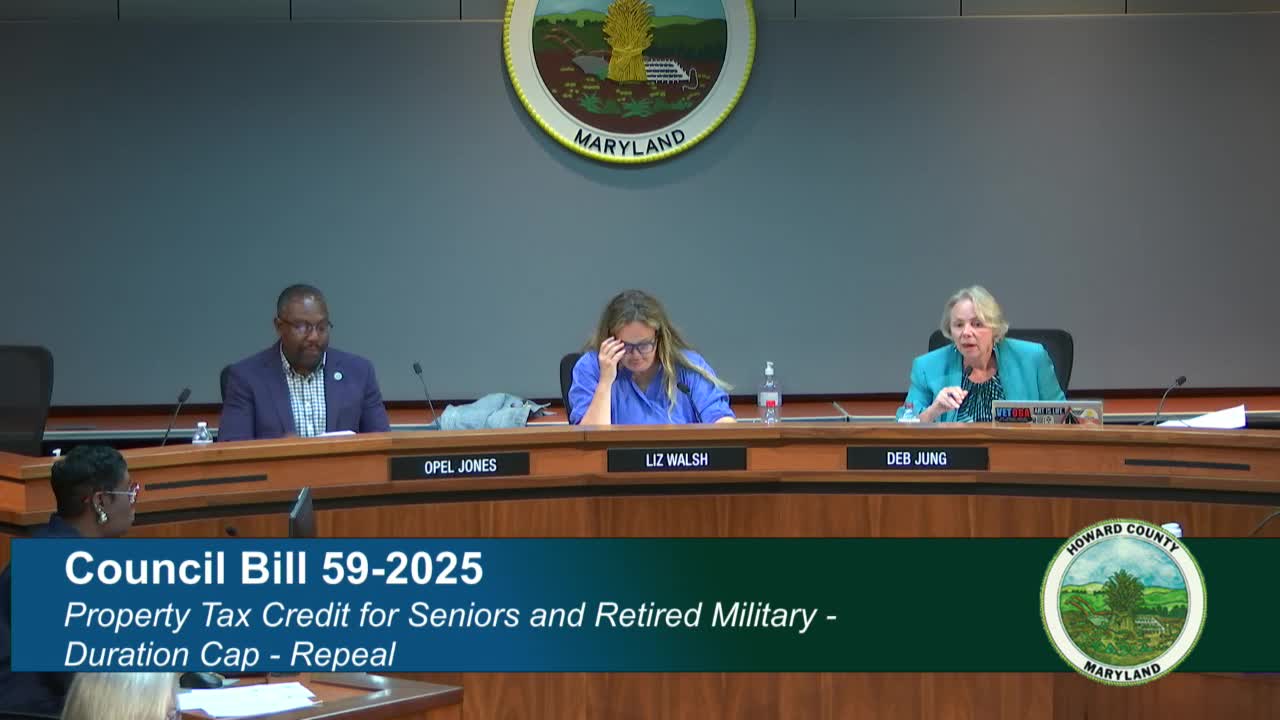
Howard County held an extended public hearing Sept. 16 on two related measures that would change property tax credits for older residents and retired military personnel: Council Bill 60 (amendments to the senior and aging‑in‑place tax credits) and Council Bill 59 (a proposal to repeal the duration cap on the aging‑in‑place credit).
Council Member Deb Young, the sponsor of CB 59, explained the bills’ goals and the rationale for relief targeted to long‑term residents. The administration supported the senior tax adjustments in CB 60 and said it would file an amendment to align veteran disability language with state criteria.
A broad cross section of residents and advocacy groups urged action. Speakers included representatives of senior organizations and service groups, local nonprofit advocates and dozens of residents who described the credit as essential to allowing long‑term homeowners to remain in place. Peter Brunner of Village in Howard and multiple speakers described how aging homeowners often face rising taxes, maintenance costs and fixed incomes; witnesses said removing the 8‑year cap on the aging‑in‑place credit would stabilize housing choices and could save county costs by reducing turnover into school‑age households.
The Howard County Citizens Association and other groups submitted petitions and written lists of supporters asking the council to remove the cap. Testimony from the National Active and Retired Federal Employees (NARFE) chapter and other senior advocates supported increasing eligibility thresholds and removing time limits.
Other speakers warned of the policy’s fiscal trade‑offs. Josh Zucker and other residents said expanding or eliminating the cap means the county would need to either raise revenue or cut services funded by property taxes — including schools, public safety and parks. Some testified that the aging‑in‑place benefit is hard to qualify for and urged that outreach and automatic enrollment be improved so eligible residents actually receive the credit.
Council members did not take a final vote during the hearing. Administration staff said they would file technical amendments and that the county is managing fiscal analysis procedures to provide earlier information on proposed bills. Council Member Young said she expected to pursue amendments requiring a proportion of housing in future redevelopment to be purchasable for lower‑cost buyers, reflecting a broader focus on housing affordability in the county.
Ending: The hearing produced wide public engagement on the senior credits, with sustained testimony both for removing the duration cap and for caution about fiscal consequences. Council members and administration staff signaled follow‑up amendments and possible work‑session review before final legislative action.